Glasgow, with its industrial past, has transformed into a recognised creative and cultural hub, complete with a vibrant street art movement that adorns the city with stunning wall murals.
Walking round all of the murals will take you a half to a full day depending on how much you dawdle. New murals emerge, and unfortunately, some vanish, typically due to building demolition or alterations. I’ve been round most of them, taking a few photos with my mobile phone, but I had an idea to try and capture some of the larger scale pieces using drone photography, so this is the first in a series of mural-related posts.
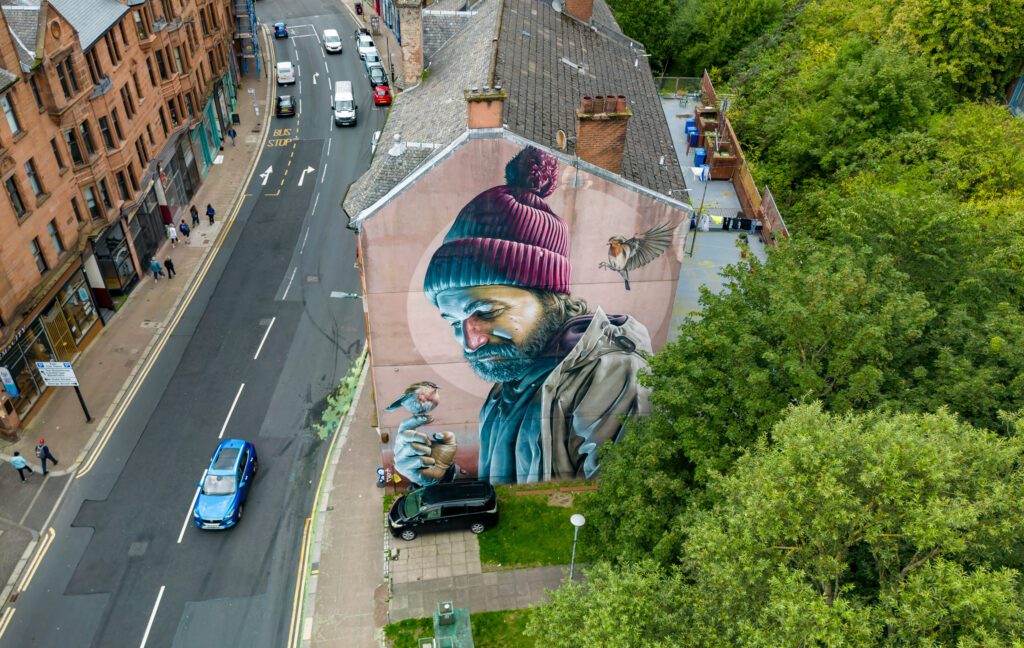
High Street. Mini 3 Pro F1.7 1/500s ISO 100.
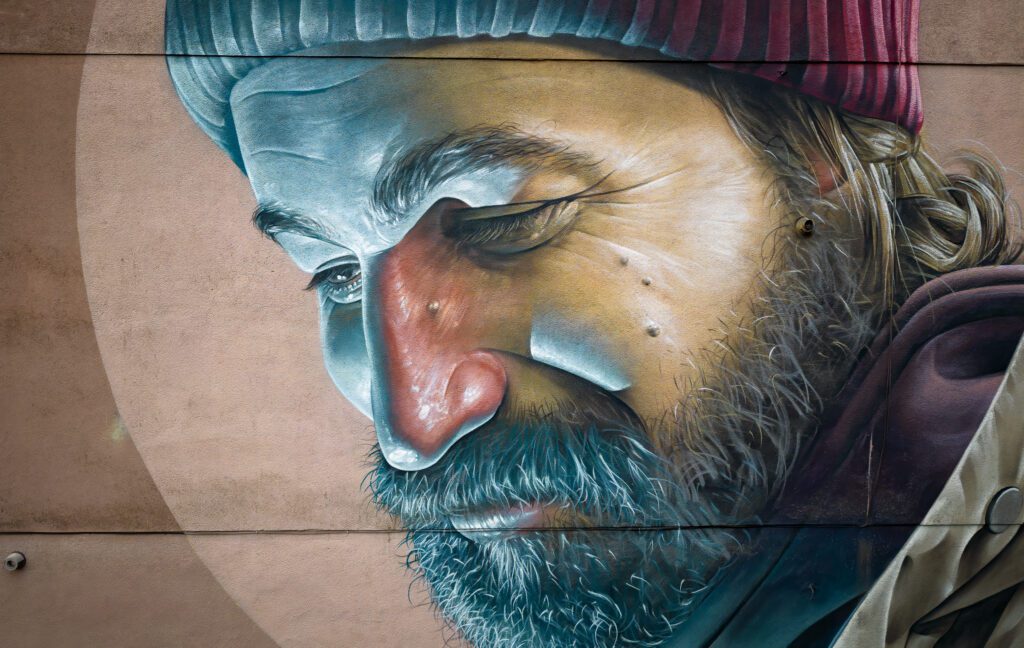
The artwork depicting St. Mungo in the High Street is possibly my favourite. Street artist SMUG created a beautiful piece of art showing the patron saint of the city with a robin. This bird illustrates the story of one of his miracles, ‘the bird that never flew’, where as a child he brought a pet bird back to life. SMUG completed the mural in February 2016, and it’s on a large scale, taking up the whole side of a building gable end. The view from above places the mural and the building into context.
After patiently waiting for several passers-by to capture their photos and continue on their way (it seems this mural is a constant photo subject), I put the Mini drone into the air and worked out the best views from the air. This proved to be a bit tricky when it got to the closer-up shots given the presence of street furniture and trees! Nevertheless, I captured some video footage and some stills without attracting too much attention, grateful for the wee drone’s relative quietness.
SMUG
Sam Bates, an Australian street artist currently living in Glasgow, has gained recognition for his exceptionally photo-realistic murals. Better known as SMUG, this gifted artist crafts his artworks entirely freehand, primarily using aerosol cans and occasionally masonry paint.
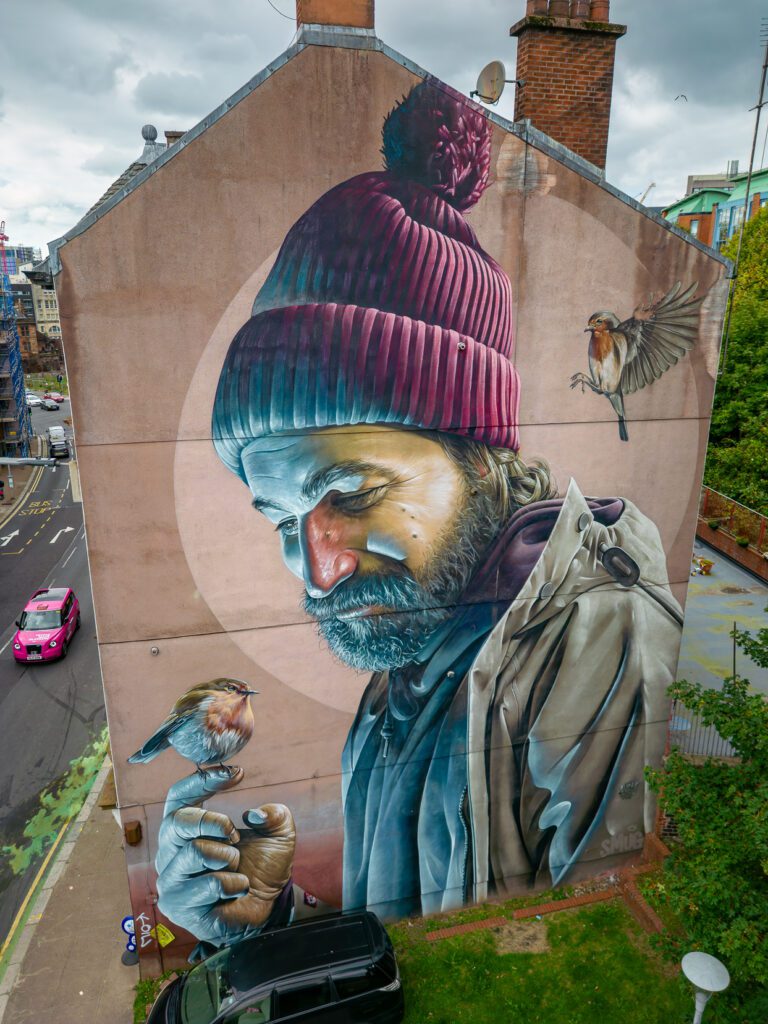
St. Mungo
Saint Mungo, also known as Saint Kentigern, is the patron saint and founder of the City of Glasgow. The monk Jocelin of Furness wrote the Life Of Saint Mungo in about 1185. He recounts how St. Enoch faced expulsion from her family after becoming pregnant. St Serf, who ran a monastery at Culross, took in both mother and son. St. Serf gave Kentigern the name Mungo, meaning something like “dear one”. At the age of 25, Mungo began his missionary work on the River Clyde’s banks. Here Mungo built his church, which later evolved into a large community that became known as Clas-gu or “dear family”. From these beginnings emerged the modern city of Glasgow.
Mungo died at Clas-gu in 614, and was buried close by his church. Today his tomb lies in the centre of the Lower Choir of Glasgow Cathedral, probably on the actual site of his grave.
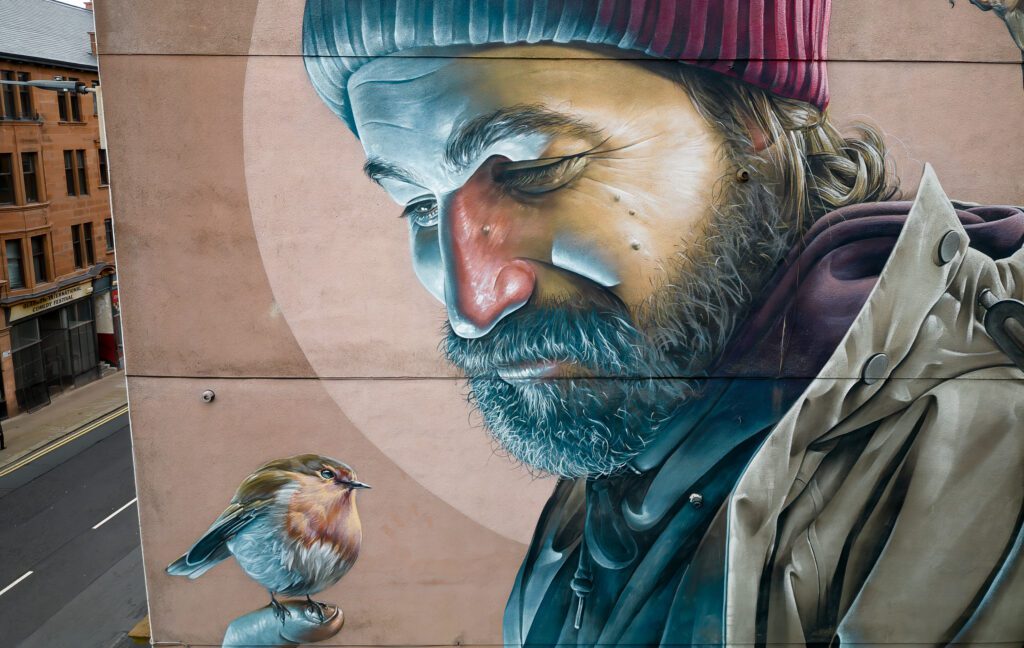
Mini 3 Pro F1.7 1/640s ISO 130.
During his lifetime. St. Mungo is said to have performed four miracles, as referenced in a poem:
Here is the bird that never flew
Here is the tree that never grew
Here is the bell that never rang
Here is the fish that never swam
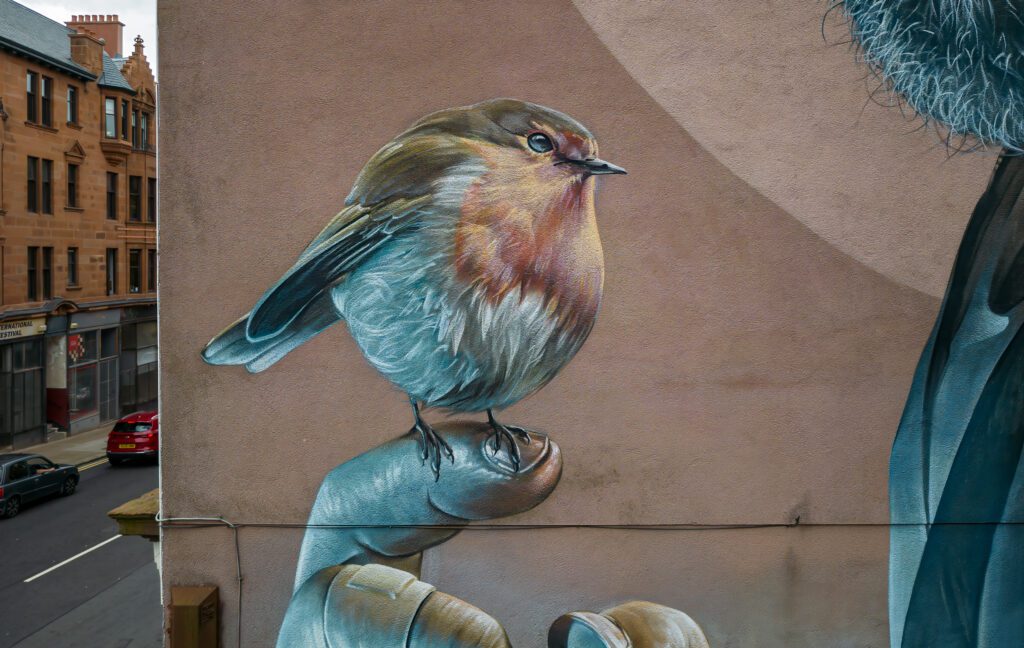
In the first account, he miraculously revived St. Serf’s pet robin, which had fallen victim to some classmates in Culross. In the second, using branches from a tree, he rekindled the fire at St. Serf’s monastery that had gone out due to him falling asleep. The third relates to a miraculous bell he brought back with him from Rome. The fourth and final story involves Queen Languoreth of Strathclyde. Her husband accused her of infidelity, and alleged she had given her wedding ring to her lover. In reality, the king had himself thrown it into the river. St Mungo ordered a servant to catch a fish from the river. The fish was cut open, and the ring found inside, demonstrating the Queen’s innocence.
Mini 3 Pro F1.7 1/400s ISO 110.
Today the bird, tree, bell and fish form the four elements of the coat of arms of Glasgow City Council. St. Mungo is also is also said to have preached the sermon that includes the words “Lord, let Glasgow flourish by the preaching of the word.” These words were later shortened to “Let Glasgow Flourish” and embraced as the city’s motto.
A related mural by SMUG complements the St. Mungo mural shown here. It’s located on the gable at the opposite end of the same Victorian tenement. This mural features St. Enoch and her son, St. Mungo, as a child.