The second part of my Calton Hill posts focuses on the hill’s lower slopes. While many people associate Calton Hill with its uppermost part where the National Monument sits, it actually begins further down, encompassing Old Calton Burial Ground and St. Andrew’s House.
Old Calton Burial Ground and Waterloo Place
The burial ground is situated on the side of Calton Hill, above Waverley Station, and was opened in 1718. The ground is the resting place of many prominent Scots, including philosopher David Hume, scientist John Playfair, and the publisher William Blackwood. Monuments include the American Civil War Memorial, and the Political Martyr’s Monument, seen in the centre of the aerial photo below, reaching 27 metres into the sky.
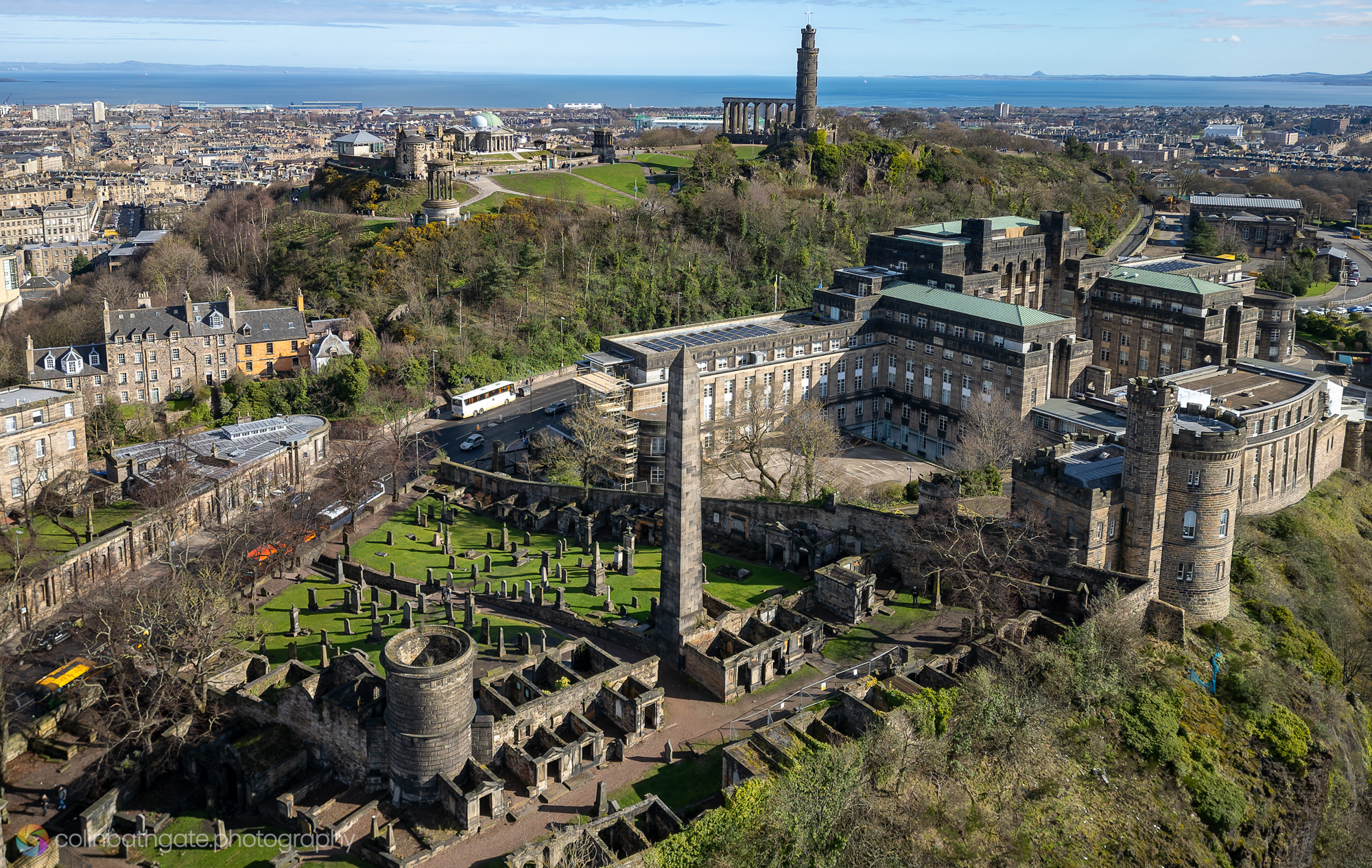
When the construction of Waterloo Place started in 1815, the plans cut through the existing graveyard, requiring the removal of bodies and stones for transfer to New Calton Burial Ground to the East.
A small area of the old graveyard is on the North side of Waterloo Place, hidden behind screen walls. The 1854 map below clearly marks this small piece of ground as being part of Old Calton Burial Ground.
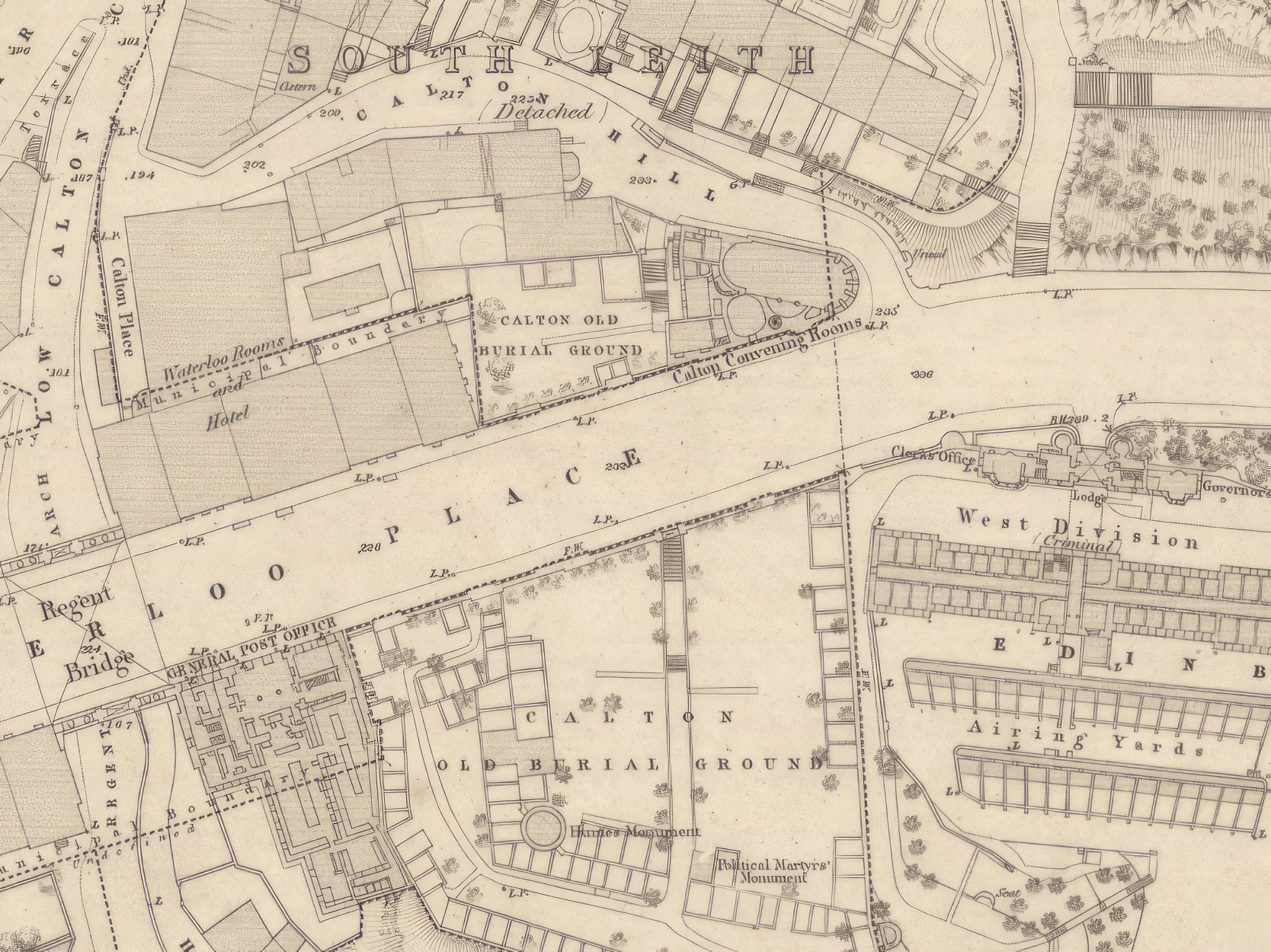
The map also shows ‘Calton Convening Rooms’, now Howie’s restaurant. This building was constructed in 1818-19 for the ‘Society of Incorporated Trades of Calton’, replacing their old rooms demolished to make way for Waterloo Place. The society regulated the right to trade in the Barony of Calton, an area that lay outside the City of Edinburgh at the time. Its members included shoemakers, bootmakers, brewers, and bakers. I believe the Incorporation also administered the small northern section of the Burial Ground, which may explain the number of tradespeople buried there.
If you enjoy looking at old maps, Alexander Kincaid’s ‘A plan of the city and suburbs of Edinburgh’ from 1784 is a beautiful drawing, and illustrates how the Calton Hill area looked before the construction of Waterloo Place and Regent Road.
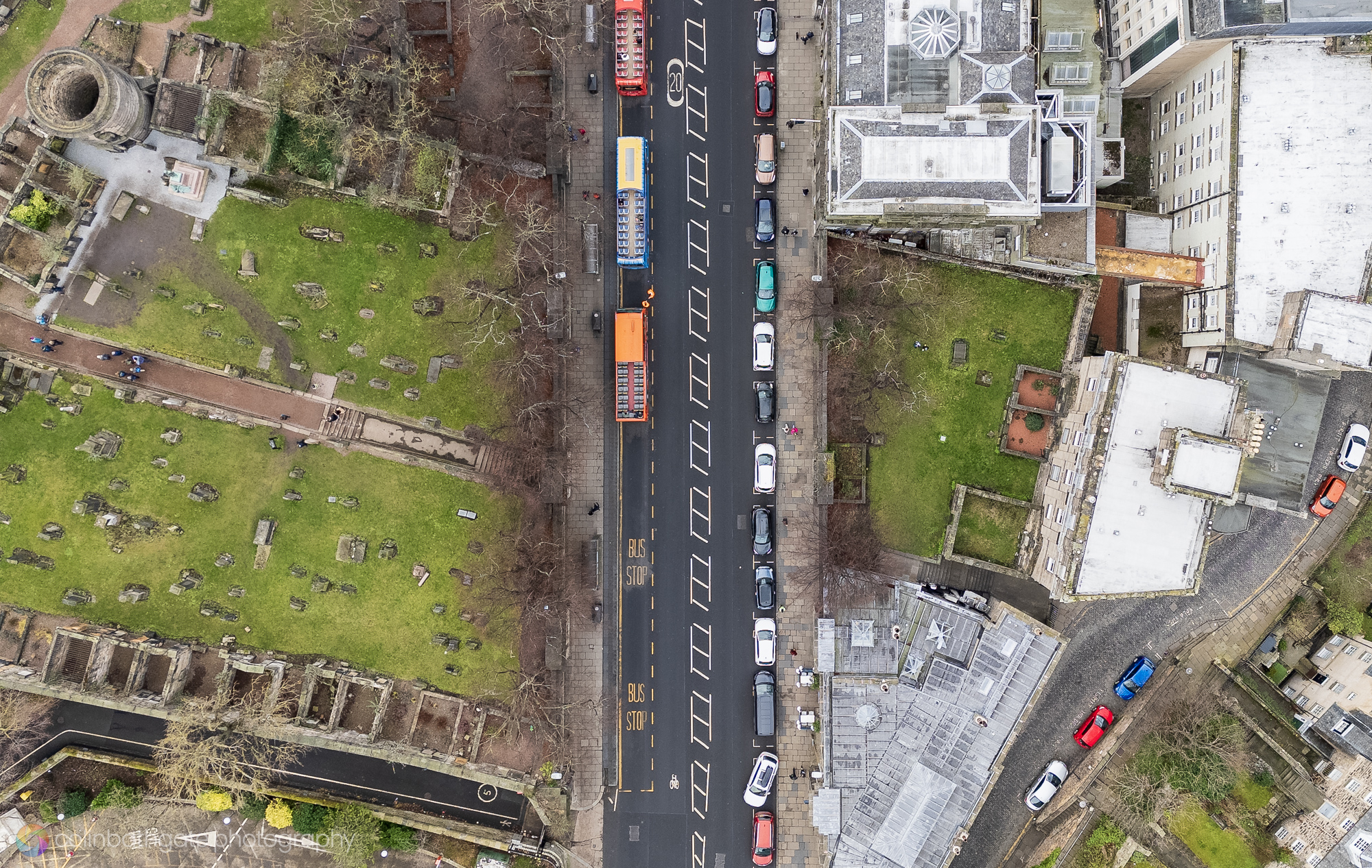
The drone image above provides an overhead view of Waterloo Place and shows how it bisects the burial ground. The only entrance to the smaller section on the left of the image can be seen between the Howie’s restaurant building at the bottom of the photo. and the Parliament House Hotel next door.
Old Calton Burial Ground, including its screen walls and monuments, is protected as a category A listed building. Sadly, when I visited many of the headstones were crumbling and broken, and the site looks like it has been neglected. Despite its significance, I find it staggering that such a historic site should be left to crumble in this way. Nonetheless, it’s well worth a visit, and I hope some of my photos pique your interest.
A Macabre Find
As you enter the burial ground, just to the left of the steps near the entrance is one of the more interesting gravestones I discovered. Captain John Gray erected the headstone in memory of his father Thomas Gray who died in 1752, and his mother Elizabeth Wilkie, who died in 1747.
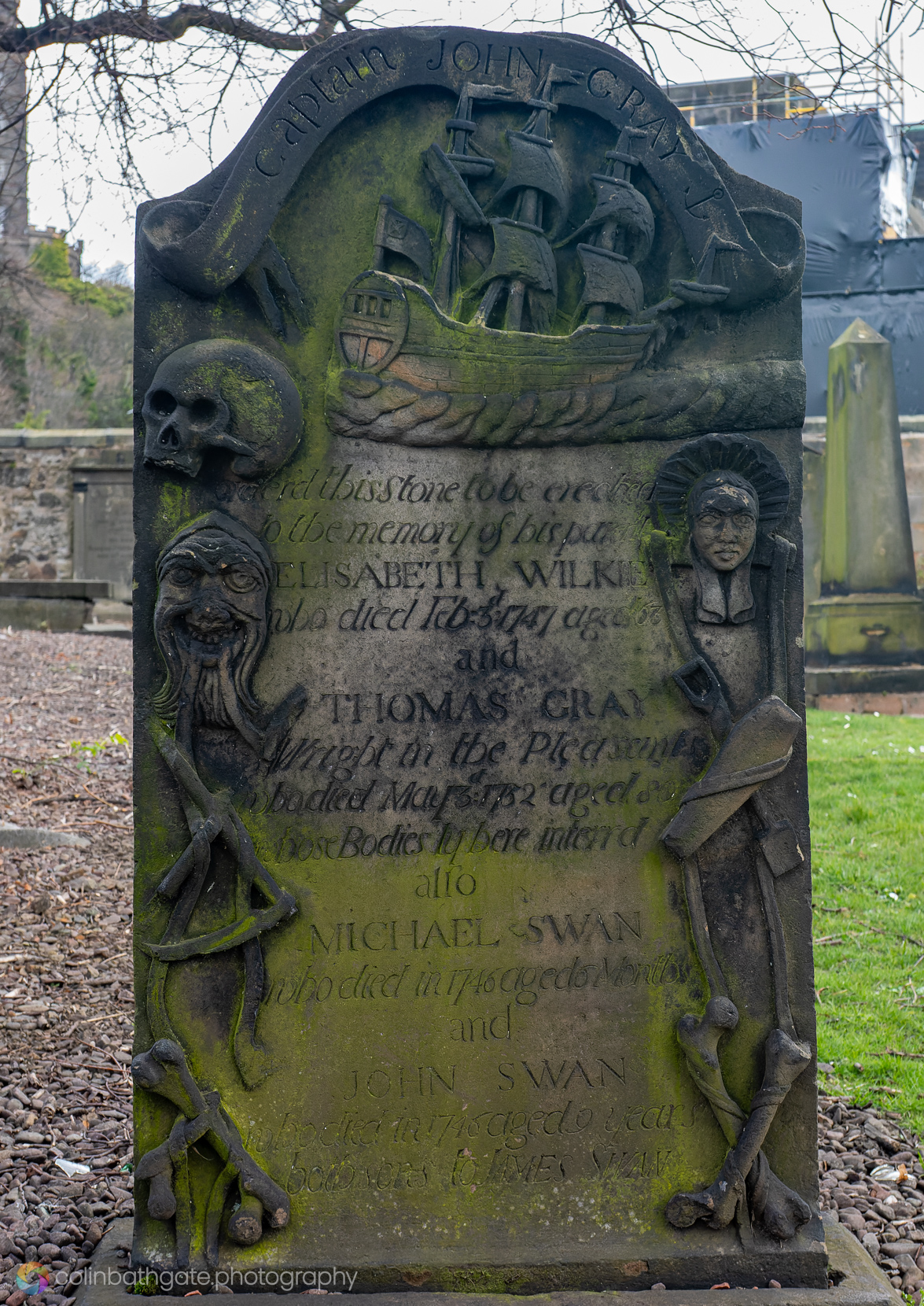
The carvings are decorative but macabre. Captain John Gray’s name appears at the top along with an anchor. Underneath you can see a carving of a 3-masted ship, shown in relief so it creates a 3D effect.
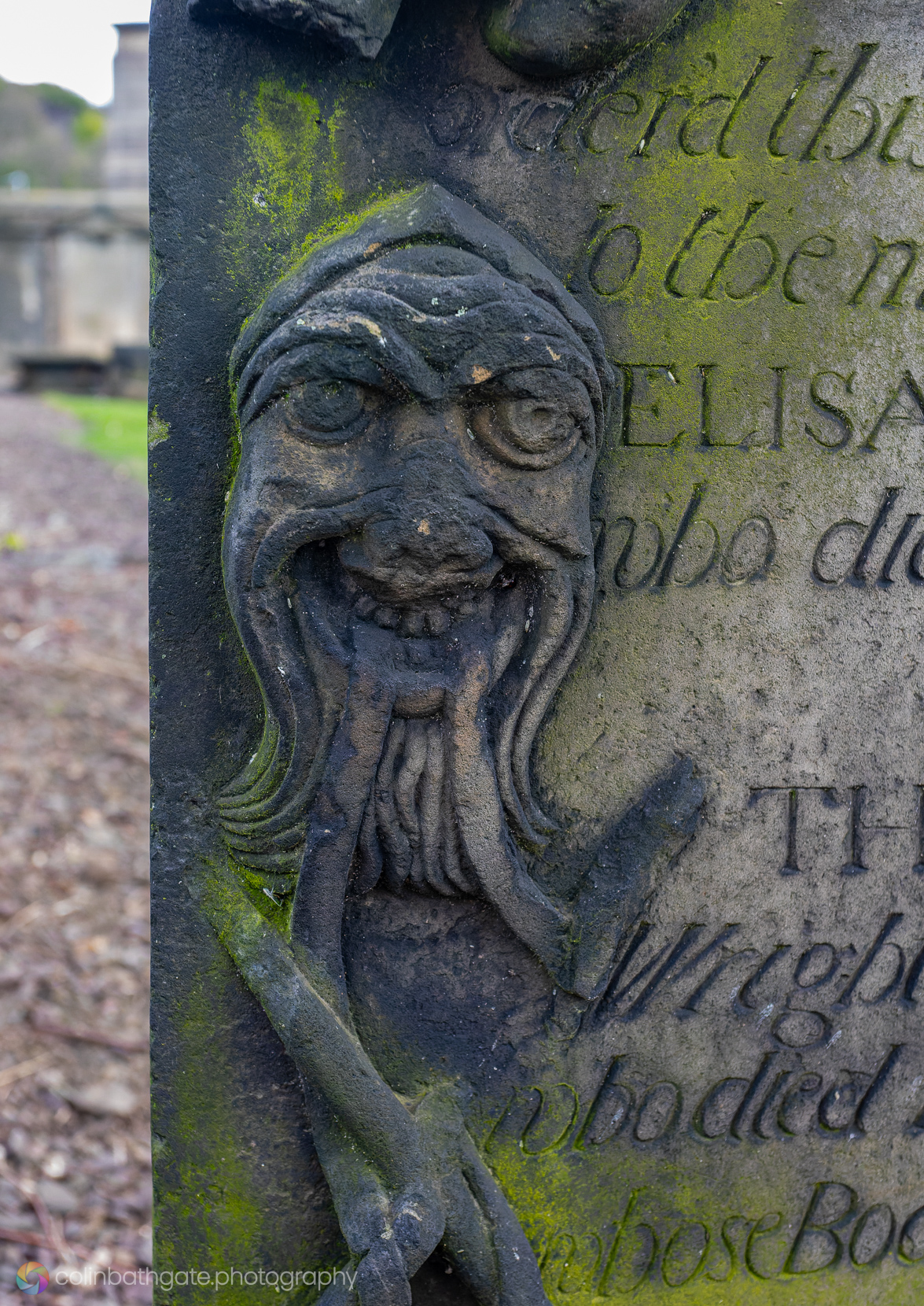
Down the left side of the stone is a skull and a male head wearing a cap, which could be his father.
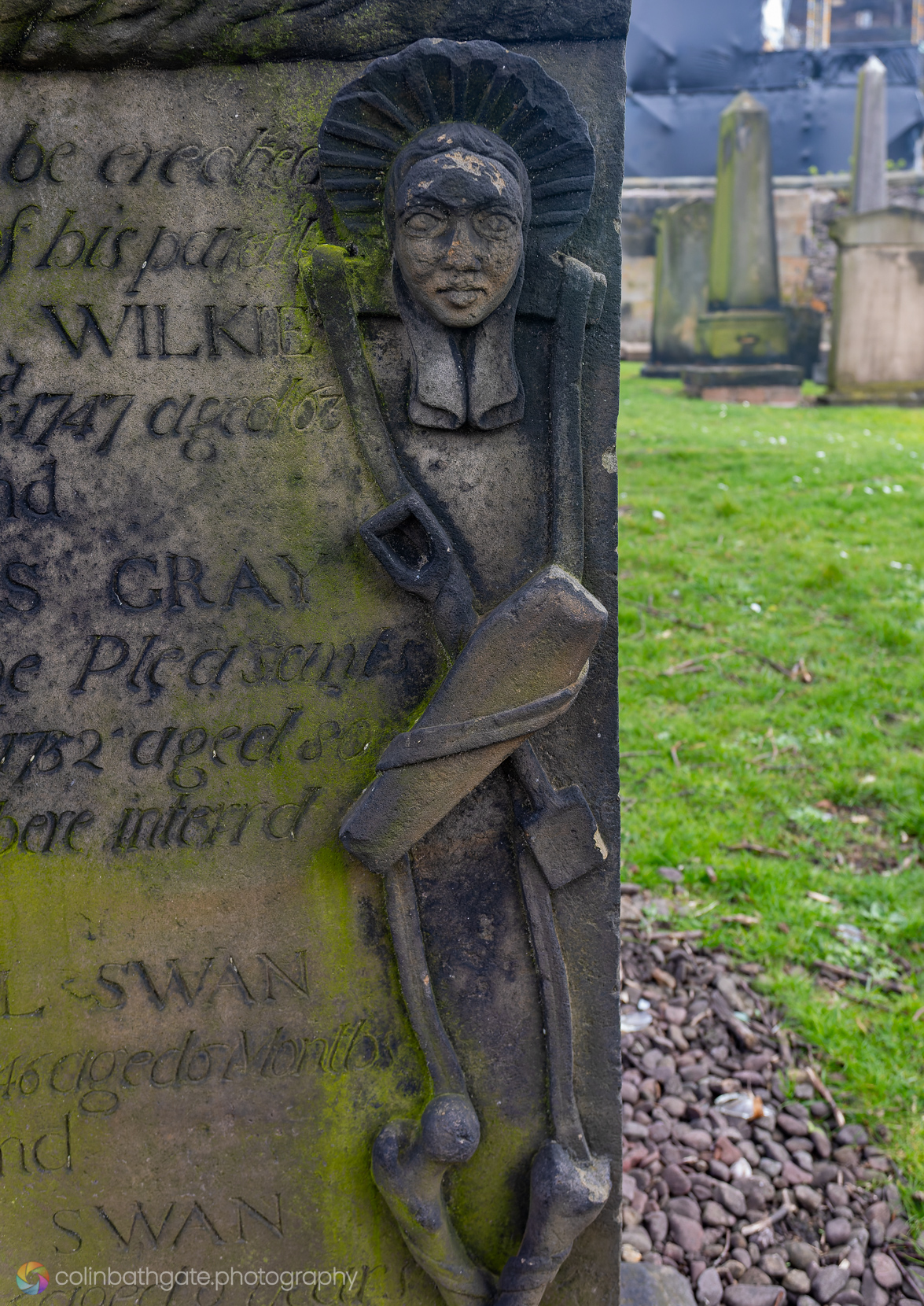
From the mouth spill two ribbons that link symbols of mortality: The King of Terrors main weapon of death, the scythe, is crossed with another implement, most likely a lance or dart, both of which are favoured symbols to be crossed with a scythe in funeral art; below, crossed bones. Down the right side is a female head, wearing a bonnet (his mother). Ribbons from the bonnet link again to symbols of mortality: a spade crossed (Tool of the sexton) with a coffin, and again crossed bones.
Canon EOS 5D Mk. IV. Exposure: 1/250s, ISO 3200, f/8, Focal length: 33mm.
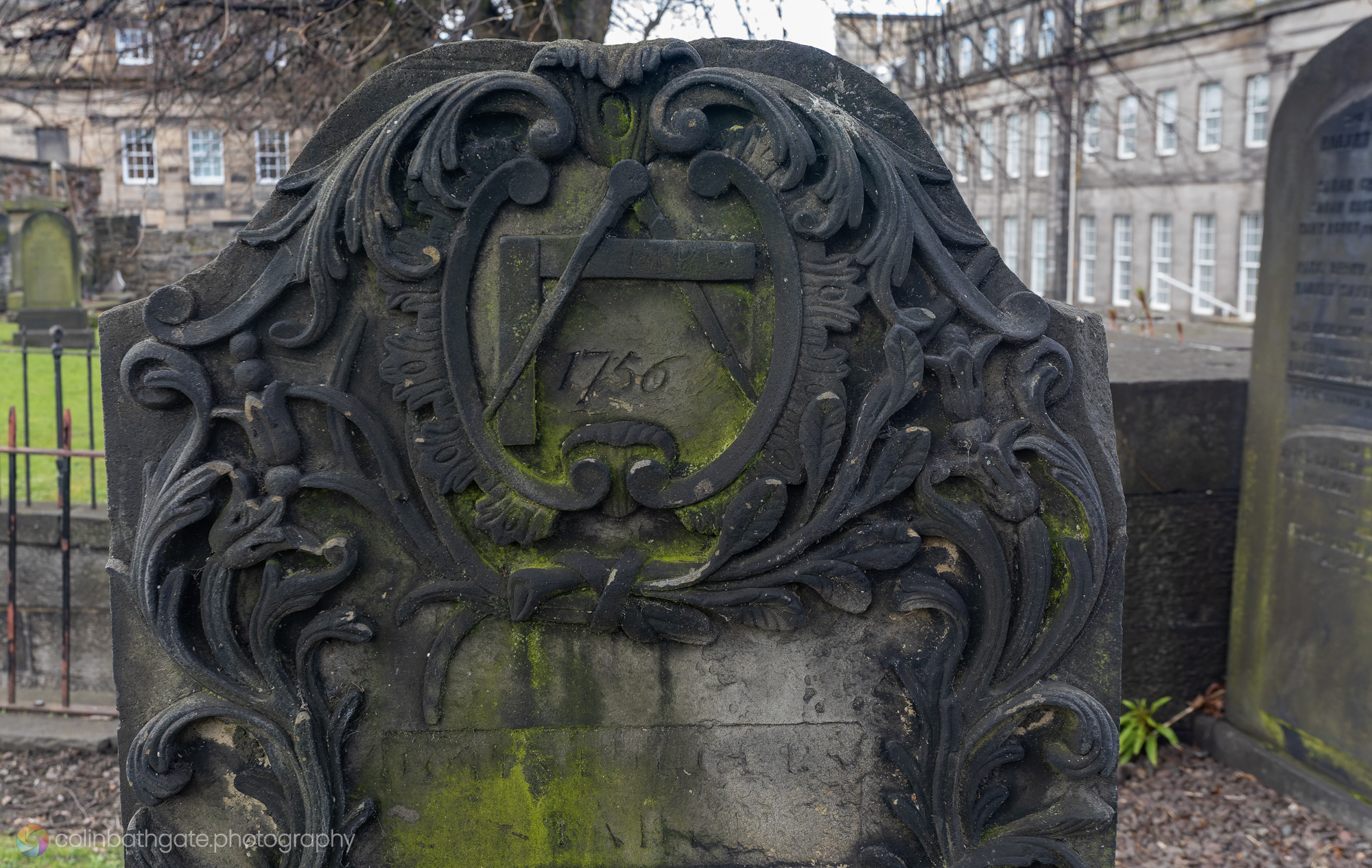
The back of the stone is also beautifully carved, and includes freemasonry symbols of a square and compass.
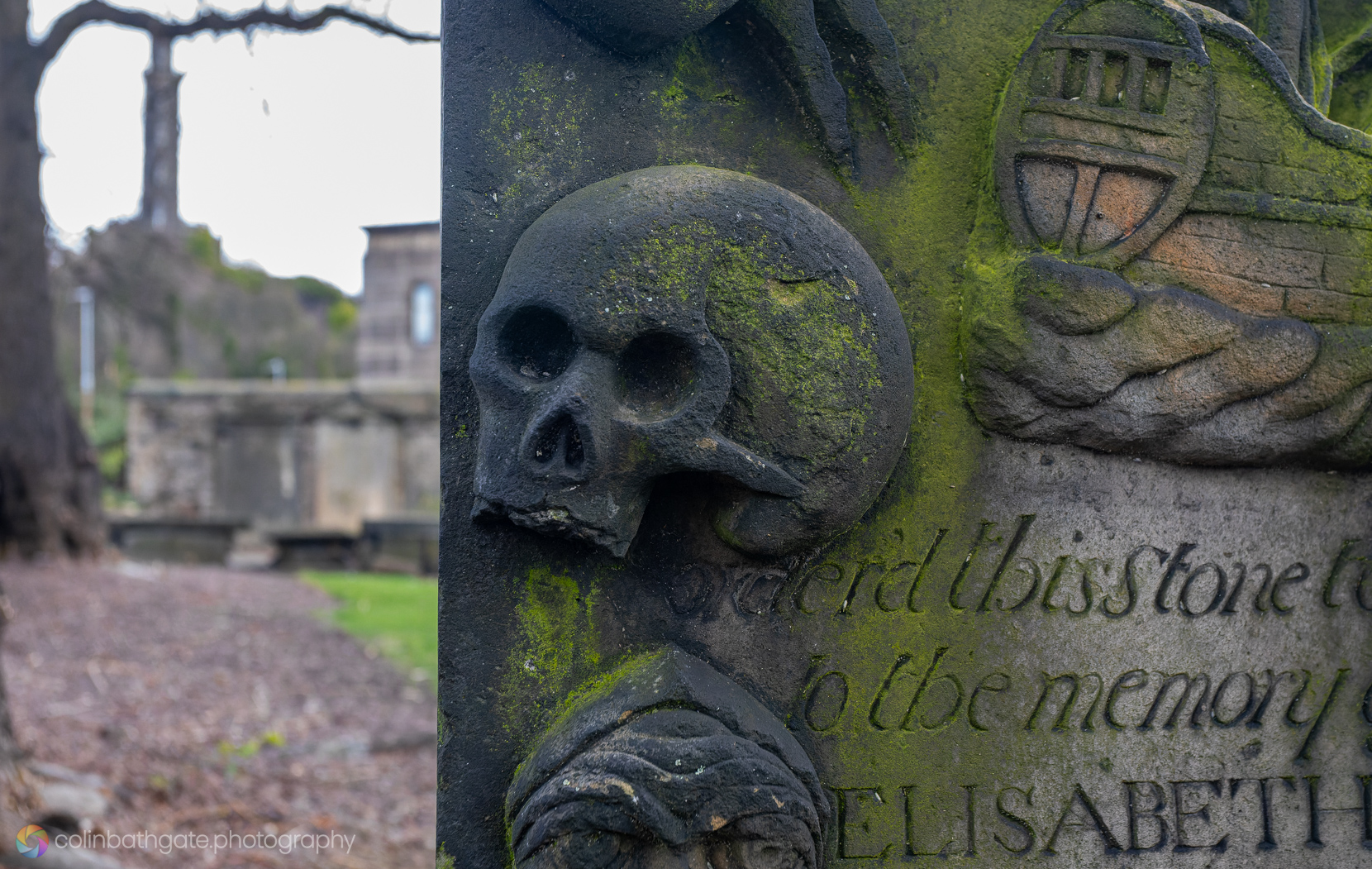
I can’t find any information about Captain John Gray, but this is a memorable headstone, probably the most interesting in the whole graveyard.
The Martyr’s Monument
In 1793 several members of The Friends of the People, an early universal suffrage movement, were brought to trial and sentenced to 14 years’ deportation. Their only crime was to campaign for the universal right to vote. Thomas Muir was their leading figure, and he along with four others were banished to Botany Bay in Australia in August 1793. Muir is a colourful figure and led a life straight out of an adventure novel. There’s a mural depicting him in Glasgow, included in another post.
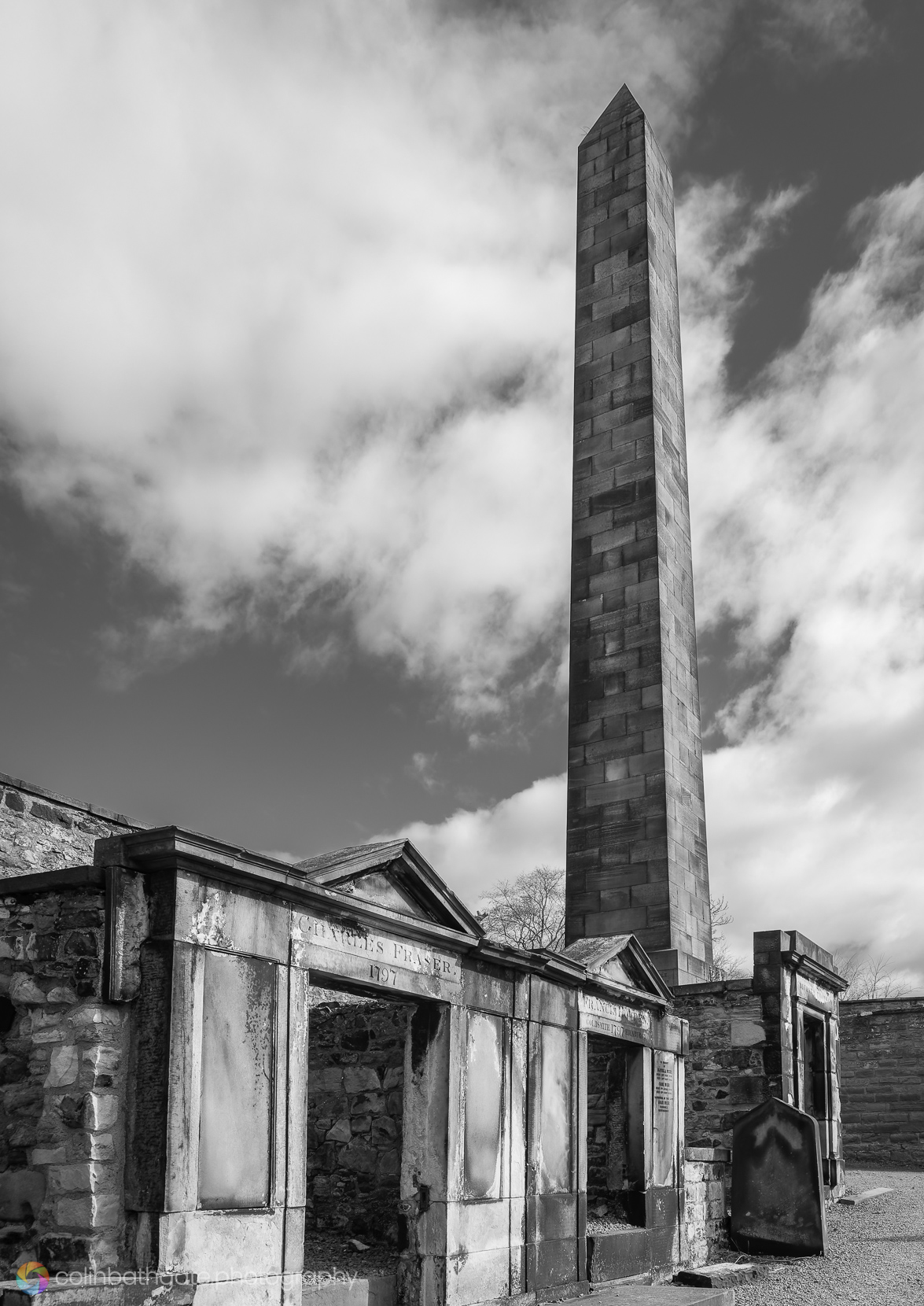
The huge obelisk is dedicated to the martyrs and has an inscription that reads:
To the memory of Thomas Muir, Thomas Fyshe-Palmer, William Skirving, Maurice Margarot, and Joseph Gerrald, erected by the Friends of Parliamentary Reform in England and Scotland 1844.
I have devoted myself to the cause of the people, it is a good cause – it shall ultimately prevail – it shall finally triumph – speech of Thomas Muir in the Court of Justiciary on the 30th August 1793.
I know that what has been done these two days will be re-judged – speech of William Skirving on the 7th January 1794.
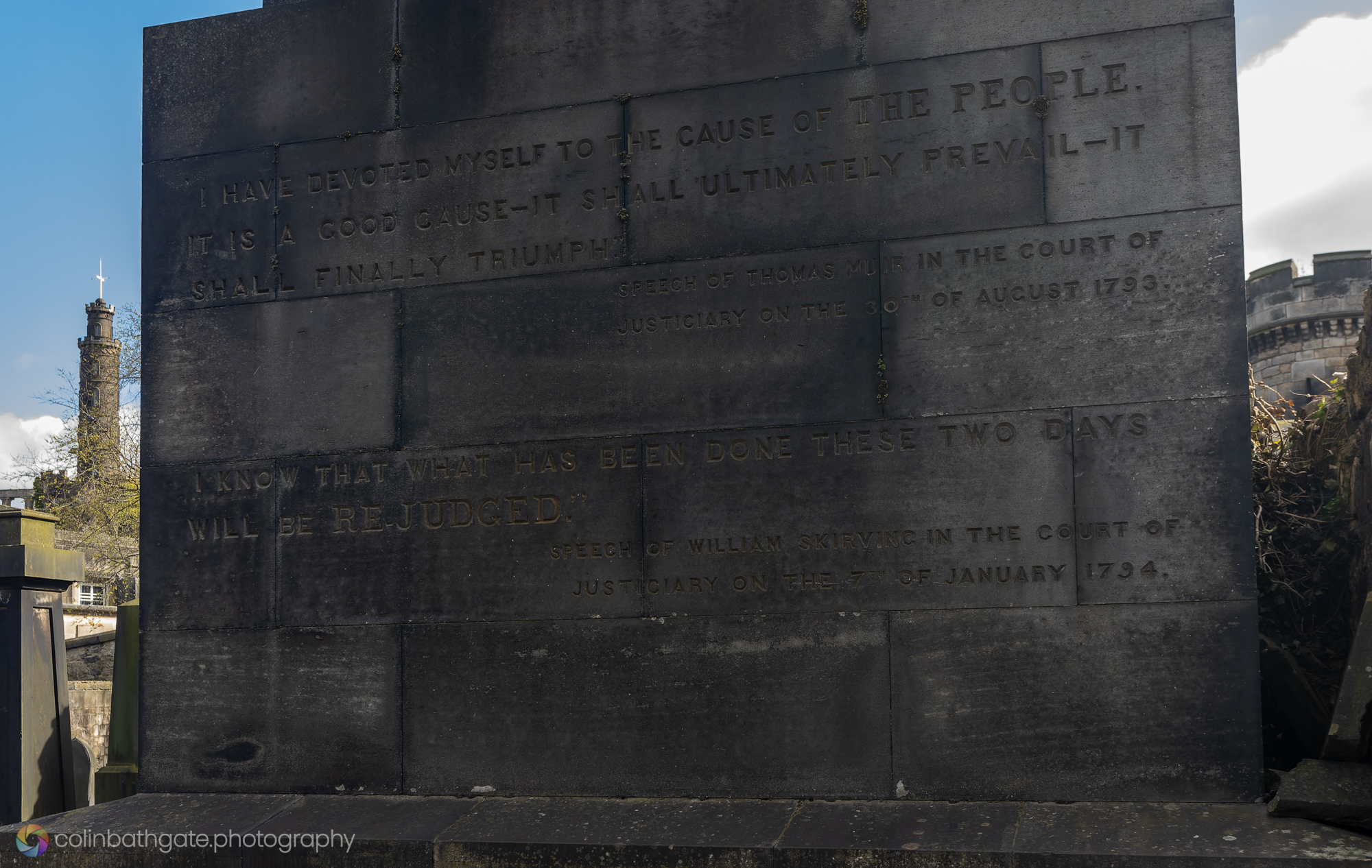
The 1832 Scottish Reform Act of 1832 achieved what the men were fighting for, and they received a pardon in 1838. The monument was erected around 50 years later.
David Hume’s Monument
David Hume (1711-1776) stands as the most influential thinker of the Scottish Enlightenment and is widely regarded as one of the most significant figures in the history of Western philosophy. His friend the architect Robert Adam designed a mausoleum for Hume, “…with an Inscription containing only my Name with the Year of my Birth and Death, leaving it to Posterity to add the Rest.” as Hume wrote in his will.
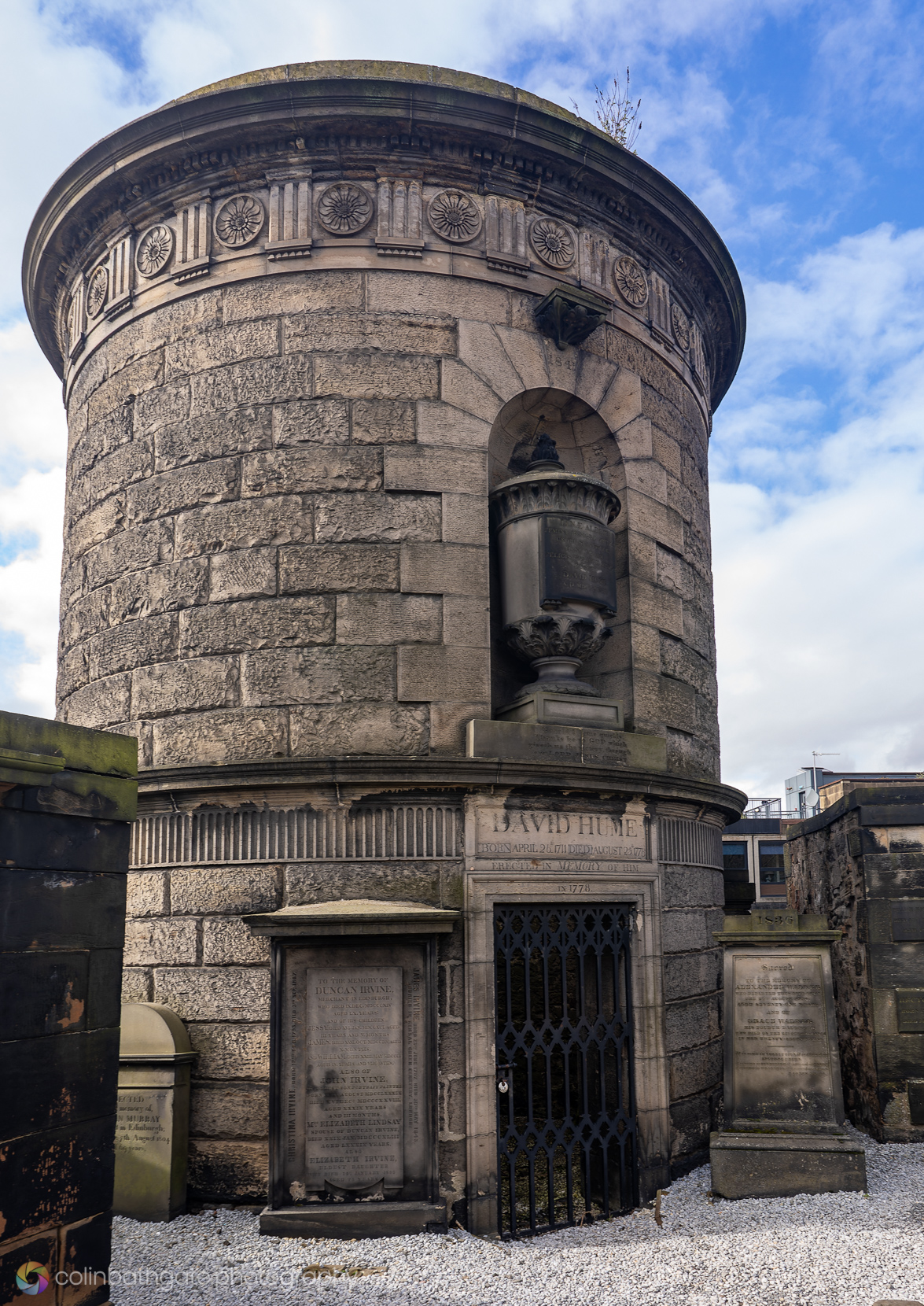
Hume died at the southwest corner of St. Andrew’s Square in the New Town, at what is now 21 Saint David Street. He was a religious sceptic (dubbed ‘The Great Infidel’) which at that time bordered on scandalous, and there’s an interesting story illustrating this, with his friends having to stand guard at his grave armed with pistols.
The American Civil War Memorial
One of the most interesting of all the monuments in the burial ground features a statue of former American president Abraham Lincoln. He stands on top of a memorial to the Scottish soldiers who fought in the American Civil War, and I believe it’s the only Civil War memorial outside North America.
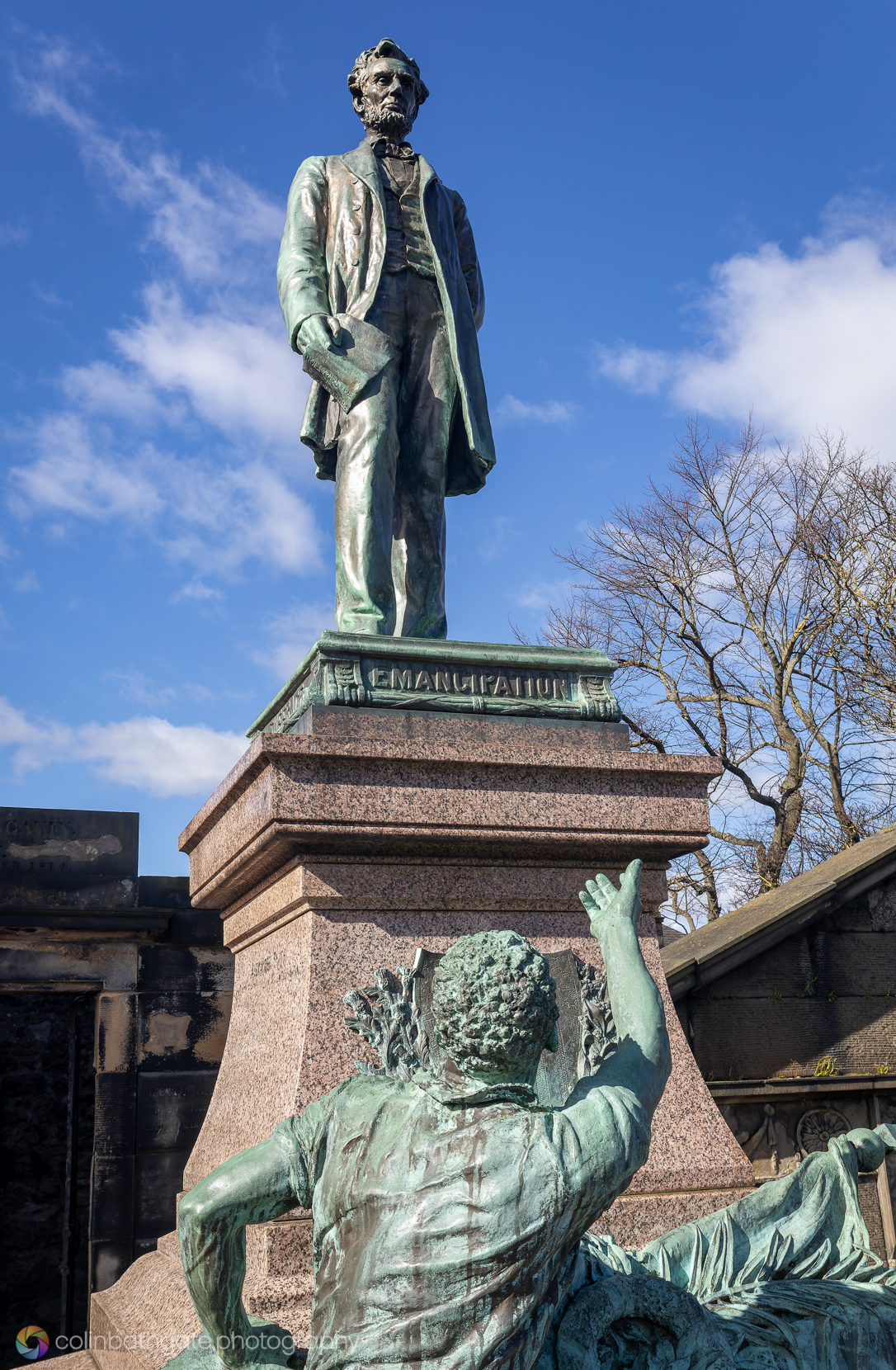
The monument was unveiled in August 1893. Canmore’s entry reads:
A bronze life-sized figure of a slave, resting on furled battle flags at the base of a red granite pedestal, holds up his right hand in gratitude to a bronze life-sized statue of Abraham Lincoln which surmounts the pedestal. Lincoln stands with his right knee slightly bent, his left hand behind his back, and holds the proclamation of emancipation in his right hand. On the east face of the pedestal below him is a bronze shield decorated with the American and British flags, flanked by thistles (left) and cotton (right).
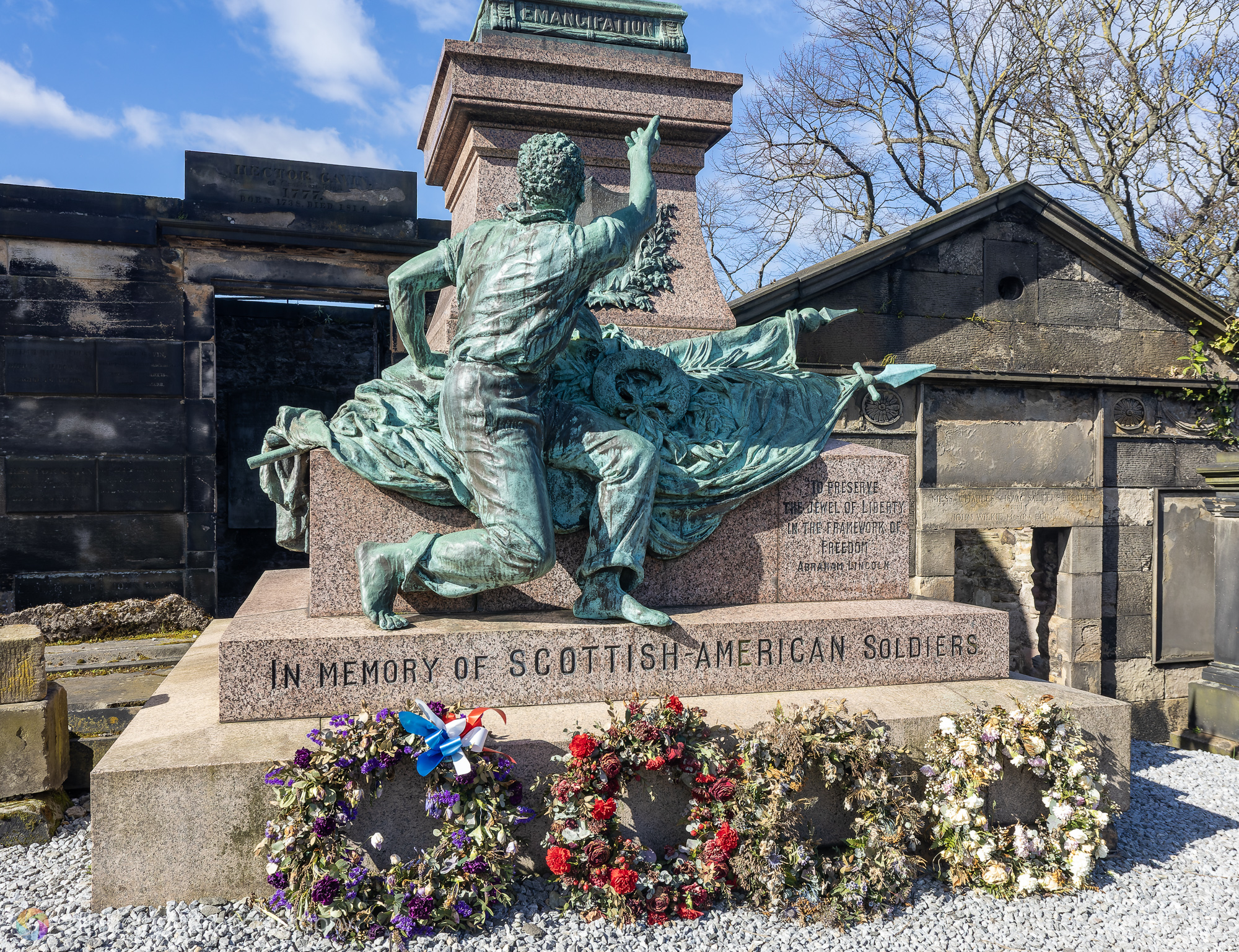
The inscription, “To preserve the jewel of liberty in the framework of Freedom” is a quotation by Abraham Lincoln. It’s a startling sight when you first encounter this monument, because it’s so different to everything else in the graveyard, both in purpose and in appearance.
Other Headstones and Monuments
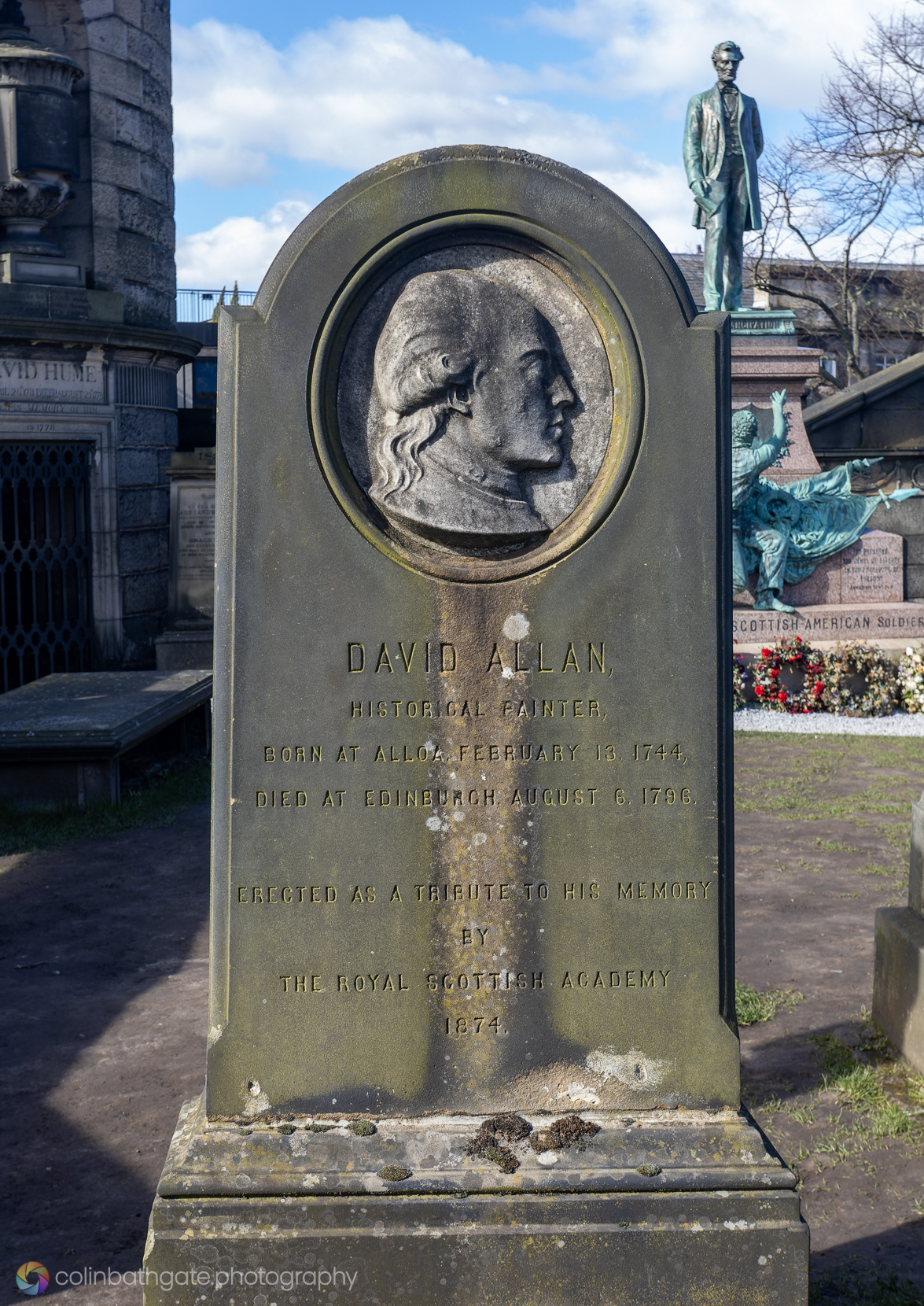
David Allan was a Scottish painter who lived at Dicksons Close on the Royal Mile in the final years of his life. He died in Edinburgh on 6 August 1796. The Royal Scottish Academy paid for and erected the headstone.
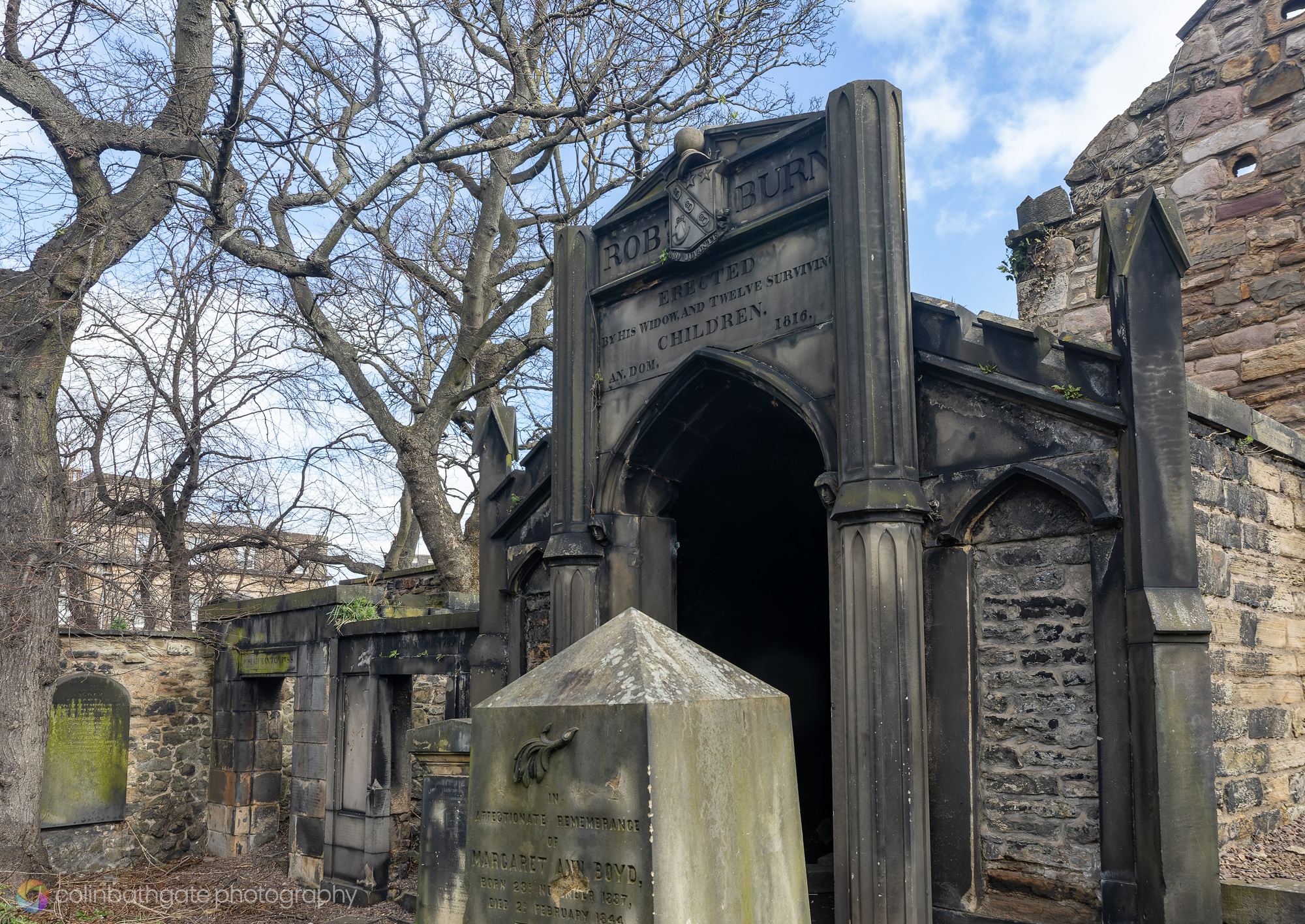
In the later west extension is a gothic mausoleum to the architect Robert Burn (not to be confused with the poet Robert Burns), who died in 1816. His widow and children are also interred here. Burn was responsible for, among other things, the gravestone of the poet Robert Fergusson in Canongate Kirkyard (commissioned by the poet Robert Burns!), the design of the Nelson Monument, the original James Gillespie’s high school, and the Hermitage of Braid mansion house.
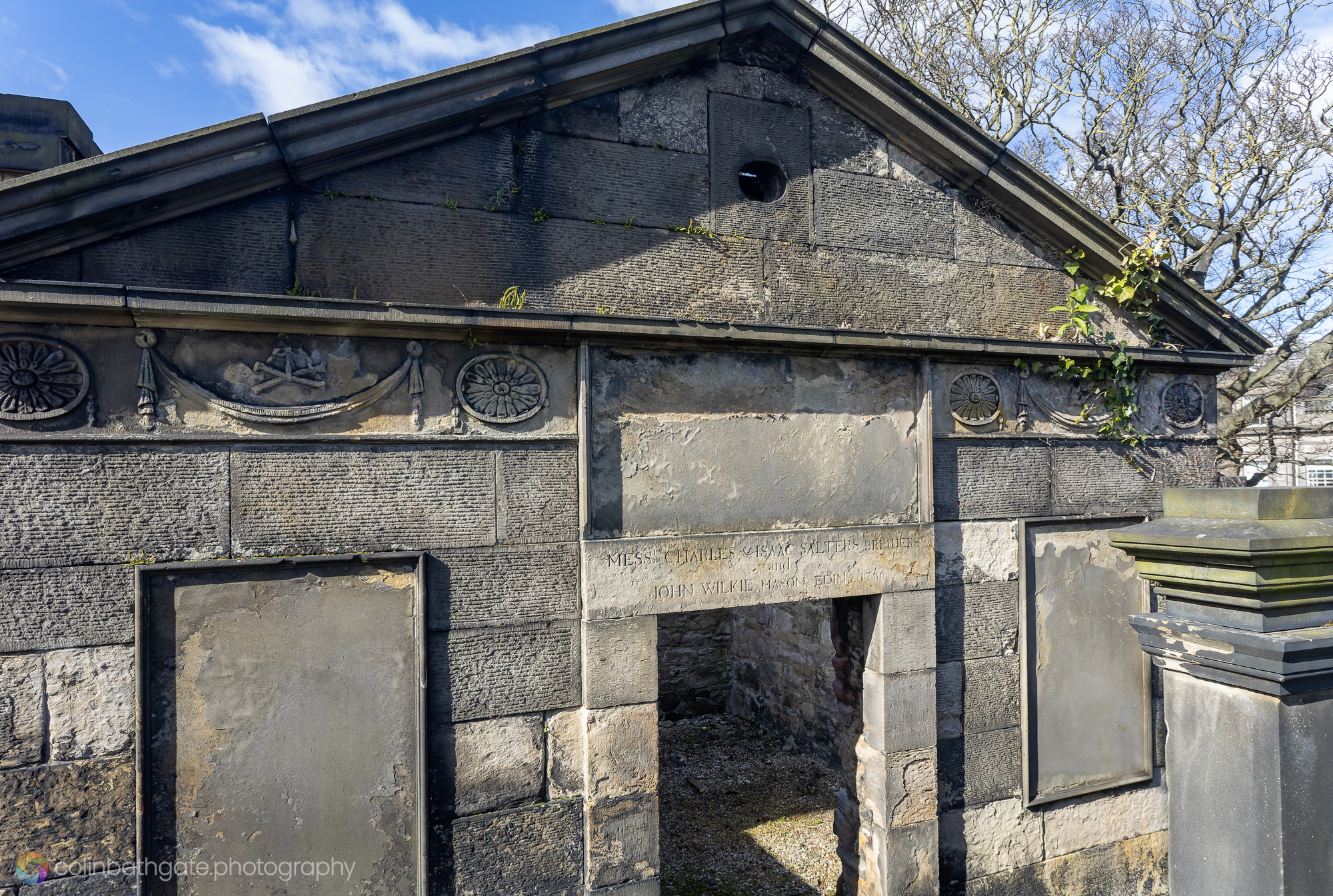
Near the Hume Monument is a sandstone enclosure for the mason John Wilkie and ‘Messrs Charles and Isaac Salters, brewers’. Again, I can’t find any reference to the Salters linked to brewing in Edinburgh but they must have made some impression on the city given the location and size of their final resting place.
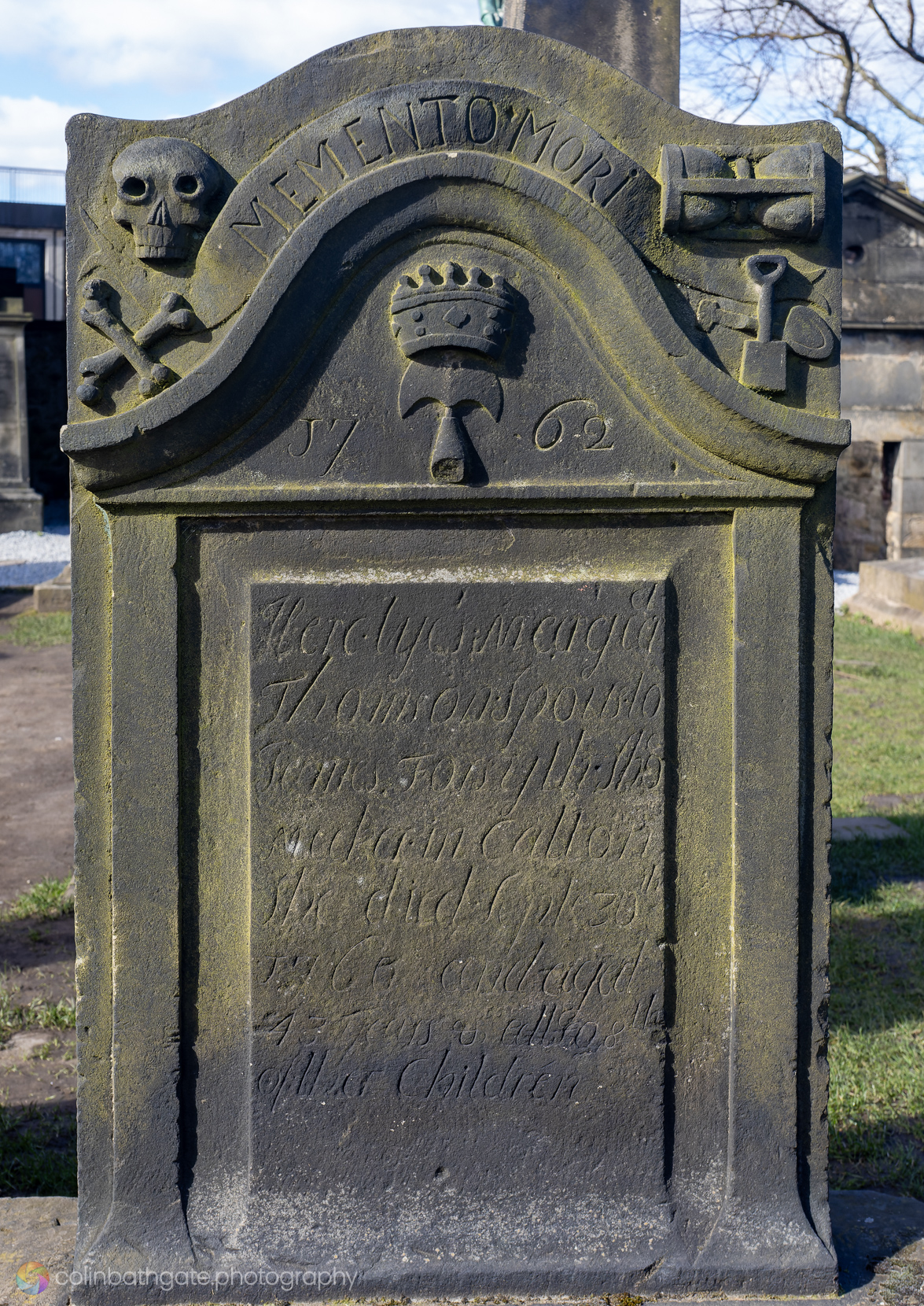
Another stone, dated 1762, bears a skull and the motto “Memento Mori”, meaning “remember you’re mortal, you will die”. The hourglass on its side, sand no longer flowing, symbolises time having stopped. Additional symbols of mortality include crossed bones and crossed turf cutter and spade. It’s sobering walking through a burial ground.
The inscription reads:
Here lyes Margrat Thomson, spous to James Forsyth, shoemecker in Calton. She died Apl 30th 1760 and aged 43 years & allso 8th of her children.
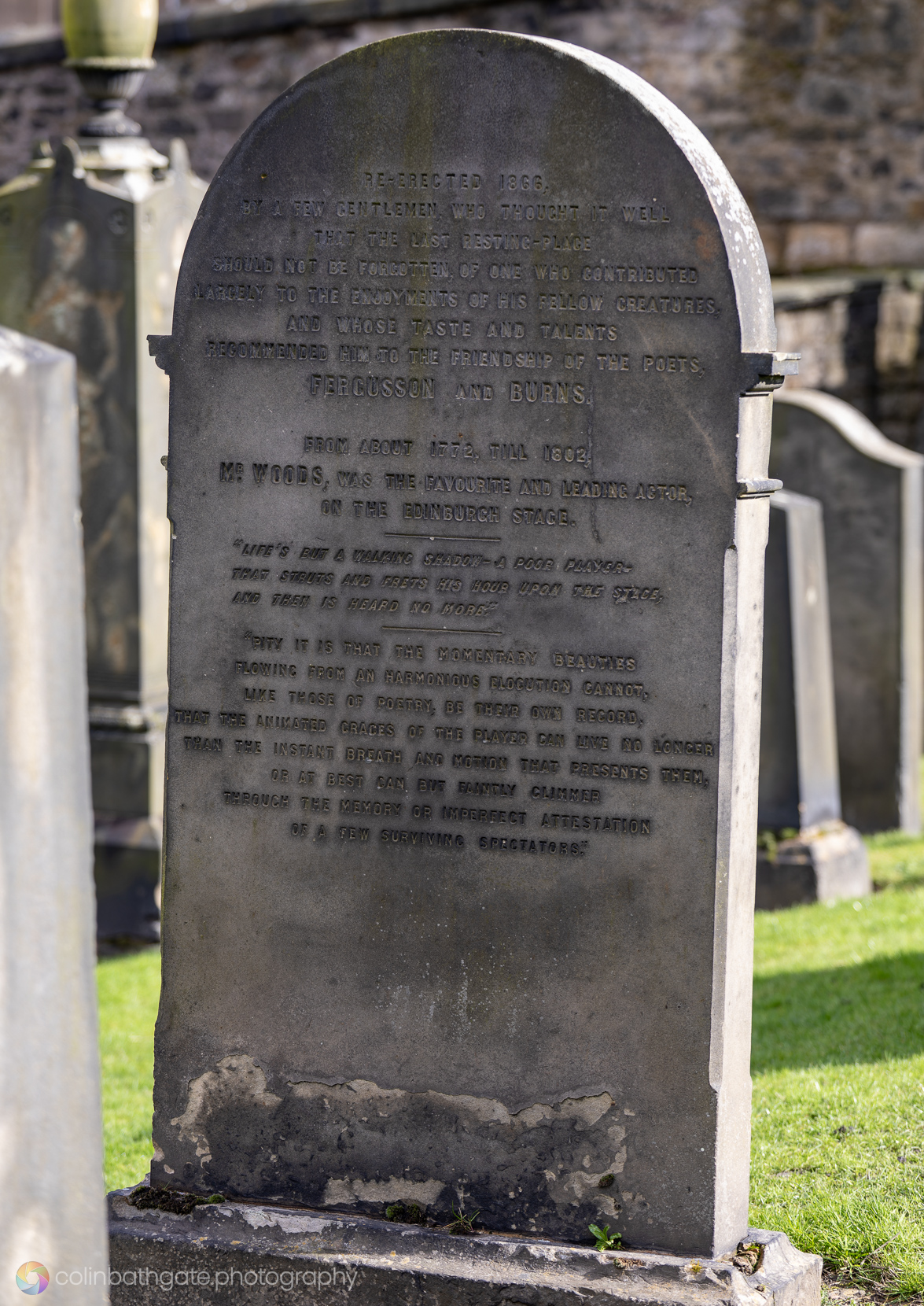
The headstone shown above was erected in the memory of an Edinburgh actor. It reads “From about 1772 to 1802 William Woods was the favourite and leading actor on the Edinburgh stage.” The main marble tablet is eroded and illegible; a new inscription has been added to the rear, which reads “Re-erected 1866 by a few gentlemen who thought it well that the last resting place should not be forgotten of one who contributed largely to the enjoyments of his fellow creatures and whose taste and talents recommended him to the friendship of the poets, Fergusson and Burns”.
I enjoyed the over-the-top quote lamenting the ephemeral nature of live performance. Colley Cibber (a fantastic name!) was a colourful character, an actor, playwright and Poet Laureate too.
Pity it is that the momentary beauties flowing from an harmonious elocution cannot, like those of poetry, be their own record, that the animated graces of the player can live no longer than the instant breath and motion that presents them or at best can faintly glimmer through the memory of imperfect attestation of a few surviving spectators.
Colley Cibber
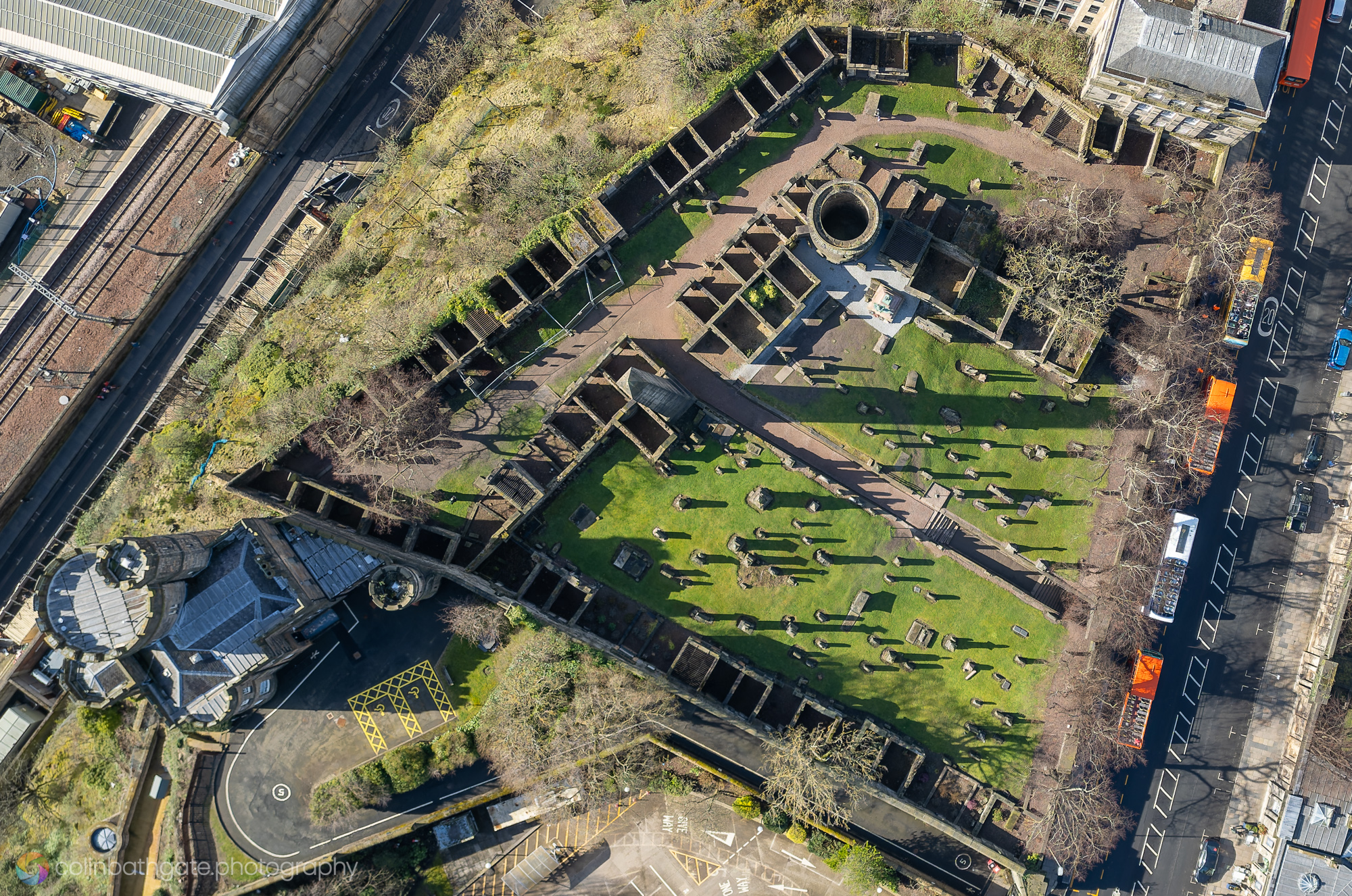
This drone shot looks down on the main South part of the burial ground. Waverley Station is at the top of the image, and Waterloo Place with its parked open-top tourist buses is on the opposite side. The turreted Governor’s House of the former Calton Jail can be seen on the left of the photo, now housing the Scottish Fiscal Commission.
St. Andrew’s House and Calton Jail
St Andrew’s House lies on the southern flank of Calton Hill and is the headquarters of the Scottish Government. The building is important for a number of reasons, including the fact that this was the first time government departments serving Scotland were brought under the same roof in Edinburgh.
The building was completed in 1939 and stands on the site of the former Calton Jail. Today, the Governor’s House with its distinctive turrets is all that remains of the former prison. The large Category A listed building looks out over Waverley Station, the Canongate and Holyrood Park.
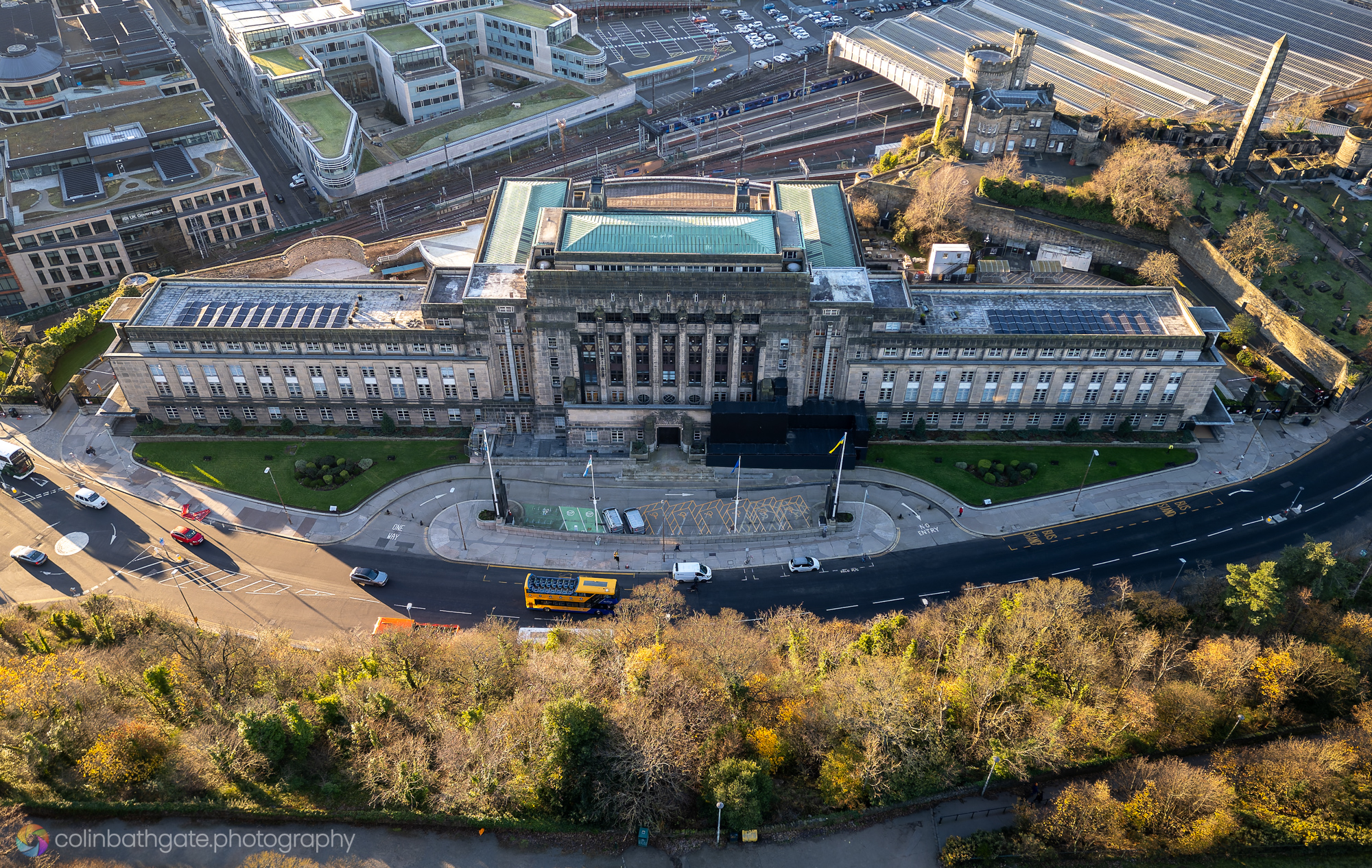
The design incorporates elements of Art Deco and features a number of sculpted decorations. I will admit that it’s not one of my favourite buildings (it’s always reminded me of something from the Soviet Bloc) but it does provide some contrast to the neo-classical buildings elsewhere on Calton Hill, and elements of the building are striking, including the entrance, shown below.
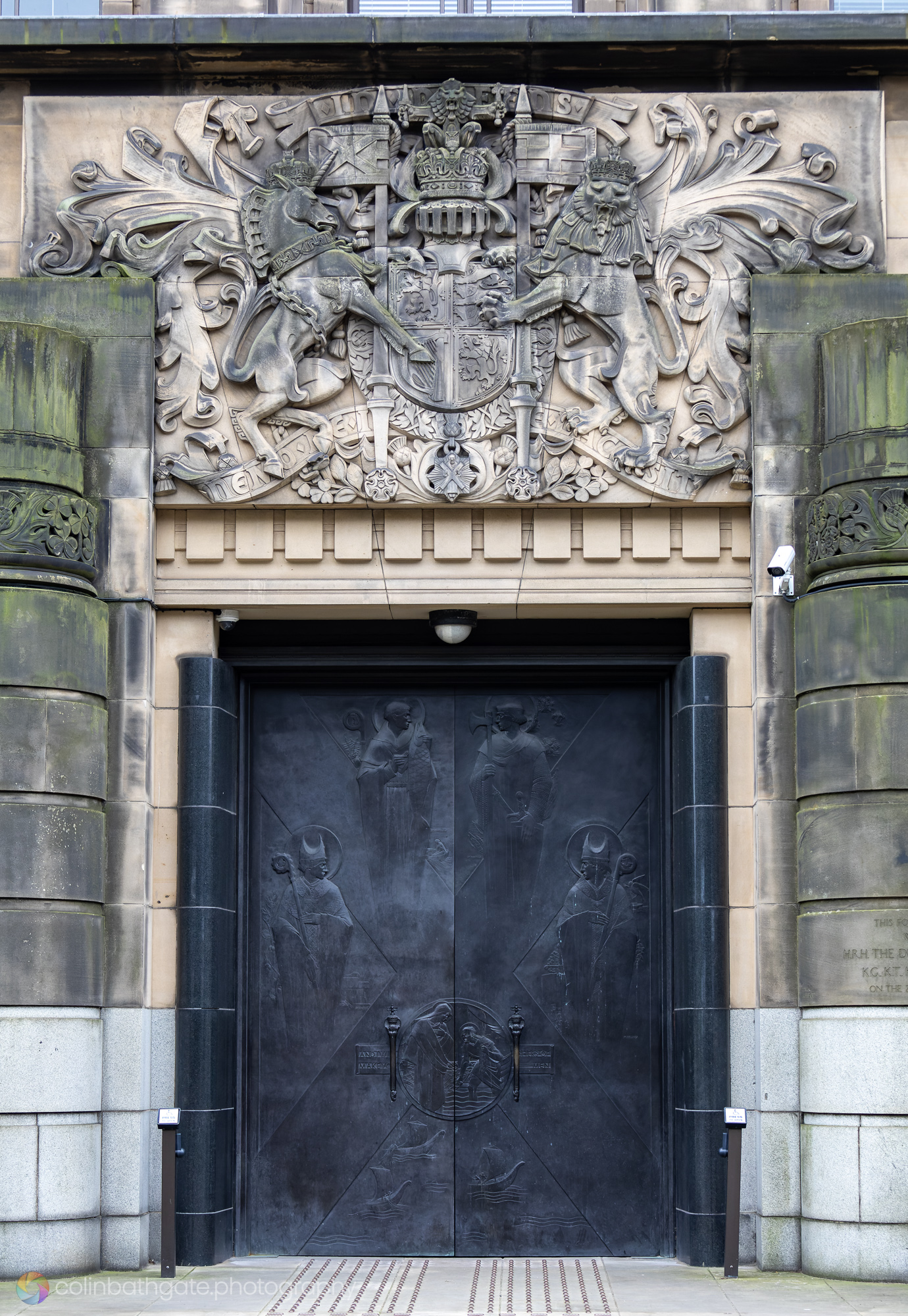
The Coat of Arms was sculpted by Alexander Carrick. The impressive bronze doors show themes from the life of St Andrew and were created by Walter Gilbert.
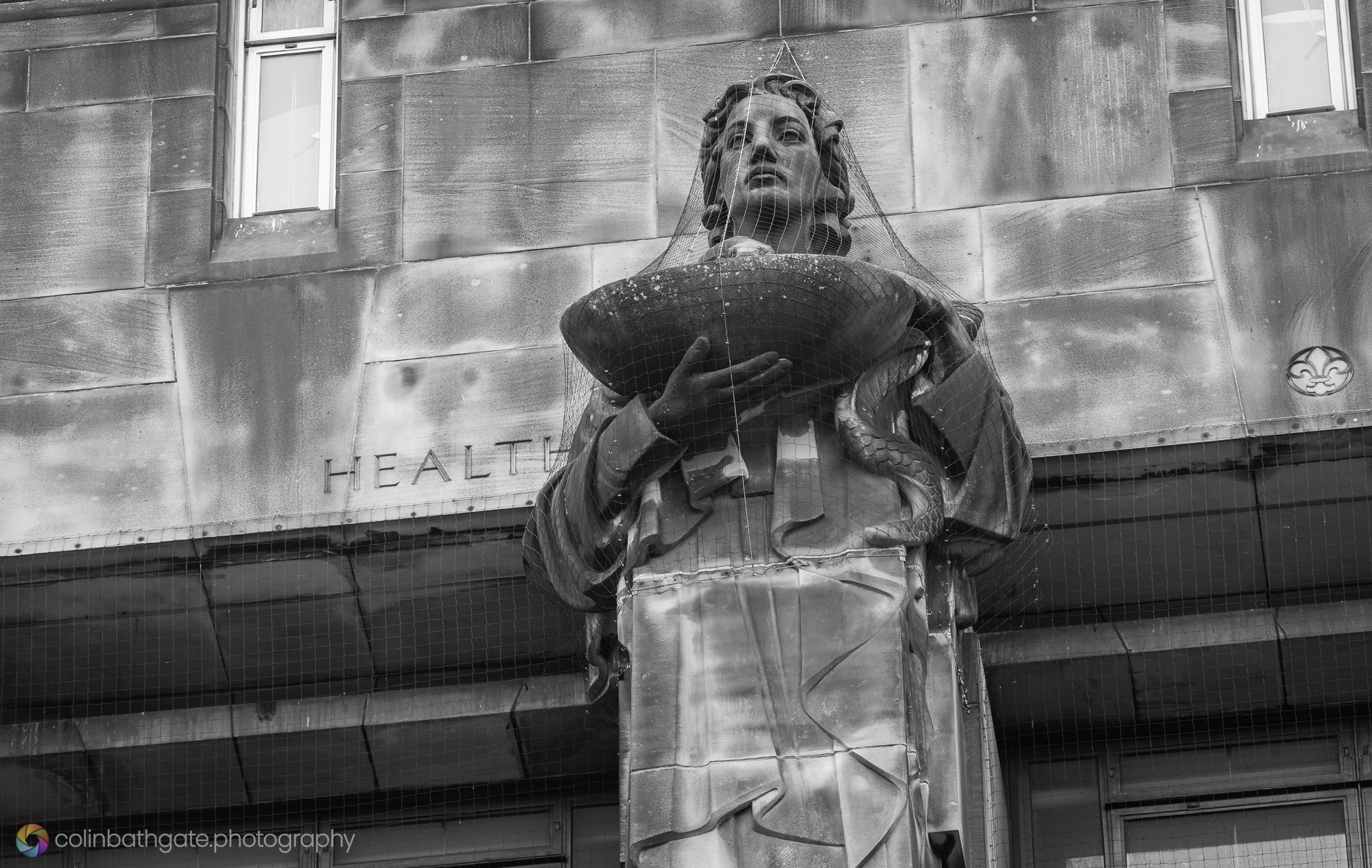
The six statues on the front building represent the six industries that the Government departments looked after: Agriculture, Fisheries, Education, Architecture, Health and Craft. For the photo above, I went with black and white to emphasise the soot and grime that has stuck to the stonework over the years. There’s a fascinating photograph (to me, at least!) showing the statues being pulled into place during construction. Note the complete lack of hard hats and other safety equipment!
Calton Jail opened in 1817, built on the site of other prisons. Demolition started in 1930 after the prisoners were moved to Saughton Jail.
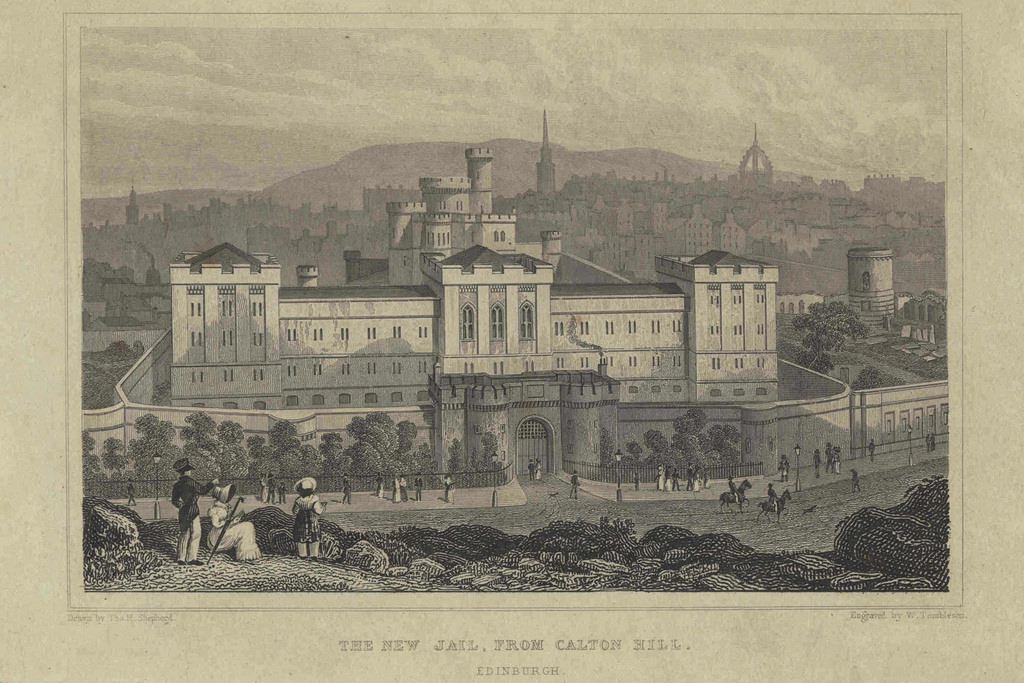
The bodies of ten executed murderers are alleged to be buried on the site of Calton Jail. They remain there to this day, under the West car park of St Andrew’s House. They include one Phillip Murray who was charged with murder and executed in October 1923. He was the last ever person to be hanged at Calton Jail prior to the opening of H.M.P. Saughton.
Collective and the Restoration of the City Observatory
Collective is an organisation dedicated to the presentation of modern art. They raised funds to restore the disused City Observatory site in partnership with Edinburgh City Council, and in 2015, Collective Architecture (no relation to Collective Gallery) took over the detailed design work of the site. The new site opened in November 2018 as a centre for contemporary art, and includes the renovated City Observatory, City Dome, and a new upmarket restaurant called the Lookout.
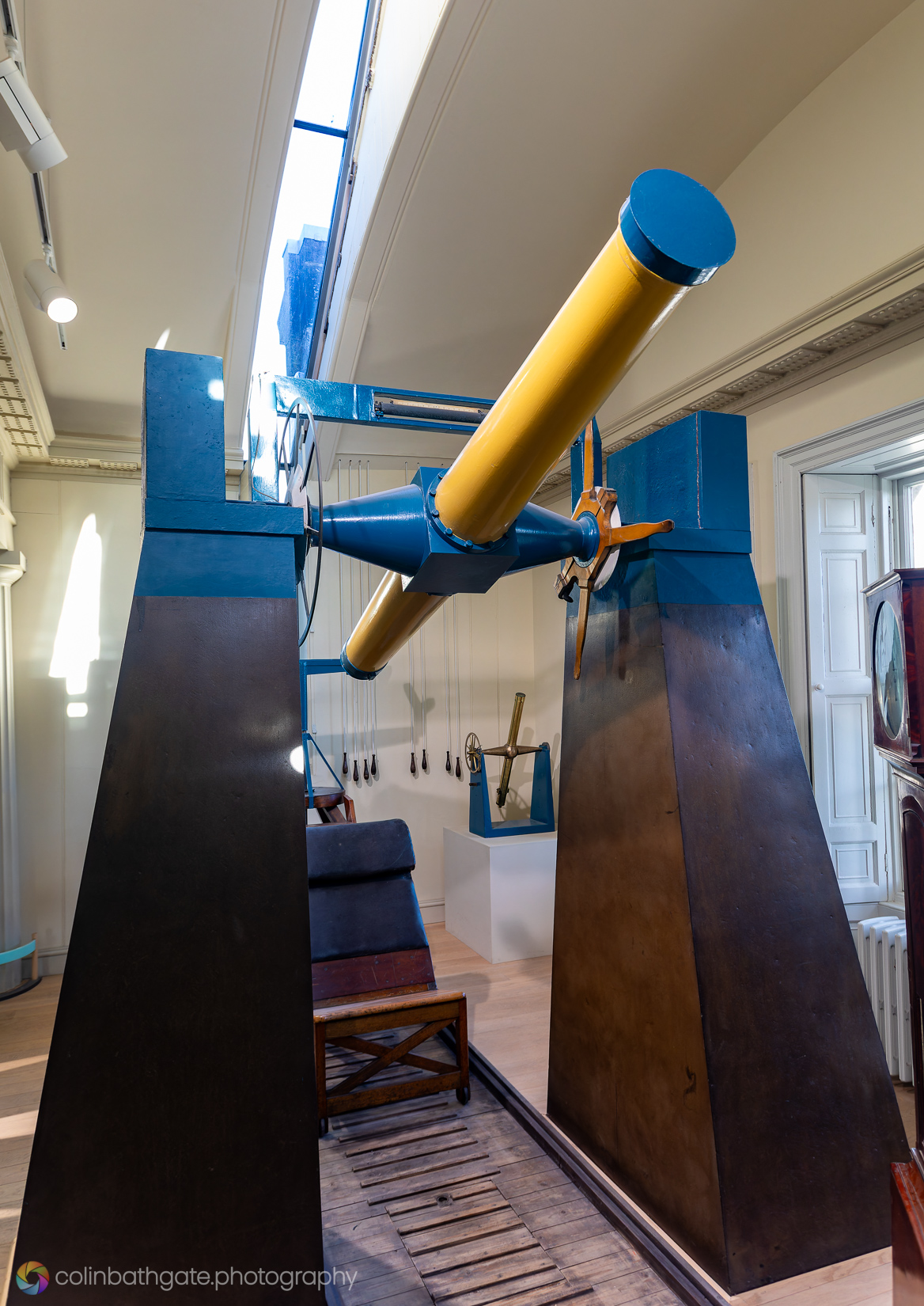
The restoration of the Playfair Observatory is a positive, but I can’t help feeling a huge opportunity has been missed. It would have been good to see more about the site’s scientific past, a nod to the achievements of the astronomers who worked there, the introduction of the time ball on Nelson’s Monument and an exploration of why this was so important for navigation at sea.
Instead, what I saw on my last visit was a small area featuring the meridian telescope, a gift shop, a small library with one person in it, and an art exhibition in the City Dome. This consisted of a few uninspiring paintings and a bizarre video playing on loop that failed to ignite any sort of interest. The whole dull experience took me less than two minutes, and I left with a bemused nod in the direction of the bored-looking student at the information desk.
Oh yes, there’s also an expensive restaurant, admittedly situated in a stunning location overhanging the hilltop, but at £37 a head for a two course lunch, I decided instead to walk back down the hillside to take more photos.
Update: it seems a lot can happen in a couple of months. Since I visited Calton Hill! The Lookout restaurant has closed permanently.
The Democracy Cairn
On the South East slopes of Calton Hill, a place where fewer people seem to venture, is a cairn made from stones taken from places in Scotland, with a brazier on top. The cairn was erected to commemorate the vigil for a Scottish Parliament held at the foot of Calton Hill between 1992 and 1997, and celebrate the vote in favour of Scottish devolution.
Attached are various plaques, including a quote from a Hugh McDiarmid poem, and one commemorating Jane Haining, a Scottish teacher who died at Auschwitz.
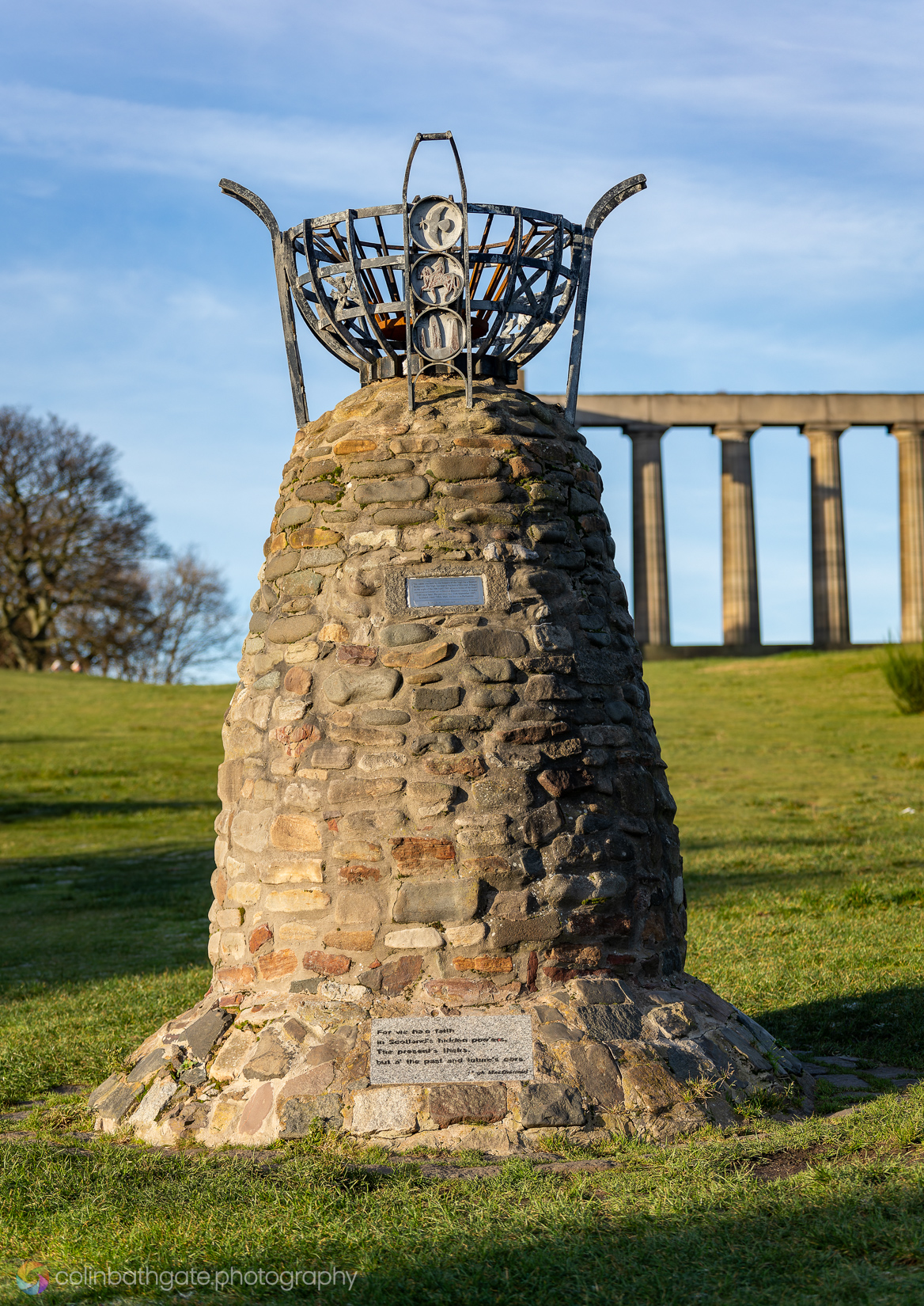
The upper plaque in the photo above reads:
“This cairn was built by the keepers of the Vigil for a Scottish Parliament. The Vigil was kept at the foot of this road. It began on the night of the 10th April 1992 as news broke of the fourth consecutive Conservative General Election victory. It ended 1,980 days later. The previous day, 11th September 1997, Scotland voted “Yes, Yes” for her own Parliament. Erected by Democracy for Scotland, 10th April 1998.”
The “Yes/Yes” result means “Yes” to a parliament and “Yes” to tax-raising powers. The cairn is making a political statement, but the grand architecture of the National Monument and the Nelson Monument were also political statements about our place in the British Empire.
That concludes my visit to Calton Hill, I hope you’ve enjoyed it. I’m already working on a new post but that one will be a lot shorter and less intricate! If you’ve any comments please add them below, and you can sign up for new post alert emails below too.