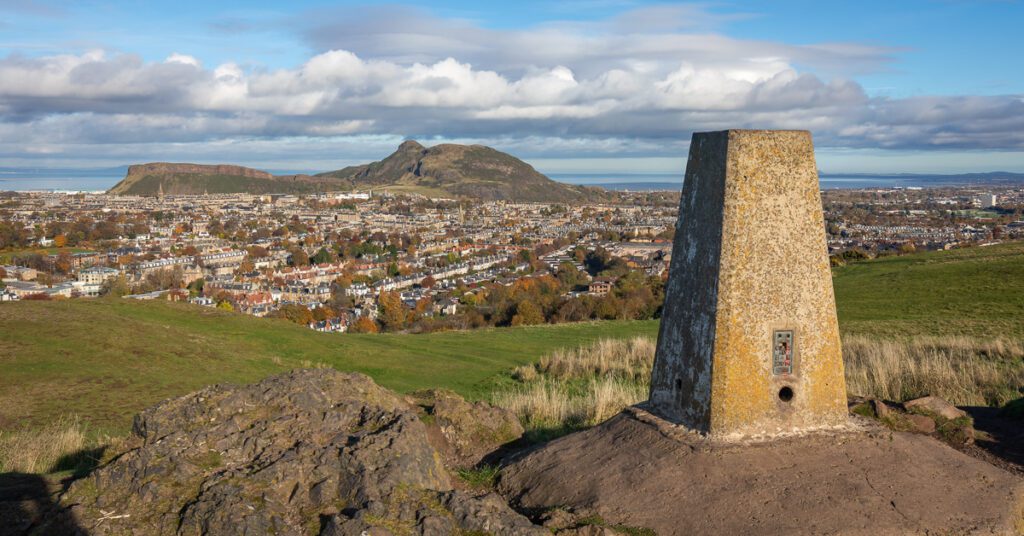
I’ve lived most of my life in Edinburgh, but I’ve only once visited this hill. For that reason, I decided to do a bit of research on the area, and get my walking boots on. This post is the result.
Background and Location
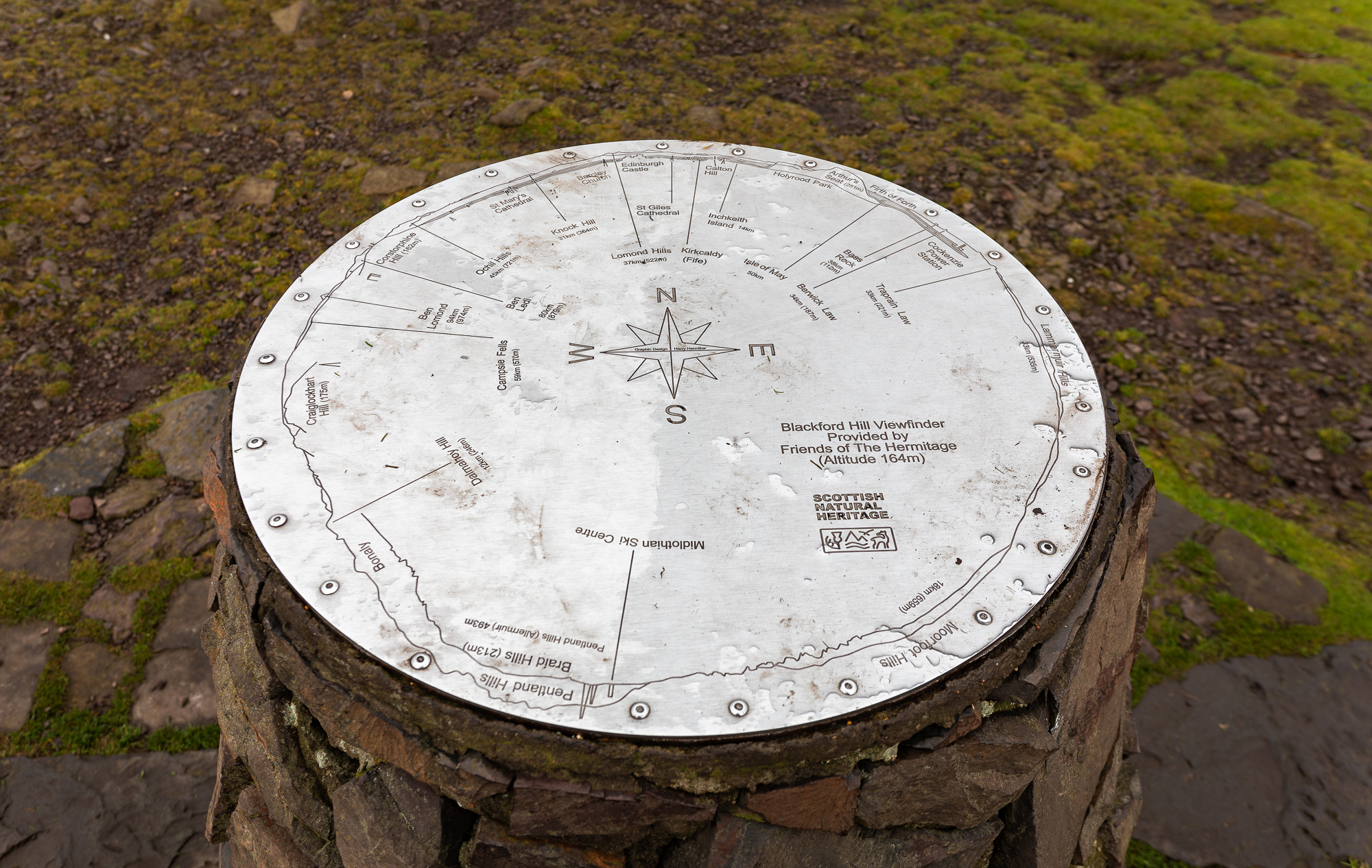
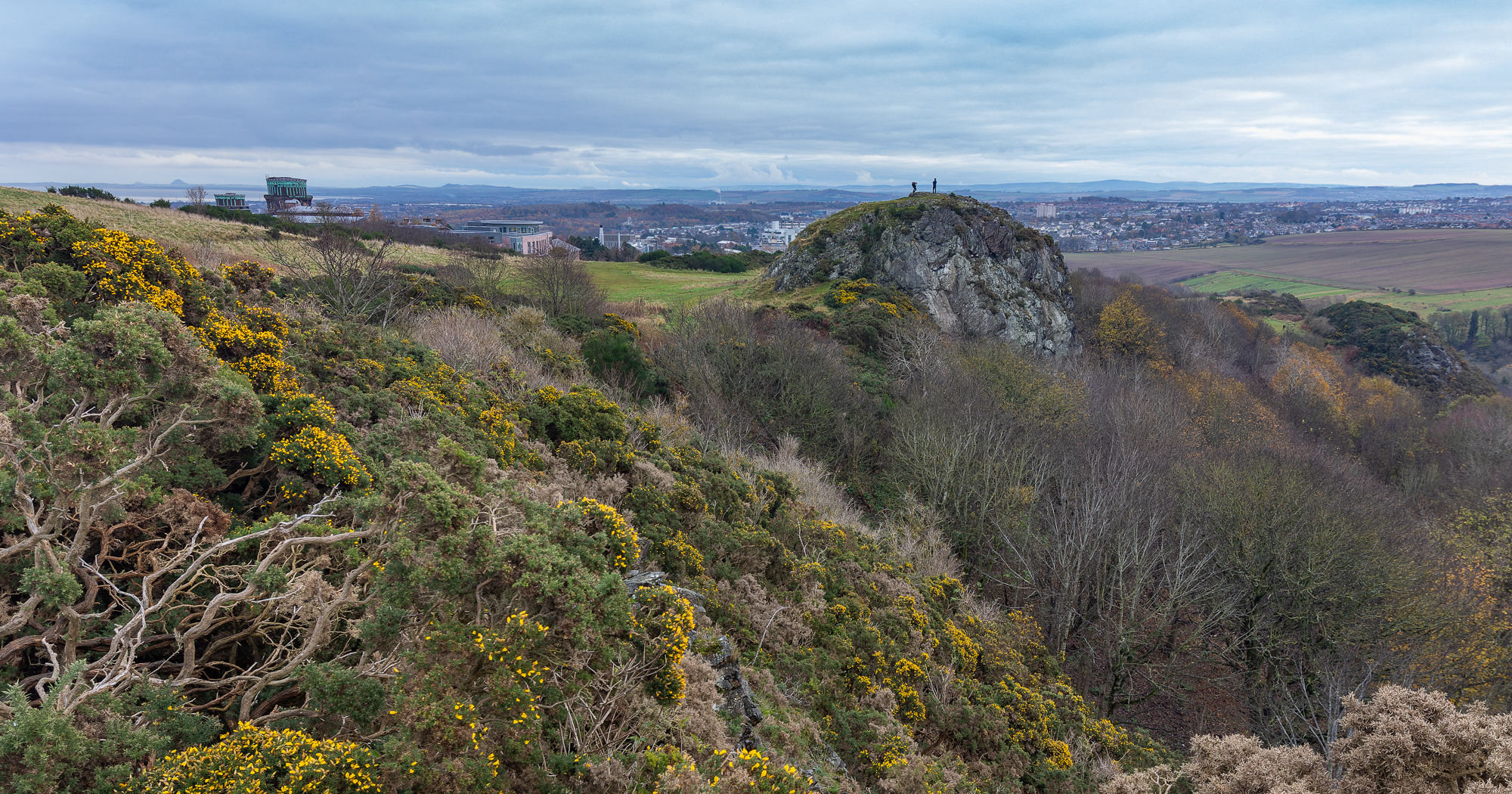
Located 2 miles south of Edinburgh city centre, Blackford Hill rises to a modest height of 164m above sea level (in contrast to the arguably more popular Arthur’s Seat, which reaches 250 metres). Nevertheless, the hill provides stunning panoramas of Edinburgh. On clear days, the Pentland Hills, Inch Keith, Fife, Traprain Law, and North Berwick Law are visible.
The landscape of Blackford Hill is the eroded remains of volcanoes that were active around 410 million years ago, combined with the effects of more recent ice sheets that melted and carved through rock to create gorges like the Hermitage of Braid. Additionally, in close proximity lies Agassiz Rock, which holds geological significance as the first evidence of glacial activity in Scotland, identified by the Swiss geologist Louis Agassiz.
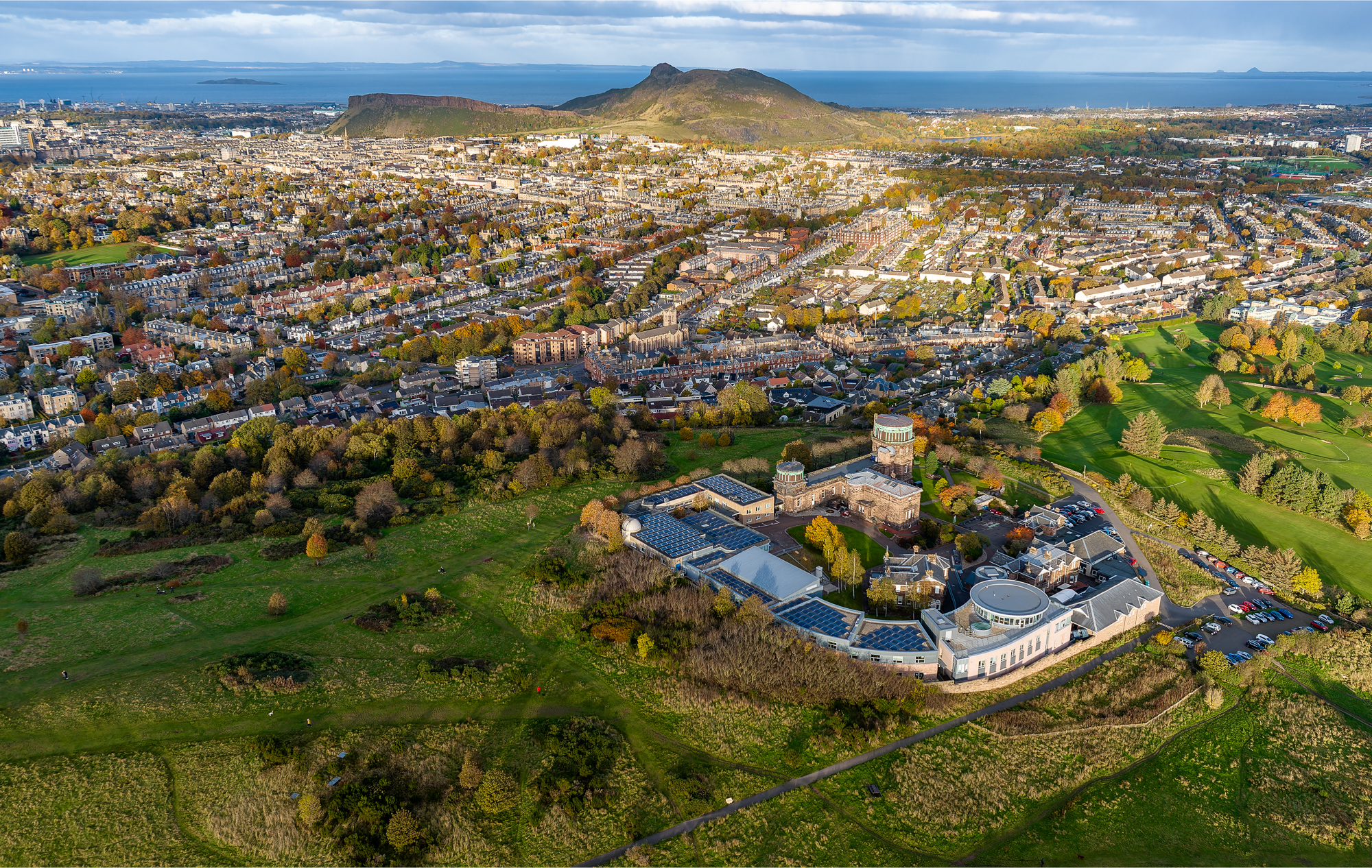
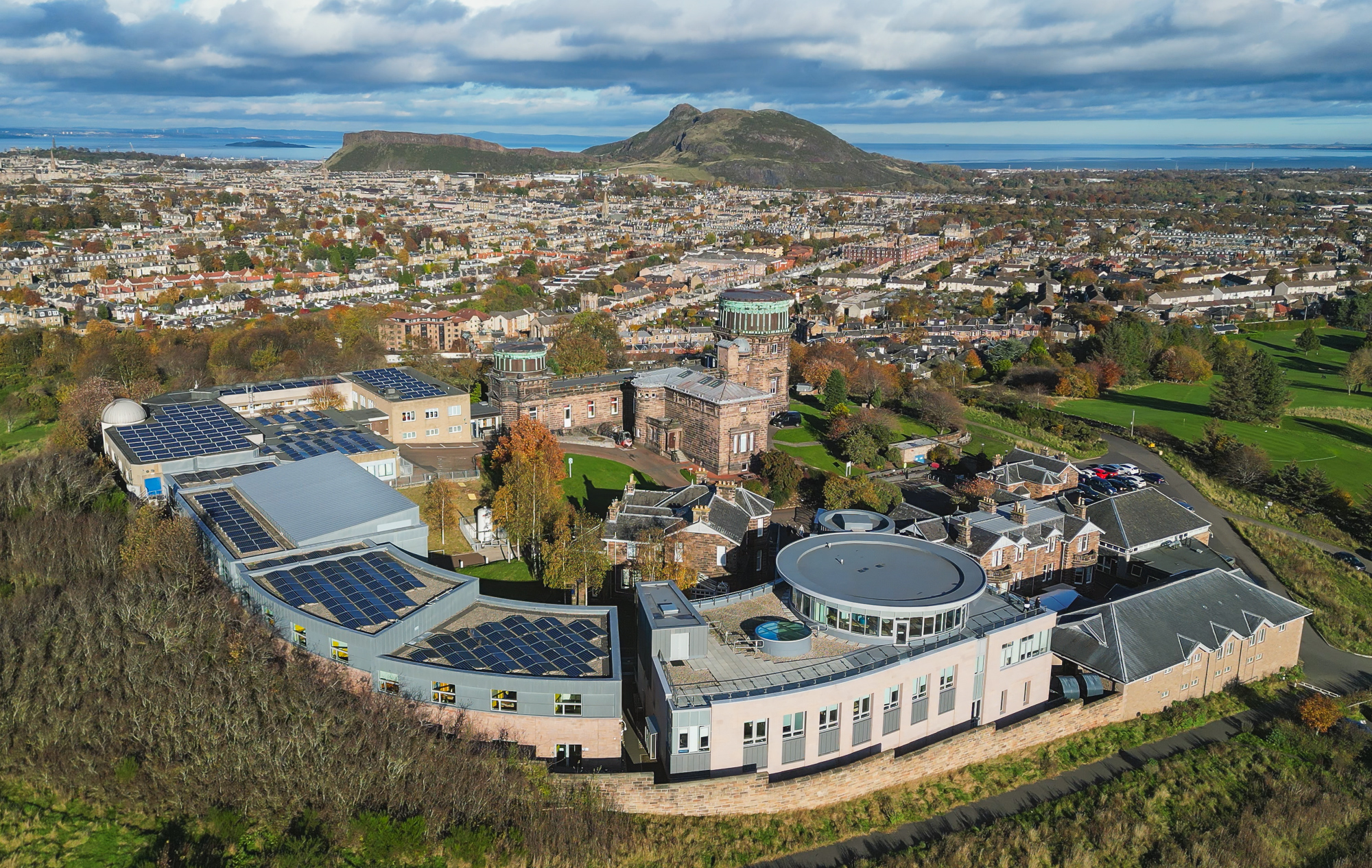
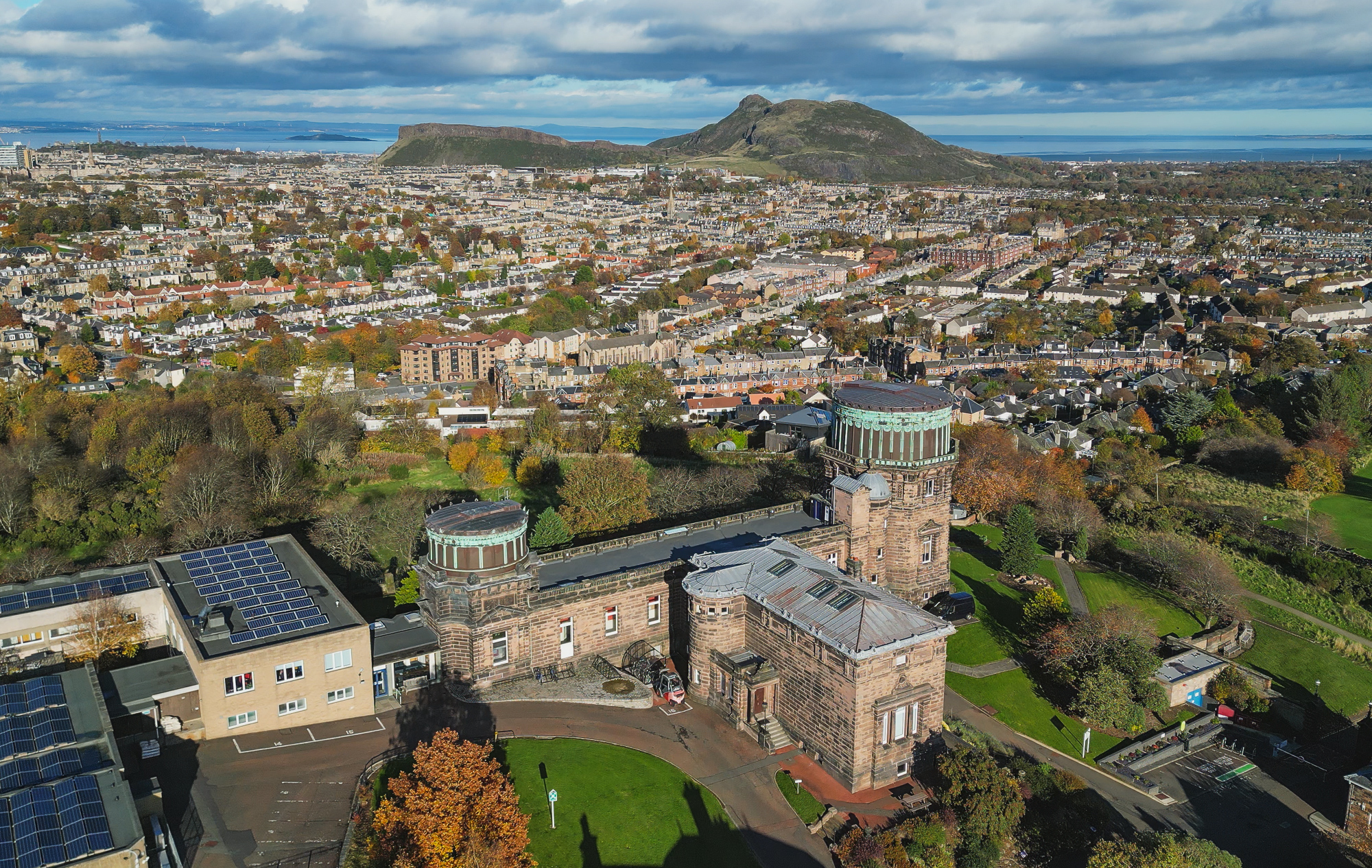
Also nestled on Blackford Hill is the Royal Observatory of Edinburgh (ROE), with its mix of historic A-listed and modern buildings. The ROE is a scientific institution carrying out astronomical research, university teaching, and designing and constructing extremely sensitive instruments for many of the world’s best telescopes.
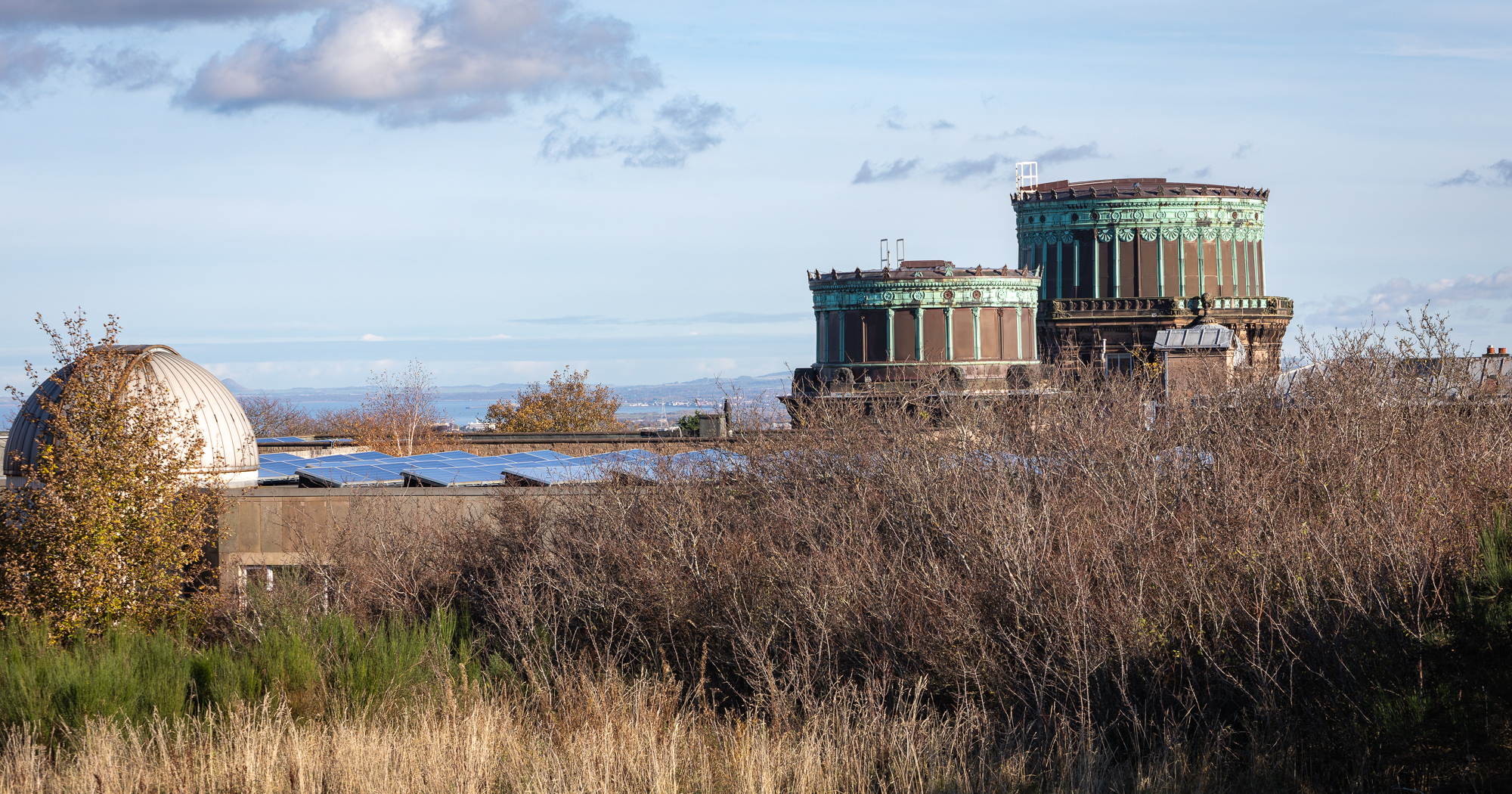
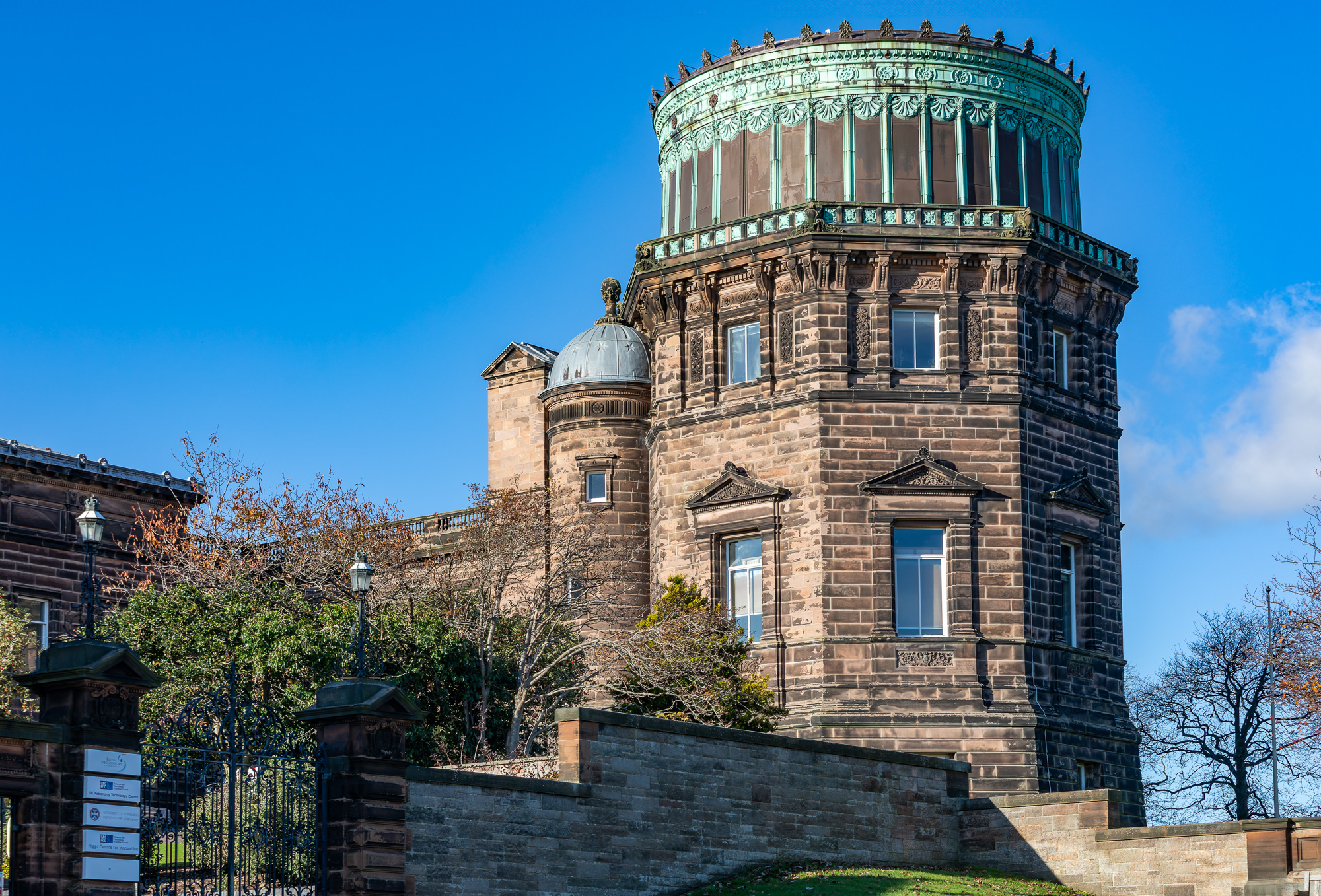
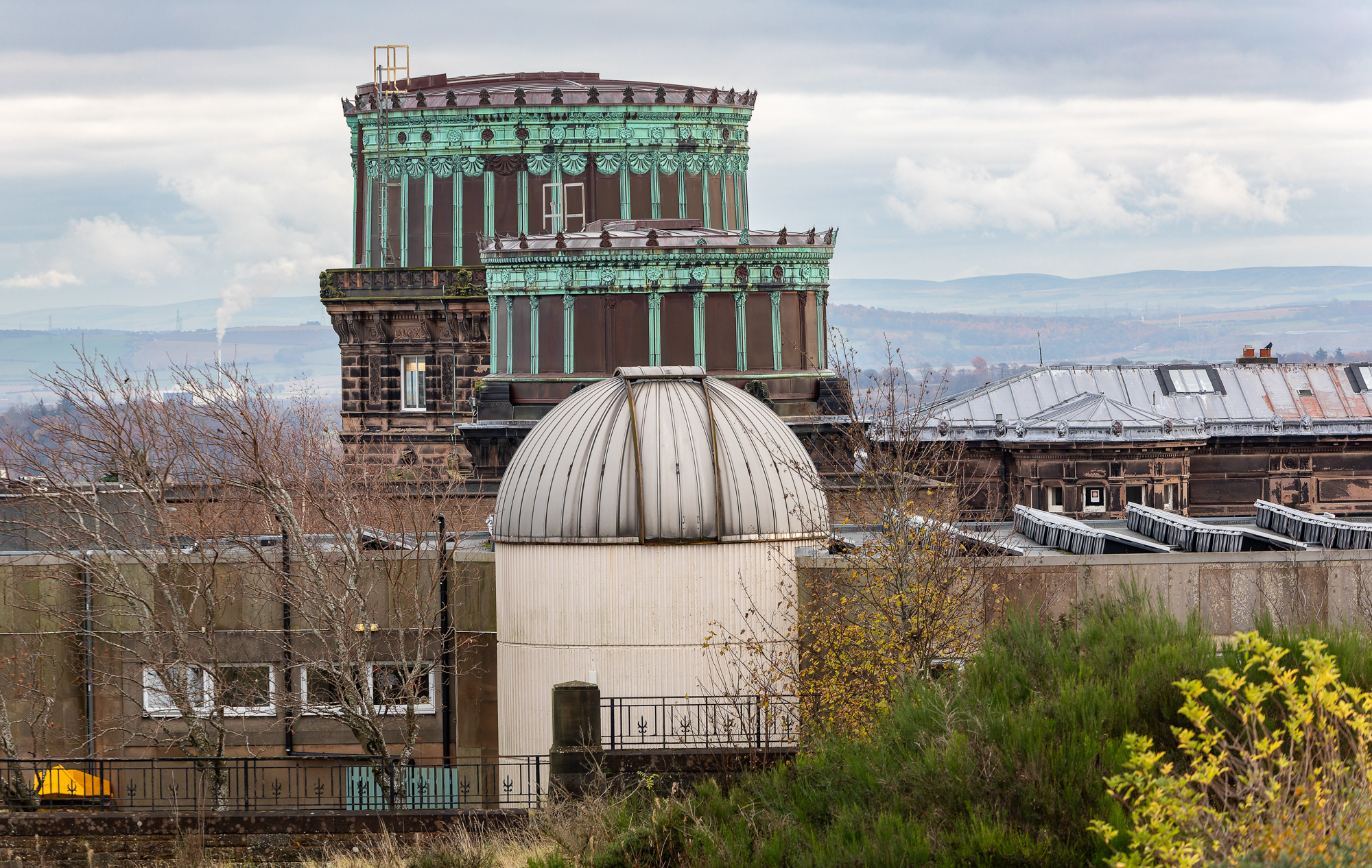
I believe the domes’ drum shape was chosen over the more usual hemispherical design because they’re more suited to Scotland’s weather. The domes’ distinctive green appearance is provided by weathered copper cladding.
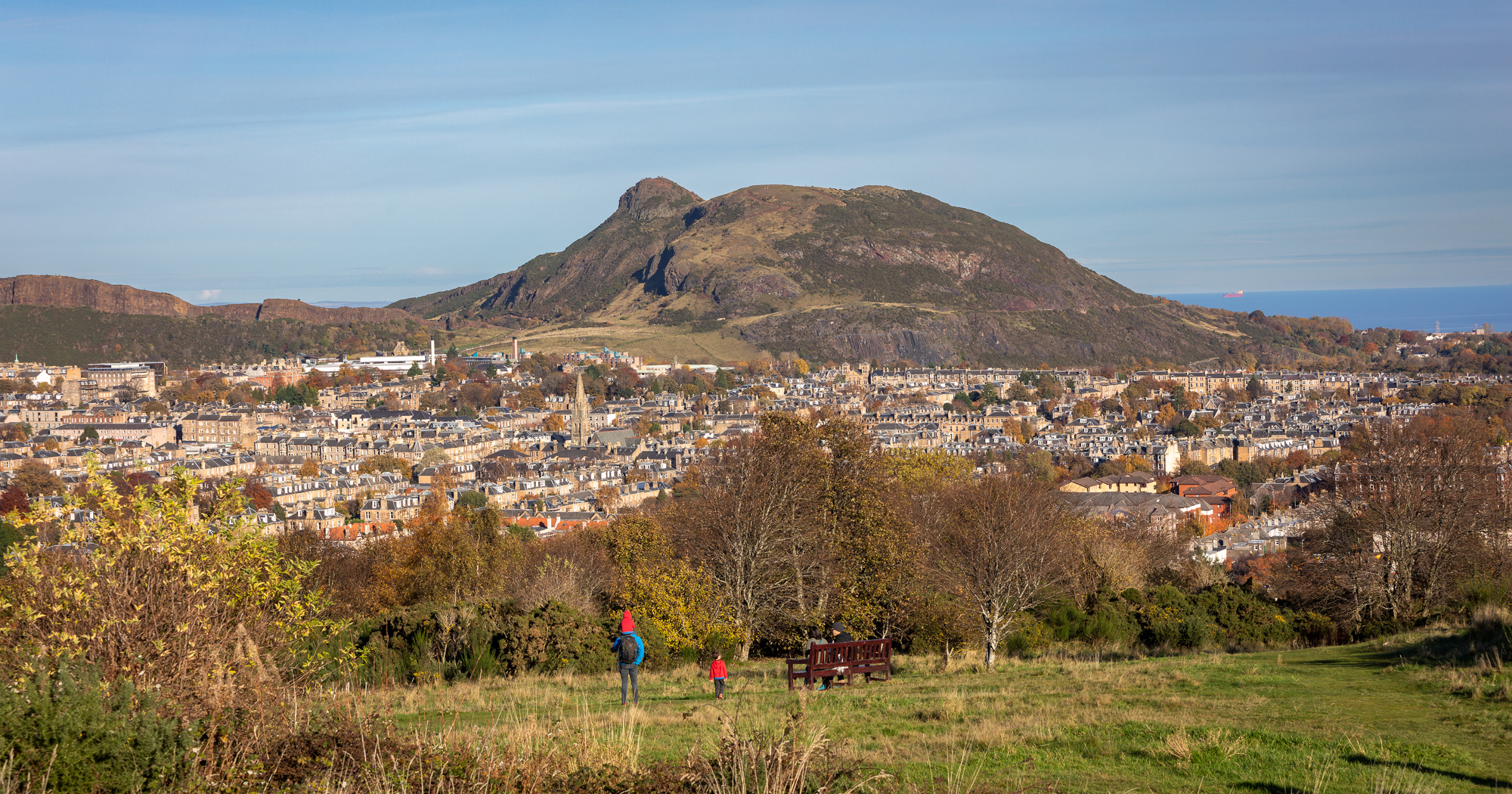
The hill itself is exposed to the elements, but the nearby Hermitage of Braid provides mature woodland shelter around its base to the South. The picturesque Blackford Pond sits further round to the North. At the Hill’s summit lies a scheduled monument, described as “the remains of a hillfort and external settlement of later prehistoric date surviving as a series of earthworks”. However, there’s not much to see, at least to my untrained eye.
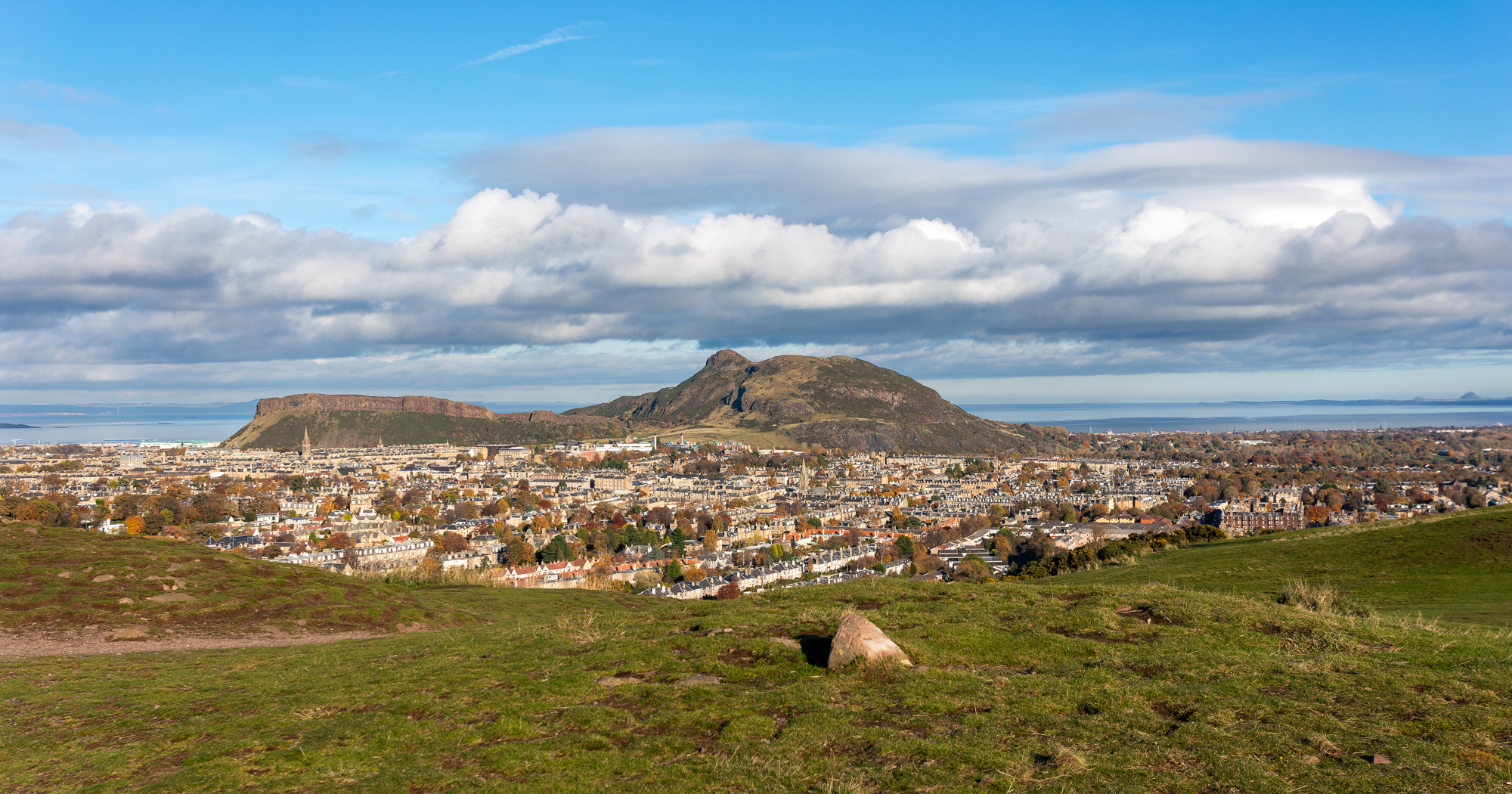
Blackford Hill is also one of the city’s so-called ‘seven hills’. The origin of this idea is unclear to me, but I believe it’s an allusion to the seven hills of Rome. It also ties in with the ‘Athens of the North’ nickname for the capital, deriving from the 18th century when the Scottish Enlightenment brought growing cultural confidence and classical architecture. The six other hills are: Arthur’s Seat, Castle Rock, Calton Hill, Costorphine Hill, Braid Hills, and Craiglockhart Hill.
The Walk Up
The ascent is reasonably short and easy, with numerous routes of varying lengths to choose from. A simple online search will throw up websites providing any combination of route, effort, and distance you prefer. There is a ‘cheat’s way’ of driving up to the public car park at the observatory; the walk up to the summit is then only a short distance from there. However, I think the best way to experience the area is to start at the Hermitage of Braids to the West of the hill, or at the entrance on Cluny Gardens near Blackford Pond (there’s also a wee coffee kiosk here if you’re in need of refreshments).
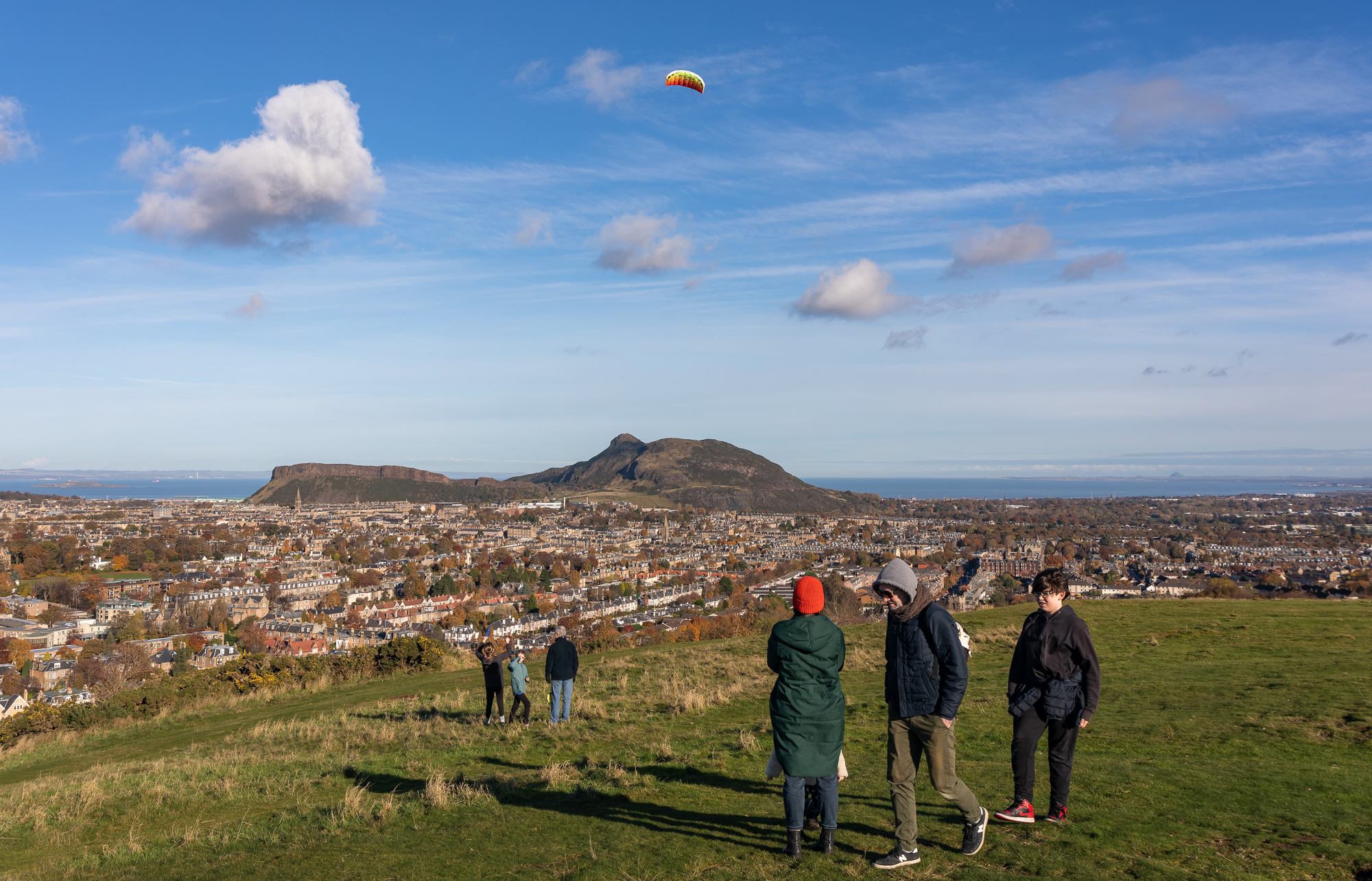
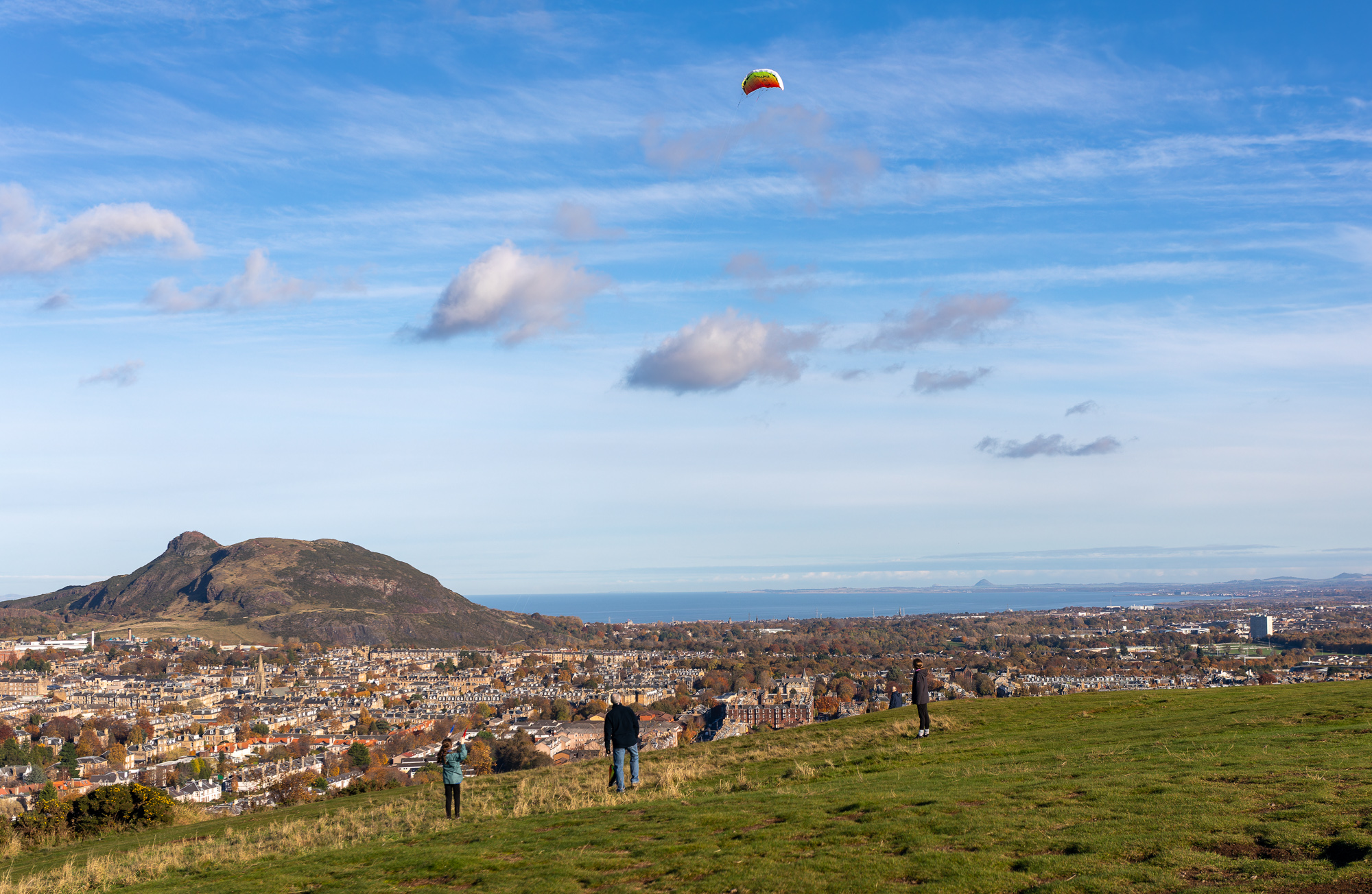
The gentle climb to the summit offers increasingly breath-taking views across the city, just remember to stop and turn around every so often! On the days I’ve walked there, I’ve found it to be very popular with dog walkers, families, and runners, especially on a sunny day (which happens all the time in Edinburgh, of course).
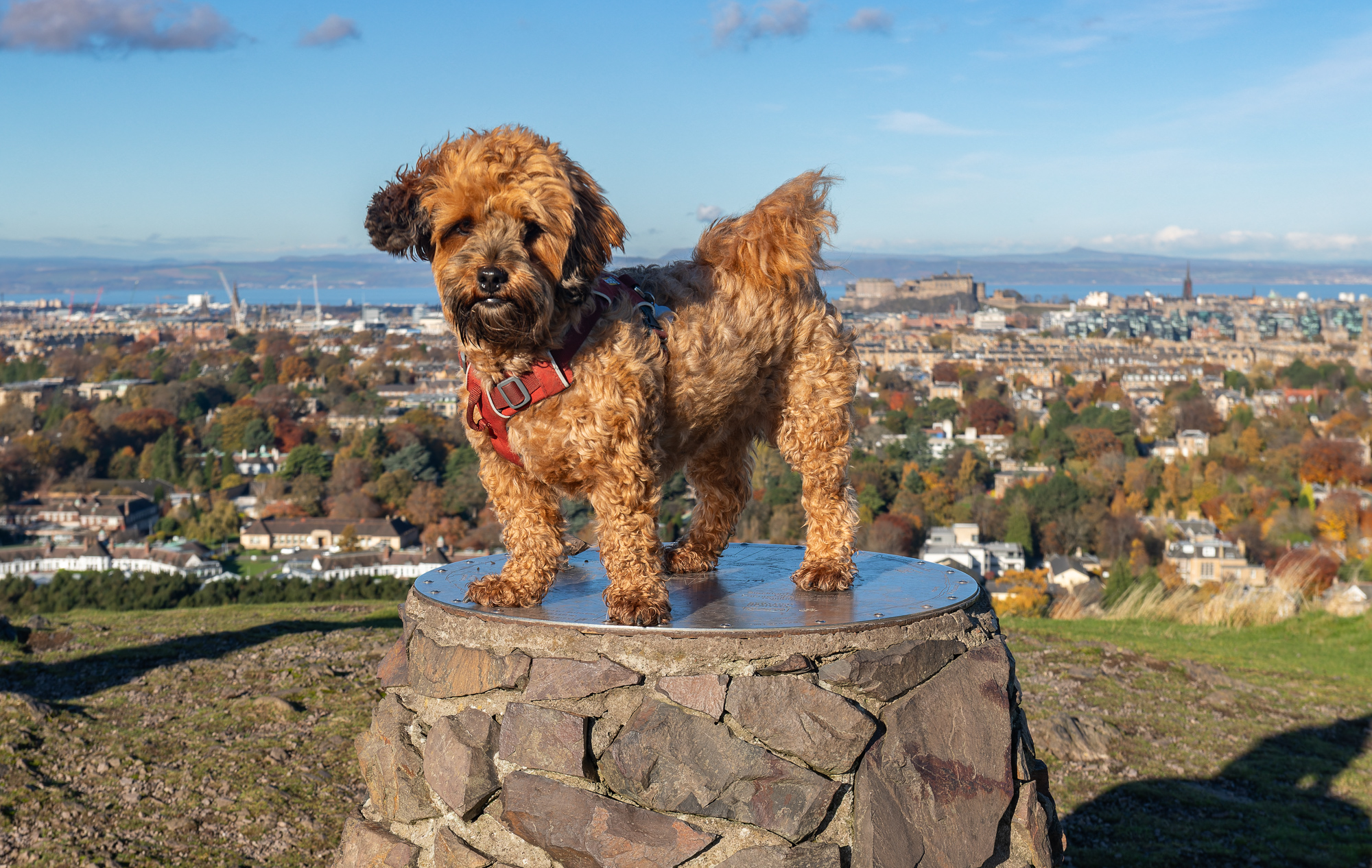
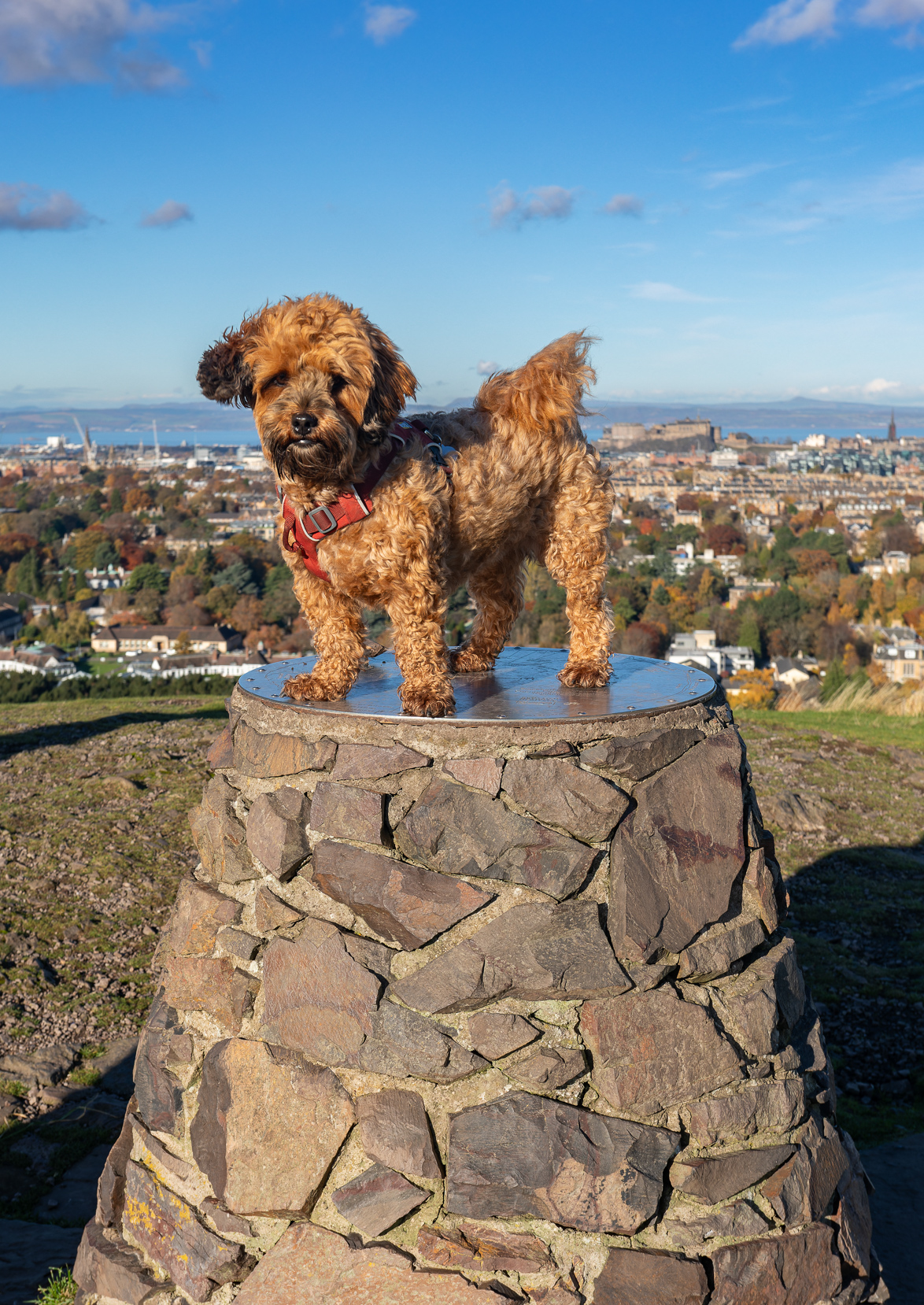
I took this pic depicting proud pooch ‘Freddy’ after I spotted his owner lifting him onto the direction marker at the summit. An irresistible photo subject!
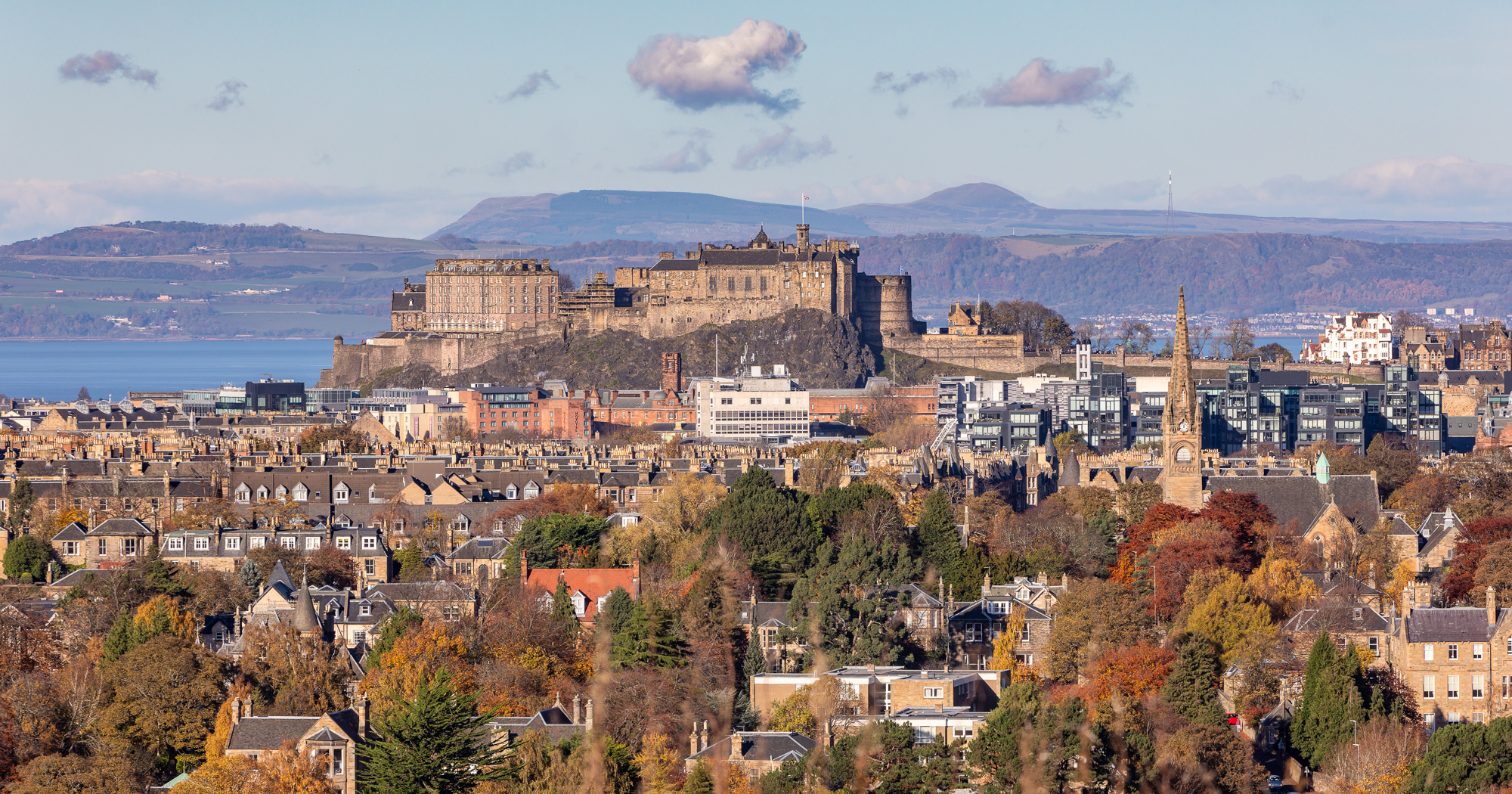
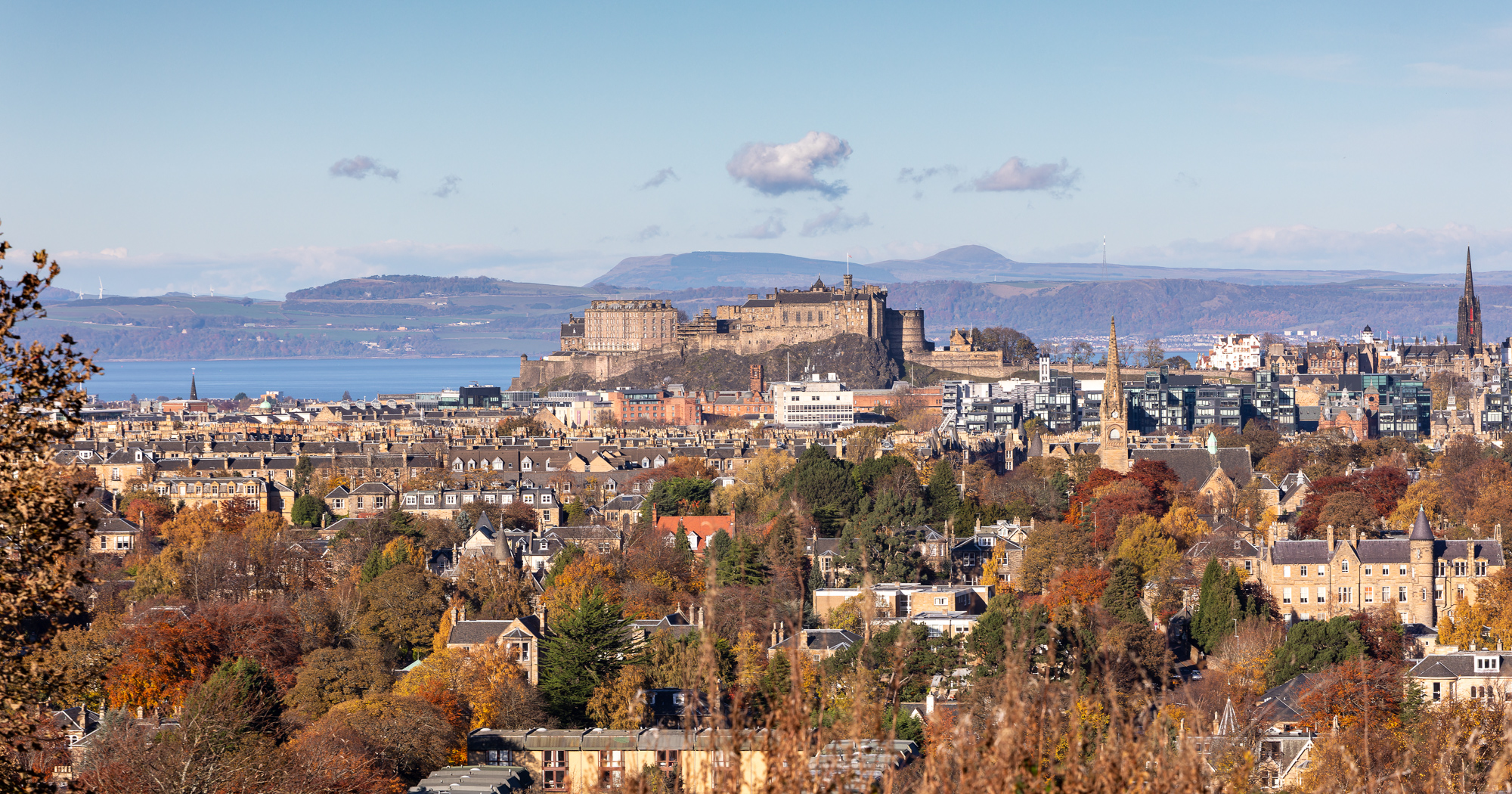
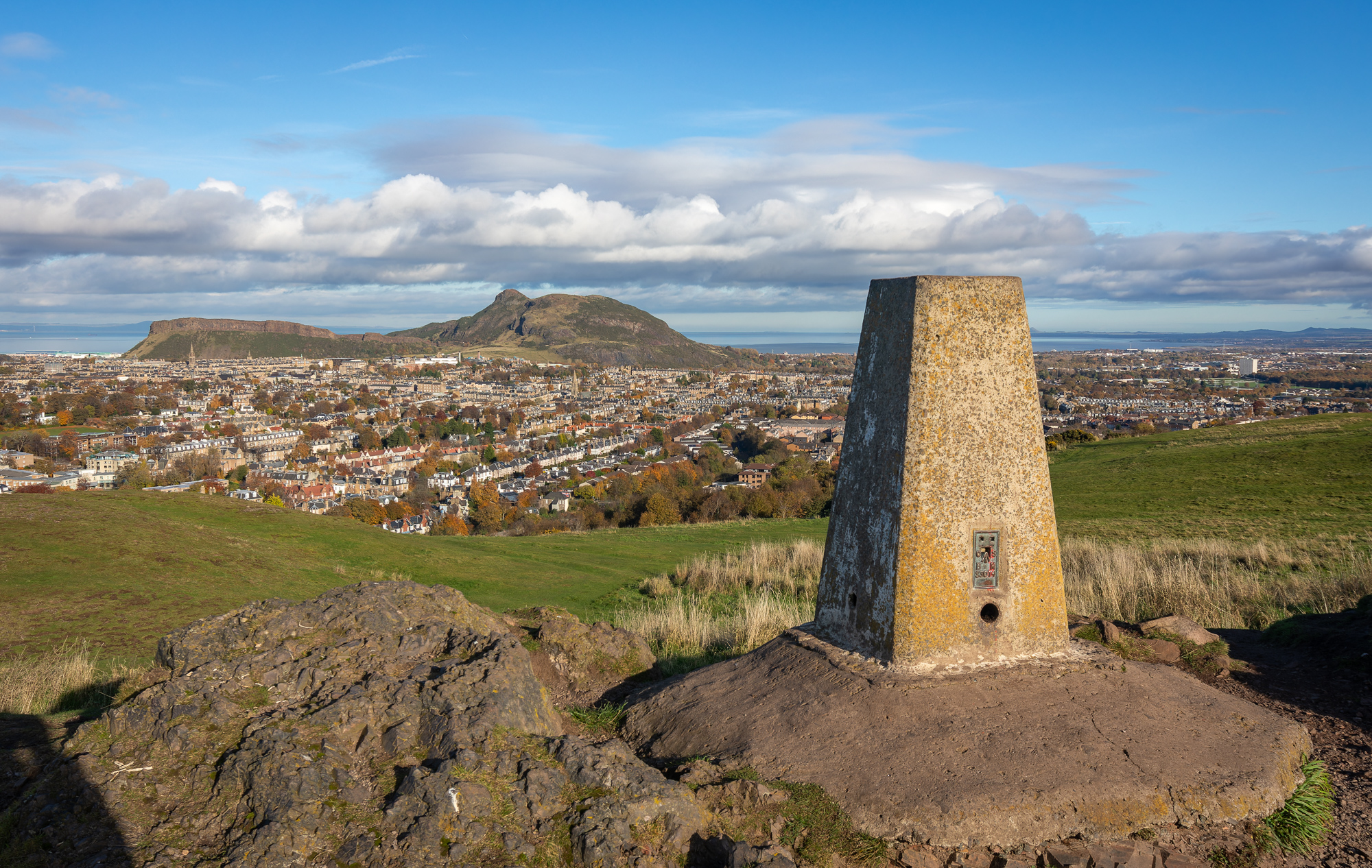
Despite its modest height, Blackford Hill is higher than the Castle rock, and offers unimpeded views to the Castle and beyond.
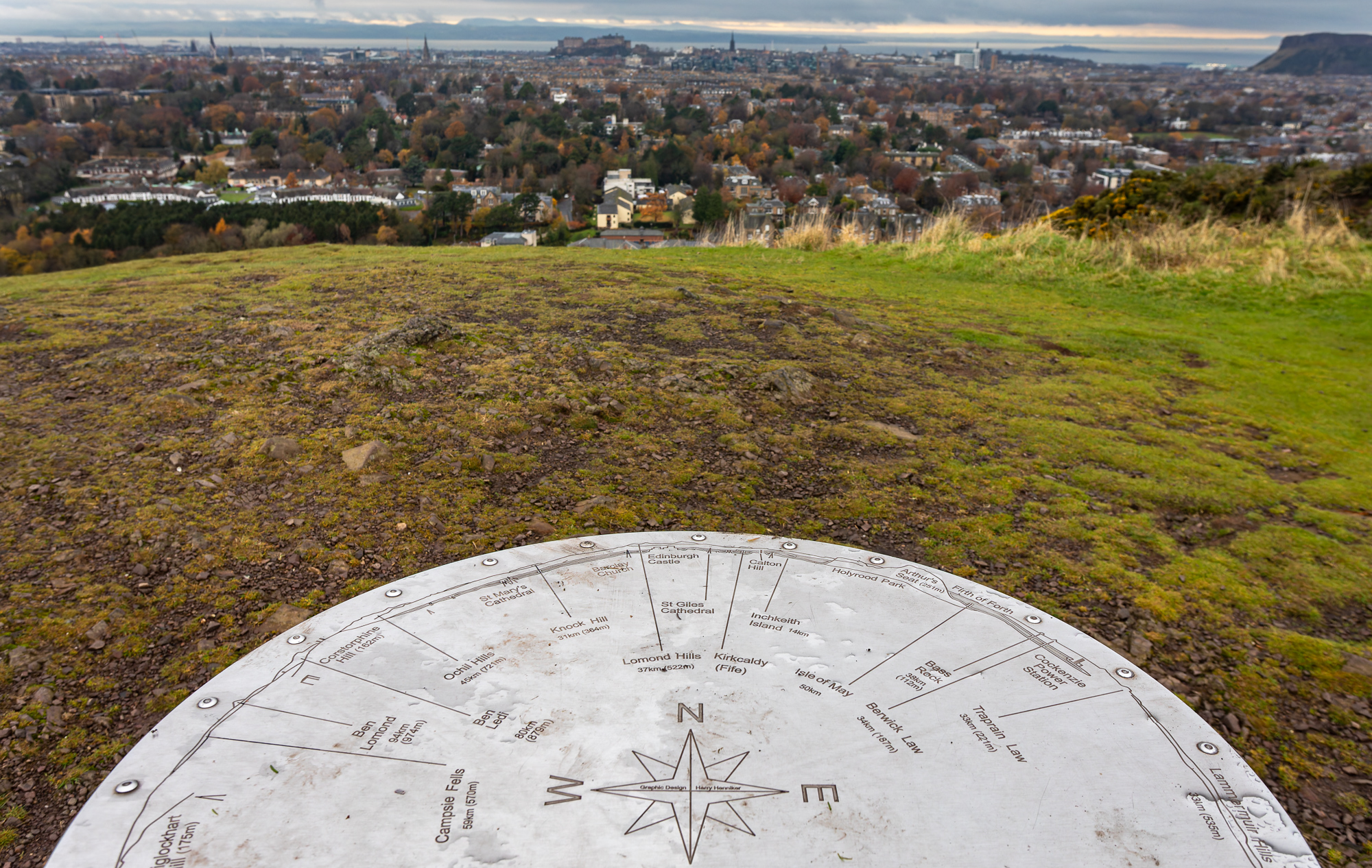
Direction marker provided by Friends of the Hermitage of Braid and Blackford Hill
Heading Back Down
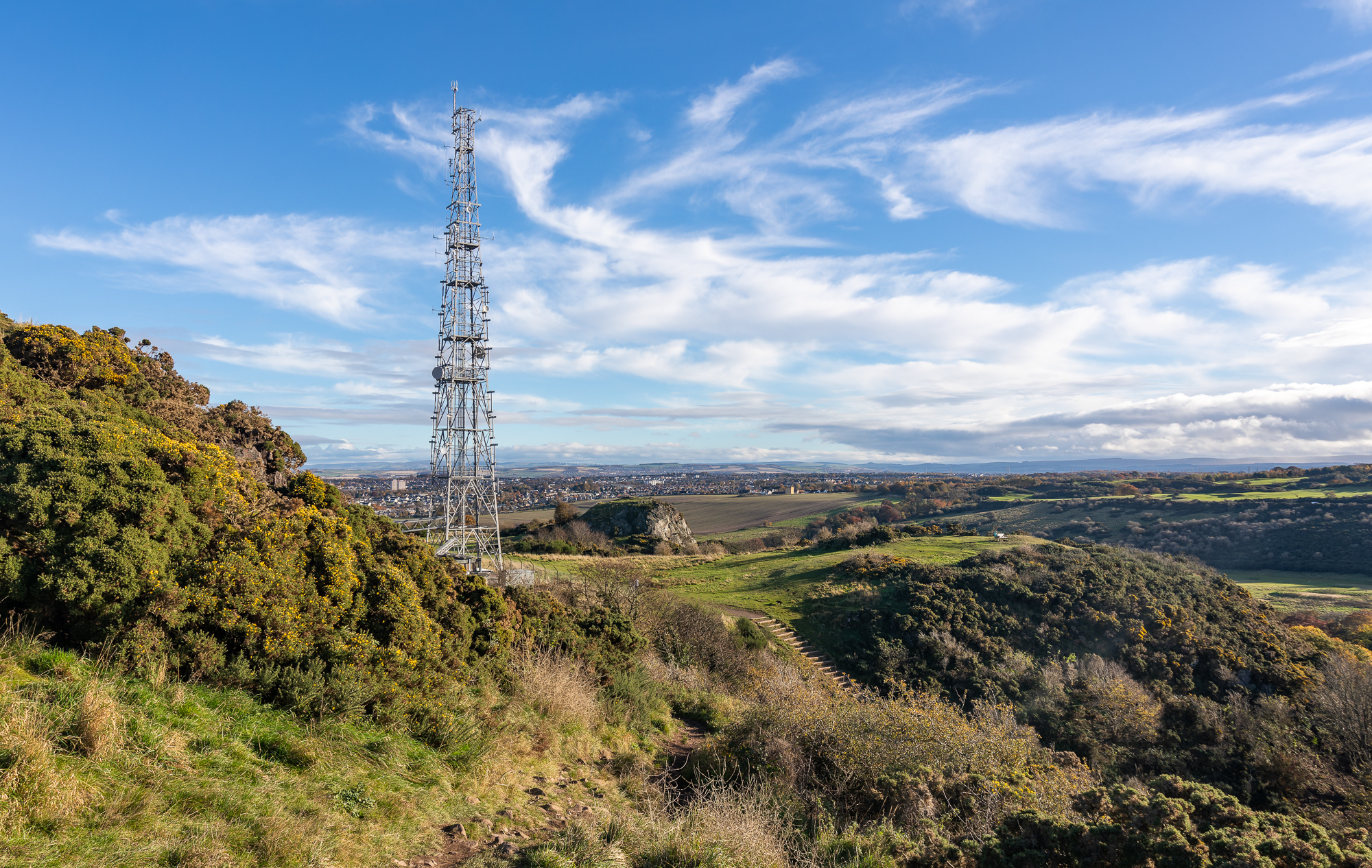
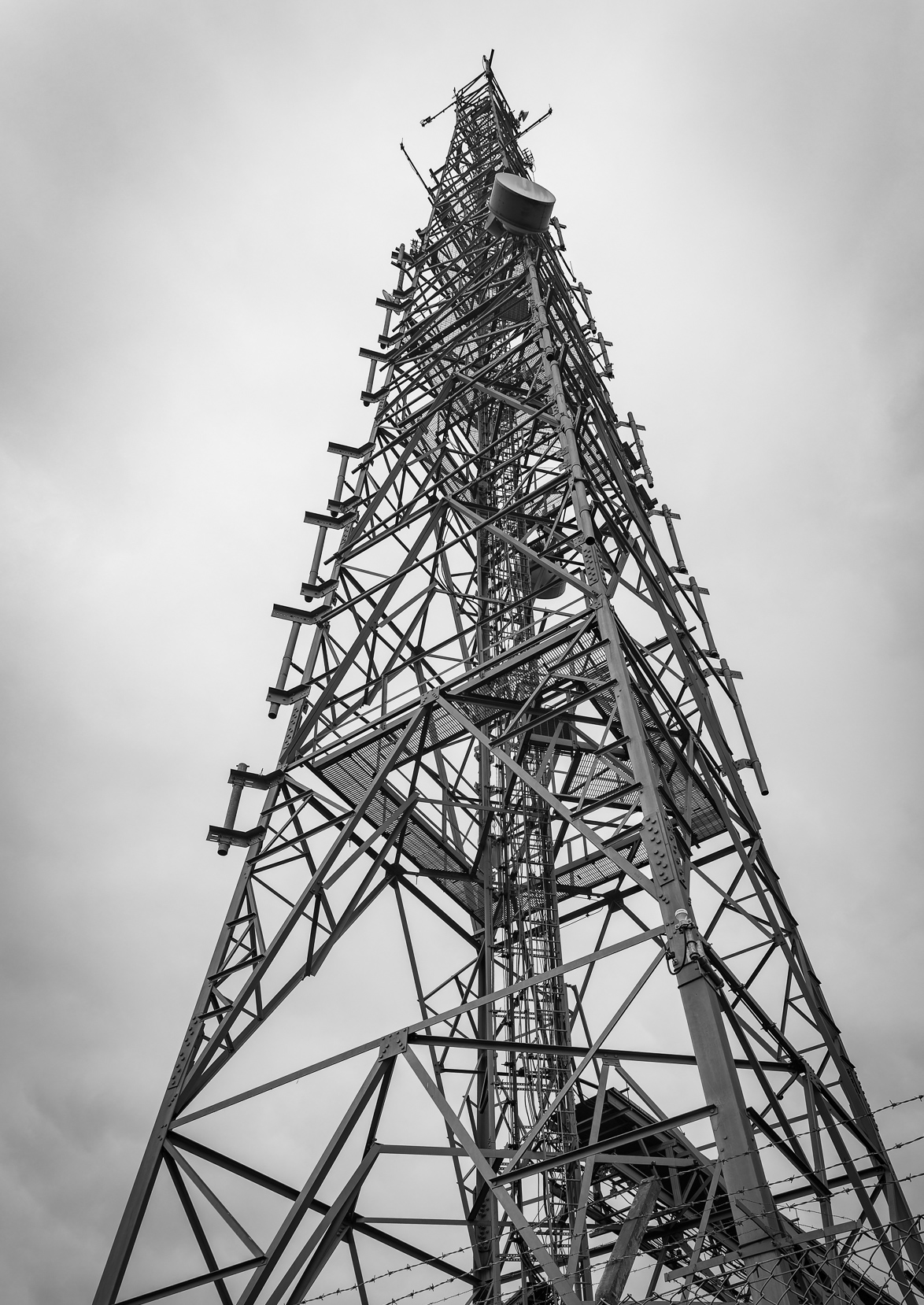
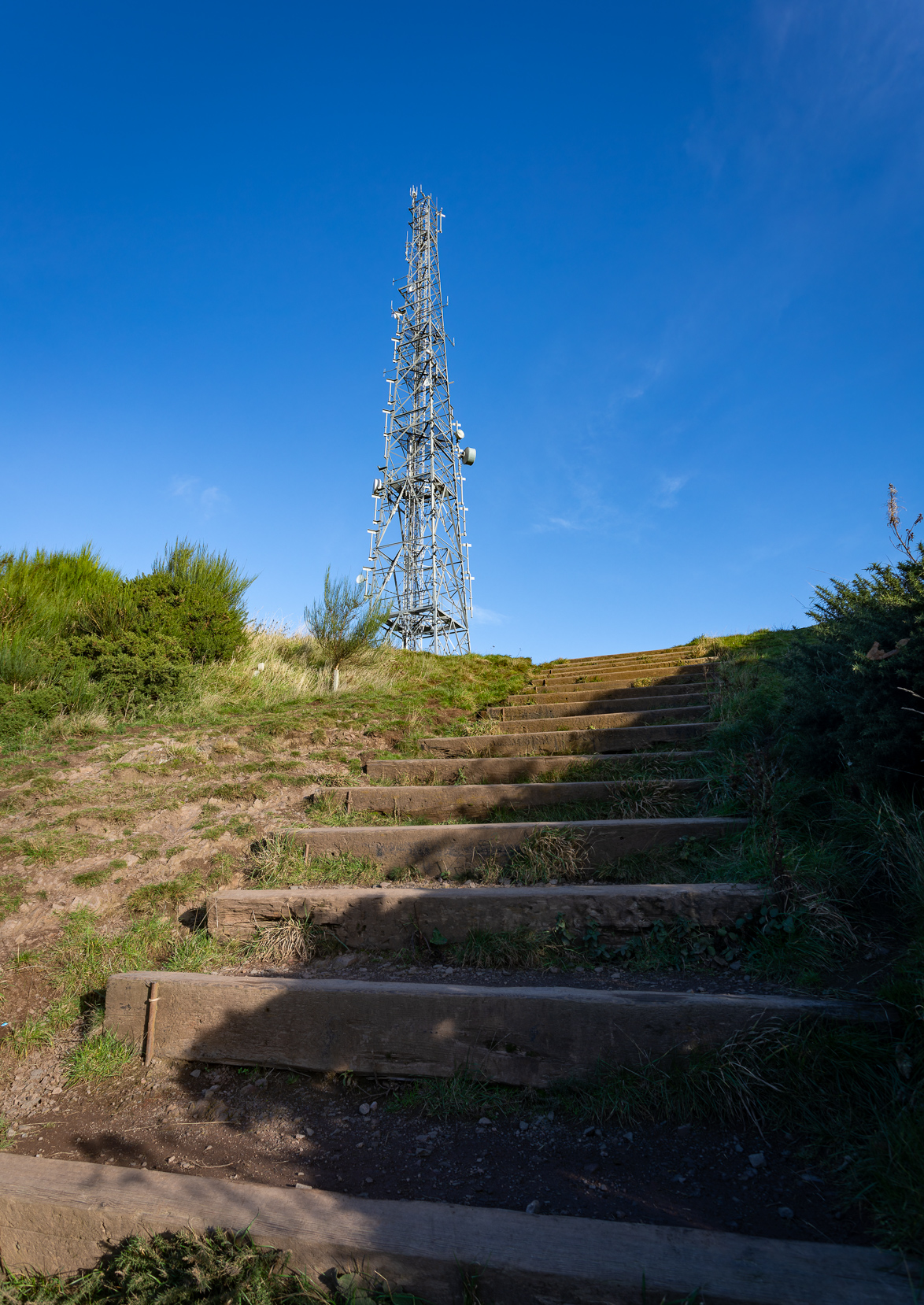
If you head back down the hill to the South, you’ll walk past the transmitter mast, likely used for mobile phone or police communications. I understand there have been several masts in the area, including television transmitters in the 1950s and 1960s. More importantly, why am I talking about transmitter masts? Moving on…
The structure does present a slight challenge, in that I don’t relish having to explain to the local constabulary why my drone has decided to join the dishes hanging from their mast. The mini drone doesn’t have obstacle sensors when flying sideways so I needed to have my wits about me. The photo also shows the wooden steps installed to limit erosion on the slope west of the summit. These steps are possibly the steepest I’ve encountered during a walk, so I was grateful for gravity’s assistance on the way down, even though it was tough on the old knees.
The Hermitage of Braid and Blackford Pond
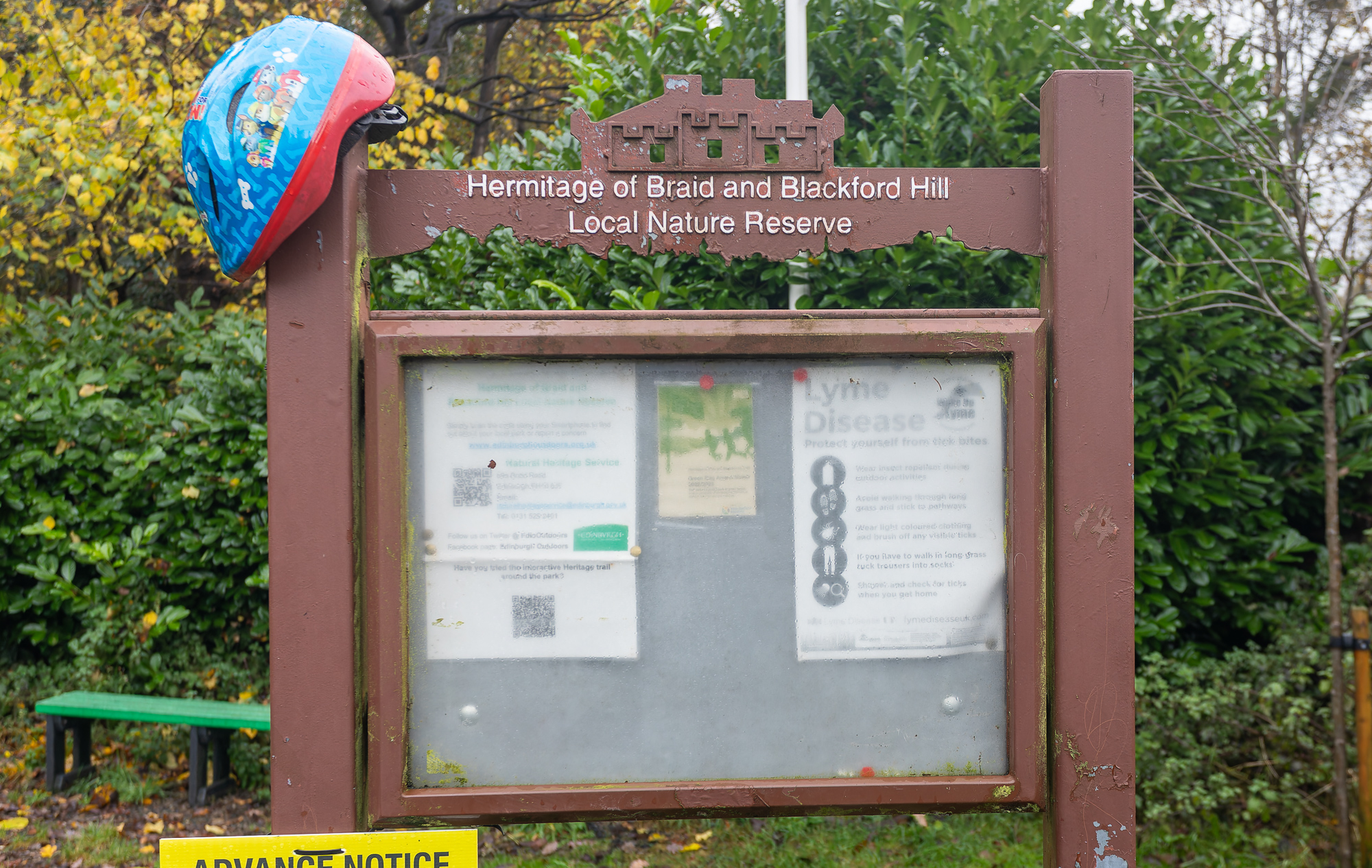
‘The Braids’ is an area between the Braid Hills and Blackford Hill, featuring pleasant, wooded walks along the Braid Burn. It’s part of Hermitage of Braid and Blackford Hill Local Nature Reserve, and area rich in diverse flora and fauna.
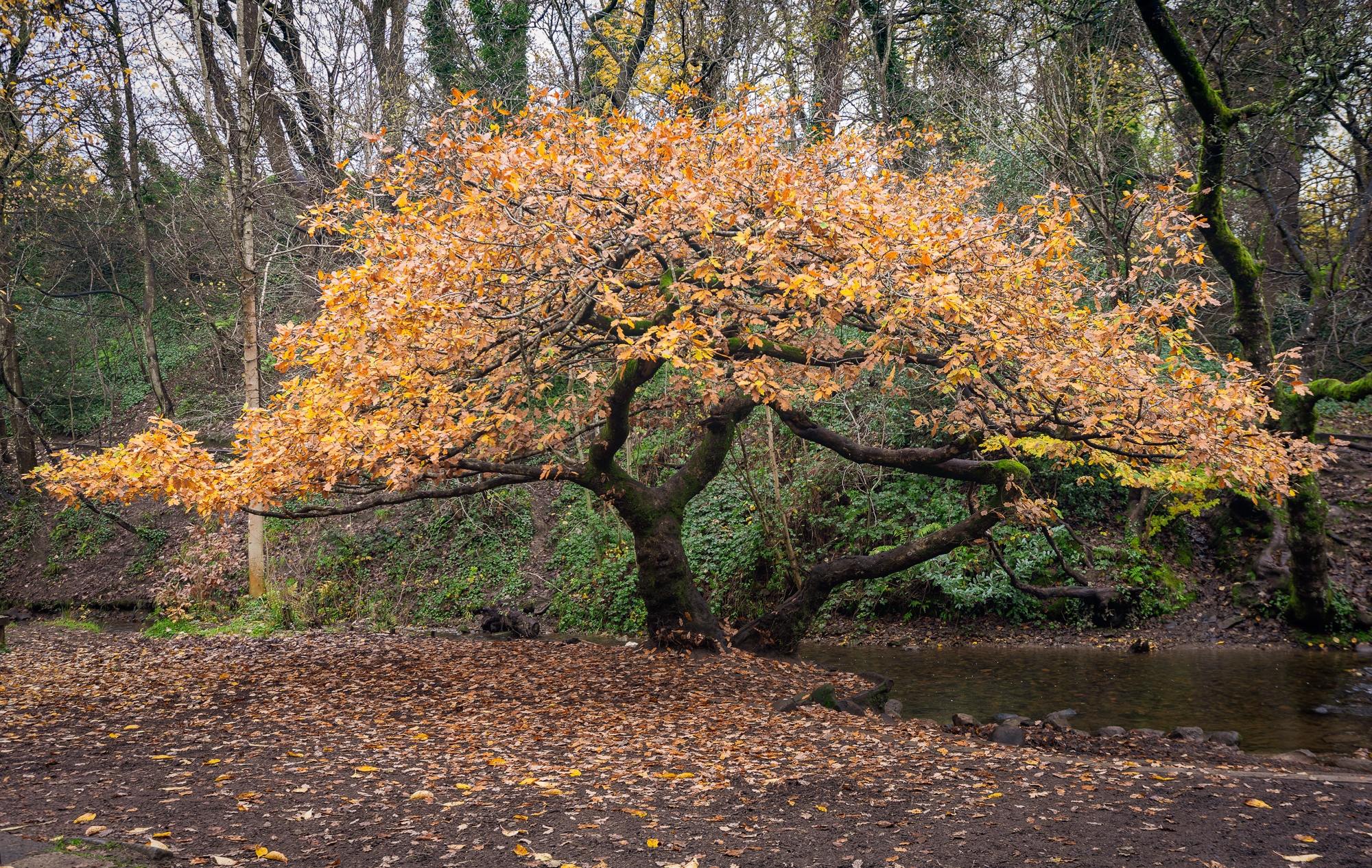
Tall trees block out light in places along the Hermitage of Braid walk, which makes for tricky photography. I took this photo at ISO 500 and f/5 to get a shutter speed of 1/60th of a second, which is fast enough to handhold but I really need to invest in a tripod!
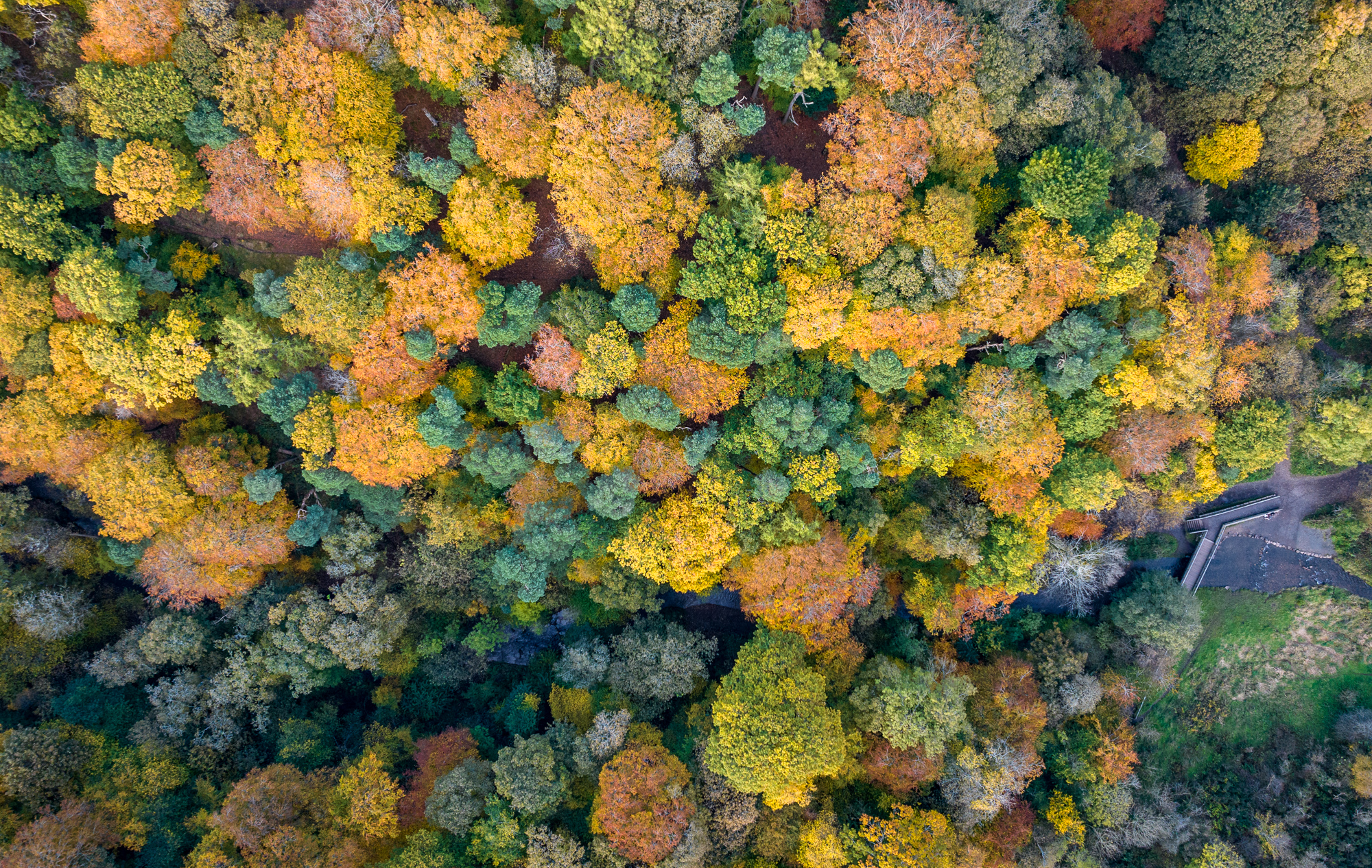
A community group called Friends of the Hermitage of Braid and Blackford Hill contribute to the conservation and maintenance of the area. Their website features a useful walking map. Although dated 2018, I don’t believe much has changed since then. I recommend the longer walk on a good day, as it takes in views across Edinburgh, and goes past the Observatory.
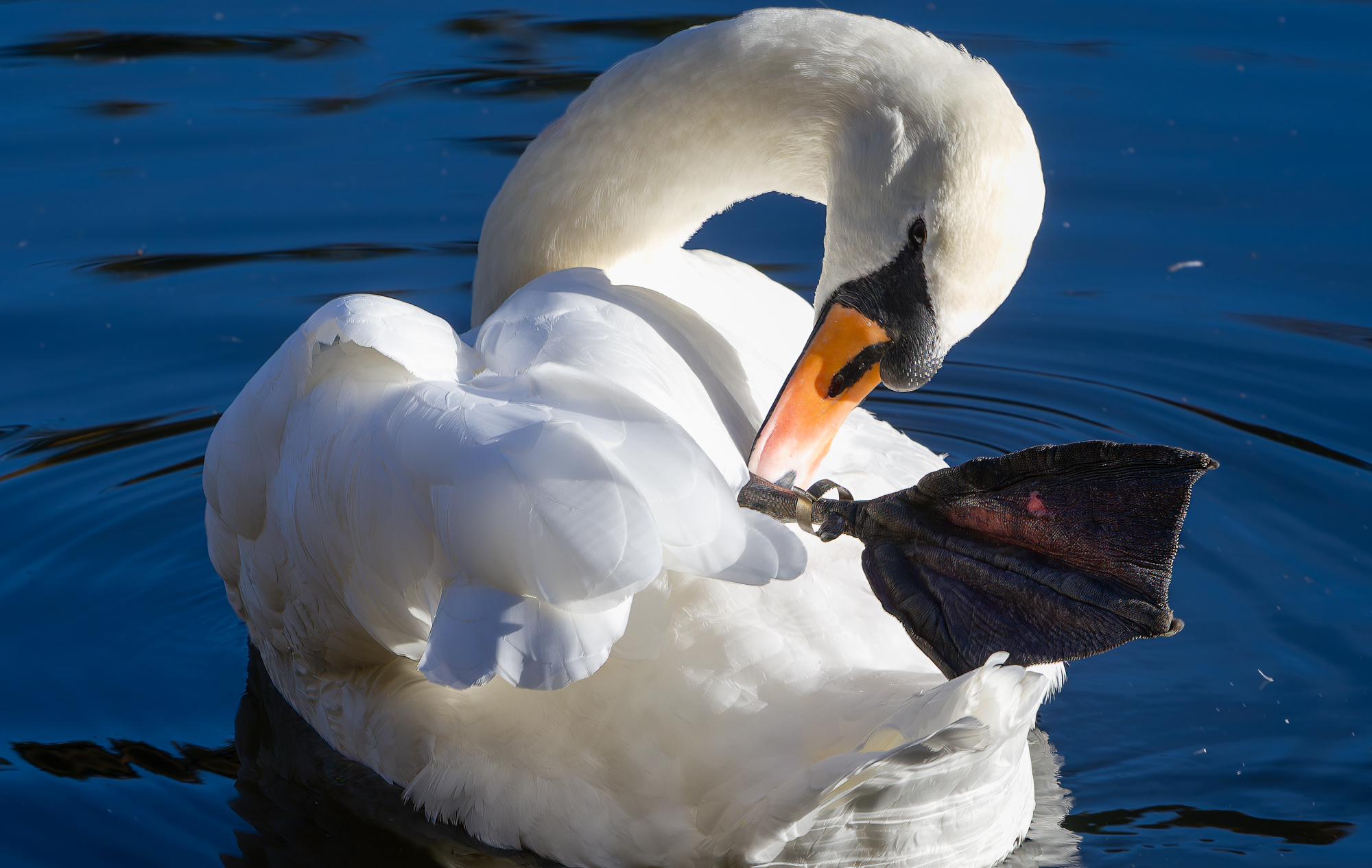
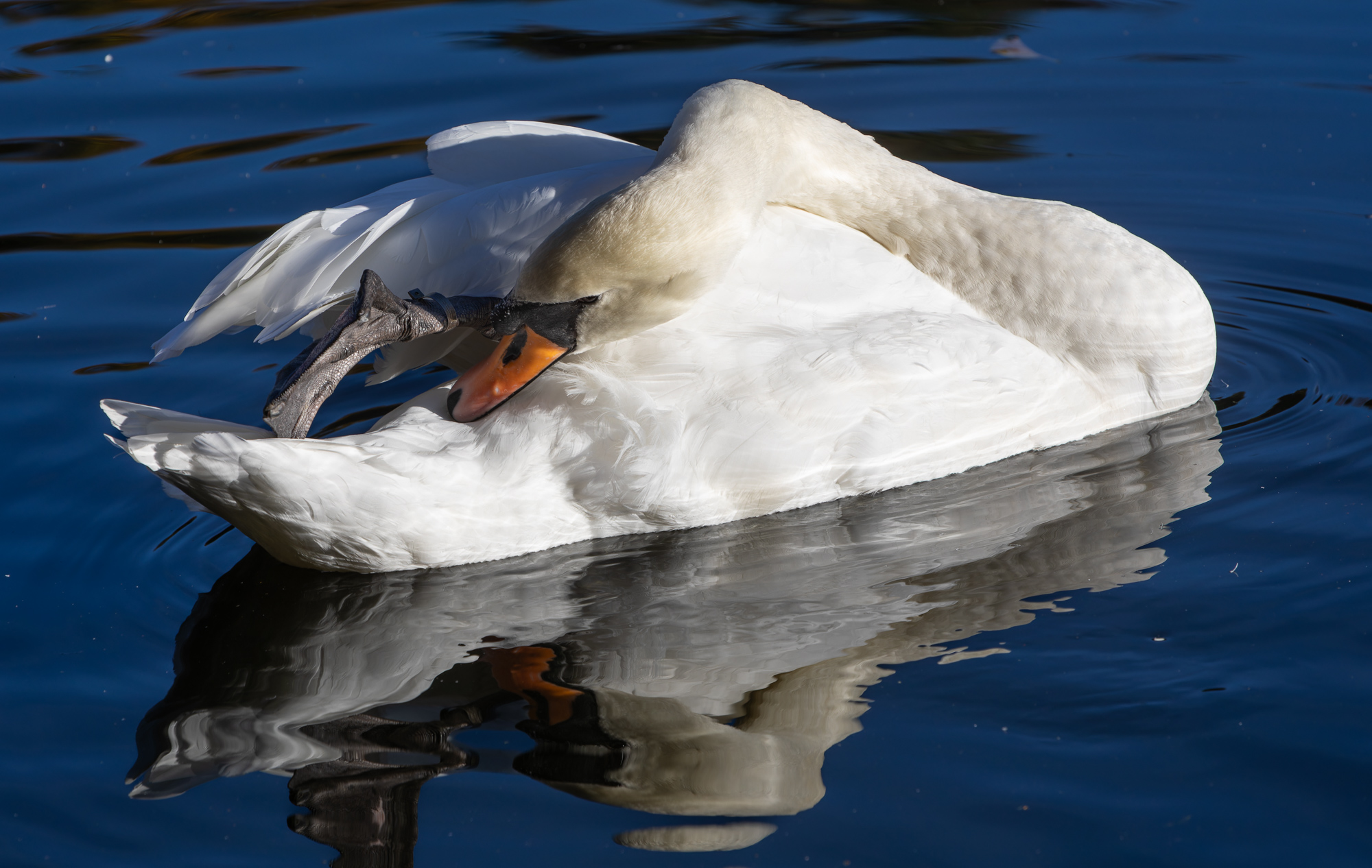
This swan was preening itself on Blackford Pond to the North of the Hill, and I just had to stop and get the camera out of the bag again. Swans are a challenge for photography, particularly with the high contrast between white feathers in bright sunlight, and darker surrounds. Consequently, it’s easy to end up with overblown highlights with no detail, such as the small area just under the neck. I’m pleased with the result, and despite the tricky lighting, the camera managed to capture good detail in the feathers. To achieve a more ‘intimate’ perspective, I cropped in closer than I usually would.
The Royal Observatory
The Royal Observatory Edinburgh (ROE) is located on Blackford Hill, My interest in the observatory stems not only from a long-held fascination with astronomy, but also a personal connection. My dad is now retired but as a precision engineer at Aviamac, he remembers making extremely tight tolerance components for the ROE. These components were for instruments that would be used in the observatories at Mauna Kea in Hawaii. He also remembers the astronomer Heather Couper’s visit to see the work in progress! Many years later my younger son enjoyed a school work placement at the ROE. It bolstered his interest in physics, which he’s now studying at university.
A Brief History of the ROE
The ROE traces its history to the early 19th century when it was originally located on Calton Hill. William Henry Playfair designed the observatory on Calton Hill, taking his inspiration from ancient Greek architecture. George IV conferred a Royal Charter on this observatory during his visit to Edinburgh in 1822. From that point on, it became known as The Royal Observatory.
By 1888, the Royal Observatory on Calton Hill faced challenges with substandard buildings, outdated instruments, and an inappropriate location. A Royal Commission recommended disestablishing the ROE and handing over the buildings and equipment to the University. However, the Earl of Crawford intervened, donating his well-equipped private observatory and impressive library to the nation. In return, the government committed to constructing and maintaining a new Royal Observatory on Blackford Hill.
The new facility opened in 1896 and was designed as both a public astronomy monument and a cutting-edge research centre.
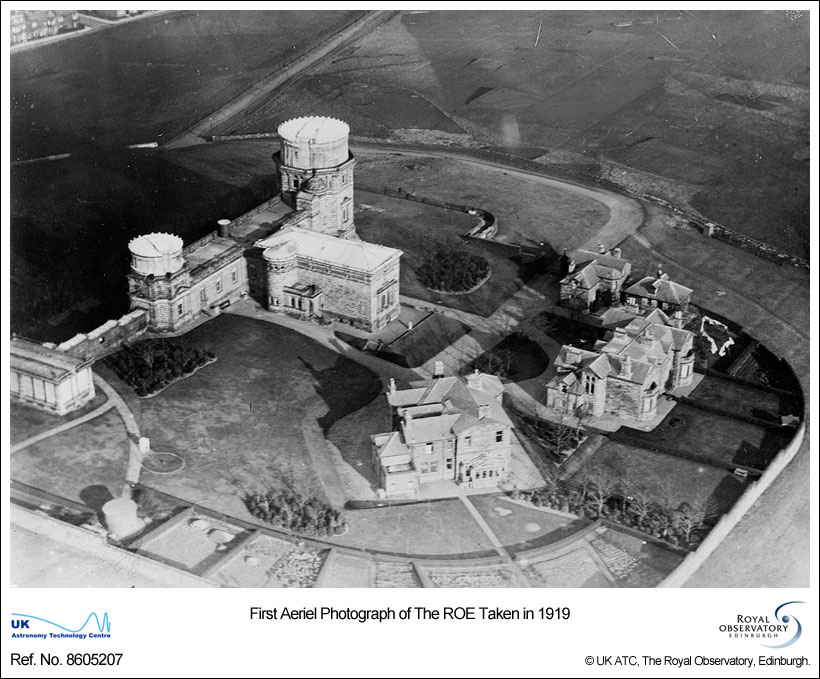
The picture above, from the ROE’s website, displays the arrangement of the original buildings in 1919. You can see the main building at the rear, home to the twin domes housing telescopes. Nearby, closer to the camera, is Copeland House, designed for the ROE’s directors. Adjacent are ‘The villas’, initially built as staff residences but now used as offices and labs.
The observatory holds The Crawford Collection, recognised as one of the most significant collections of astronomical books in the world.
The ROE expanded during the 1960s to 1980s, with the Brück Building, the South Building, and Mechanical Workshops. The most recent addition was in 2018 when The Higgs Centre for Innovation opened its doors. The Higgs Centre’s goal is to bridge the gap between cutting edge science and commerce.
The ROE Today
The ROE remains a significant centre for astronomical research and public engagement via its visitor centre. The Observatory is home to the UK Astronomy Technology Centre (UKATC), “a national centre of excellence for the development of scientific instrumentation and facilities for ground- and space-based astronomy.” My understanding is that the ROE is an umbrella name for the UKATC, the IfA (Institute for Astronomy) at Edinburgh University, and the Visitor Centre.
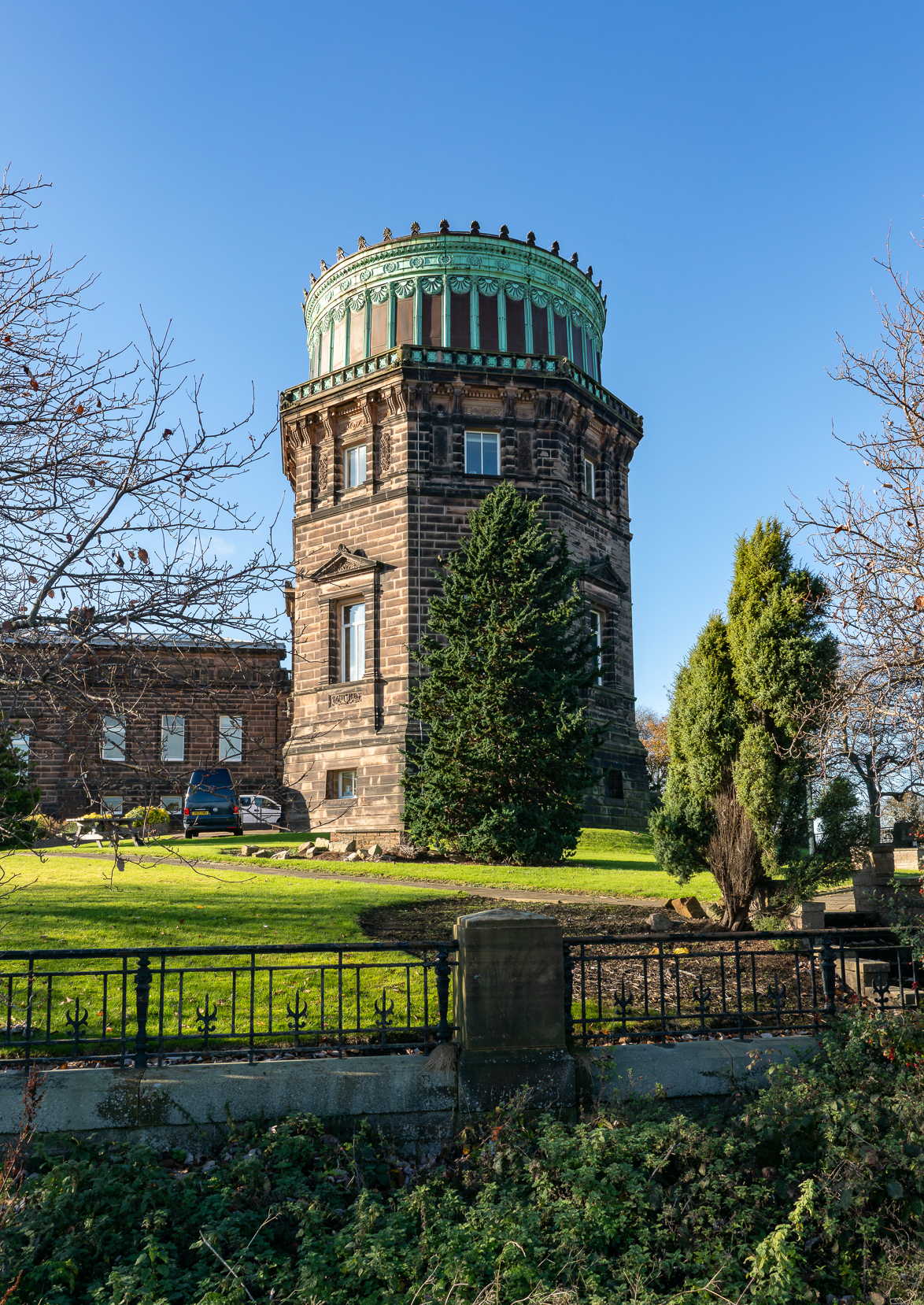
While I’ve attended night classes at the ROE, I haven’t had a chance to see the 36-inch Cassegrain reflector telescope ‘in the flesh’. The ROE had the instrument installed in 1930 in the East dome. The telescope is now part of the visitor centre exhibition but is no longer operational.
The West Dome once accommodated a 16/24-inch Schmidt camera installed in 1951. This equipment was moved to the National Museum of Scotland in 2010.
The sole operational telescope at the university now is a 20-inch reflector. The ROE had this instrument installed in 1967 within a hemispherical dome on top of the teaching laboratories. This device is primarily used for undergraduate teaching.
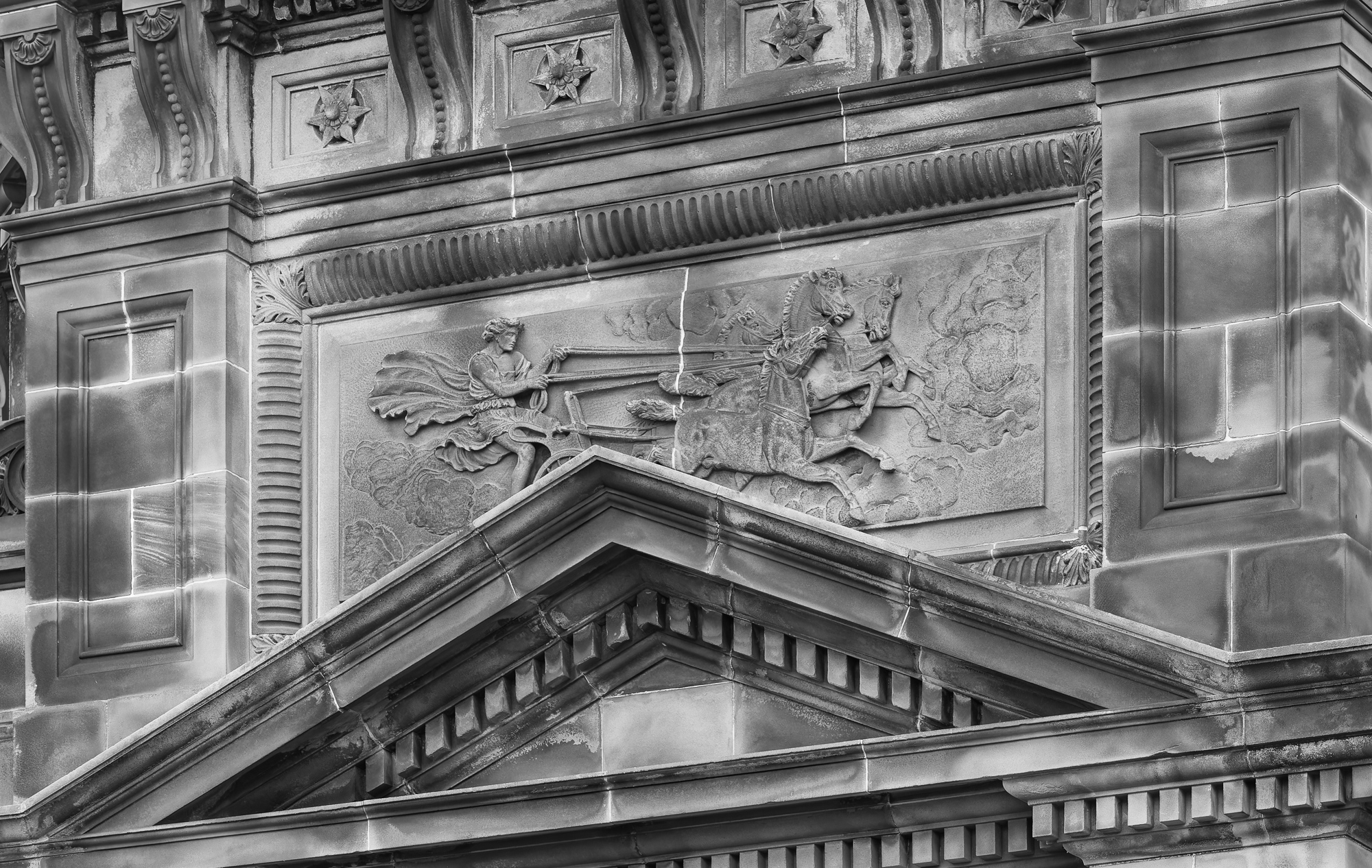
The exterior of the main building features decorations related to astronomy. As an example, the photo above shows the pediment (triangular bit) of a window on the smaller, western tower. Above this is a carving of the Sun god Phoebus with his chariot. This Greek god was responsible for bringing the sun to the earth each day. I converted the photo to monochrome, which shows up the variations in the stonework, as well as those alarming cracks running down the walls!
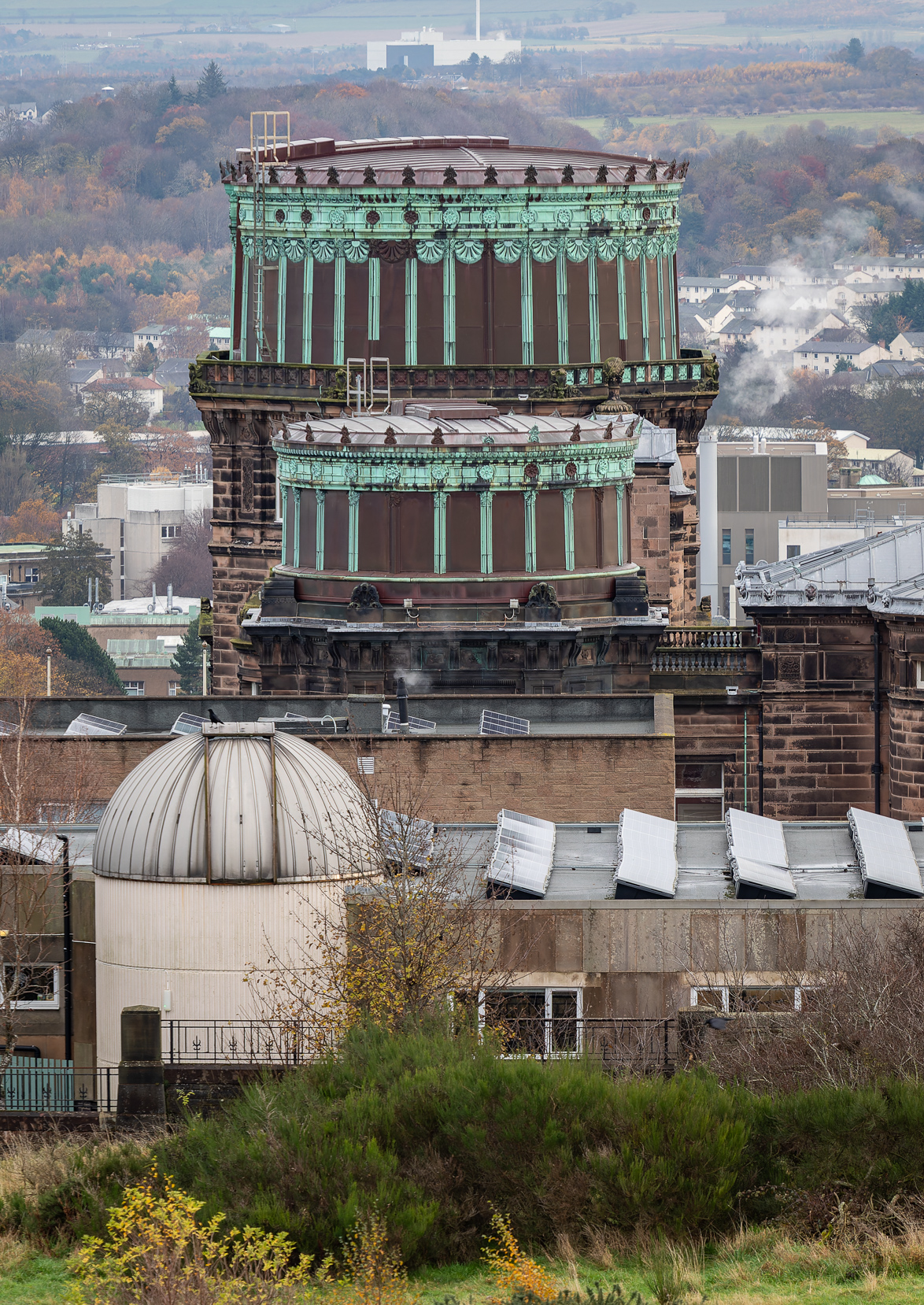
The photo above shows the two drum domes belonging to the 1894 building lined up with the smaller hemispherical dome of the teaching labs. I used a telephoto lens to compress the apparent distance between the domes. This creates the illusion that they are closer together than they are. A wide aperture f/5 helped to blur the distant background and make the observatory buildings stand out. You can see the layout of these domes in the photo below – C, B, and the small dome on building K.
This photo was captured from a video still taken by my Mini 3 Pro drone. I’ve overlaid it with letters which relate to the key below the photo. Skip past this section if you’re not interested in specific buildings and their purpose!
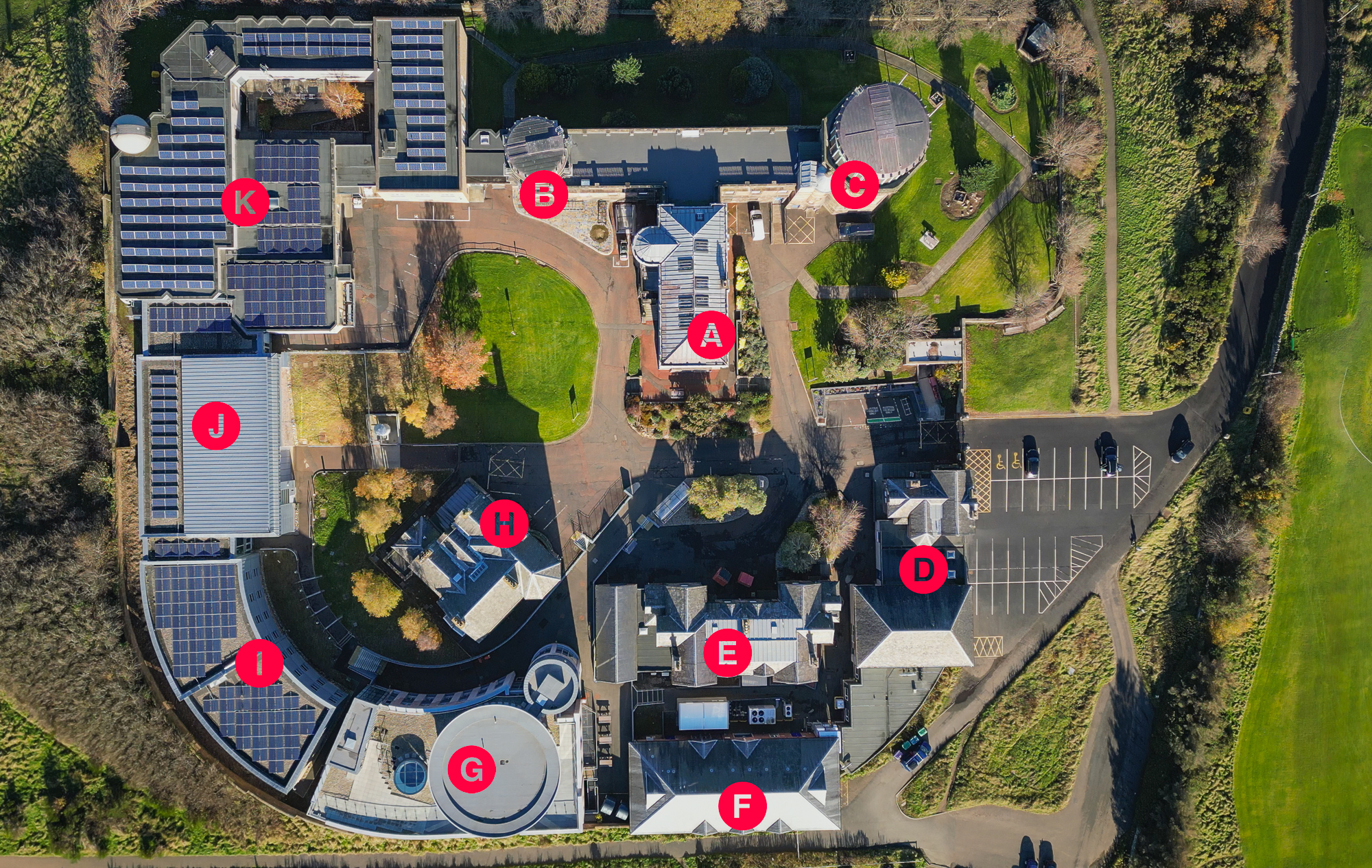
| A | Main Building – Library and Visitor Centre | G | Higgs Centre for Innovation |
| B | West Tower and drum dome (6.7 metres in diameter) | H | Copeland House (Director’s residence) |
| C | East Tower and drum dome (11.6 metres in diameter) | I | Crawford Offices |
| D | Mechanical Workshops and The Lodge (Reception Area) | J | Crawford Labs |
| E | The Villas | K | Brück Building – Labs and Lecture Theatres |
| F | South Building – Labs and Canteen |
Pano and Video

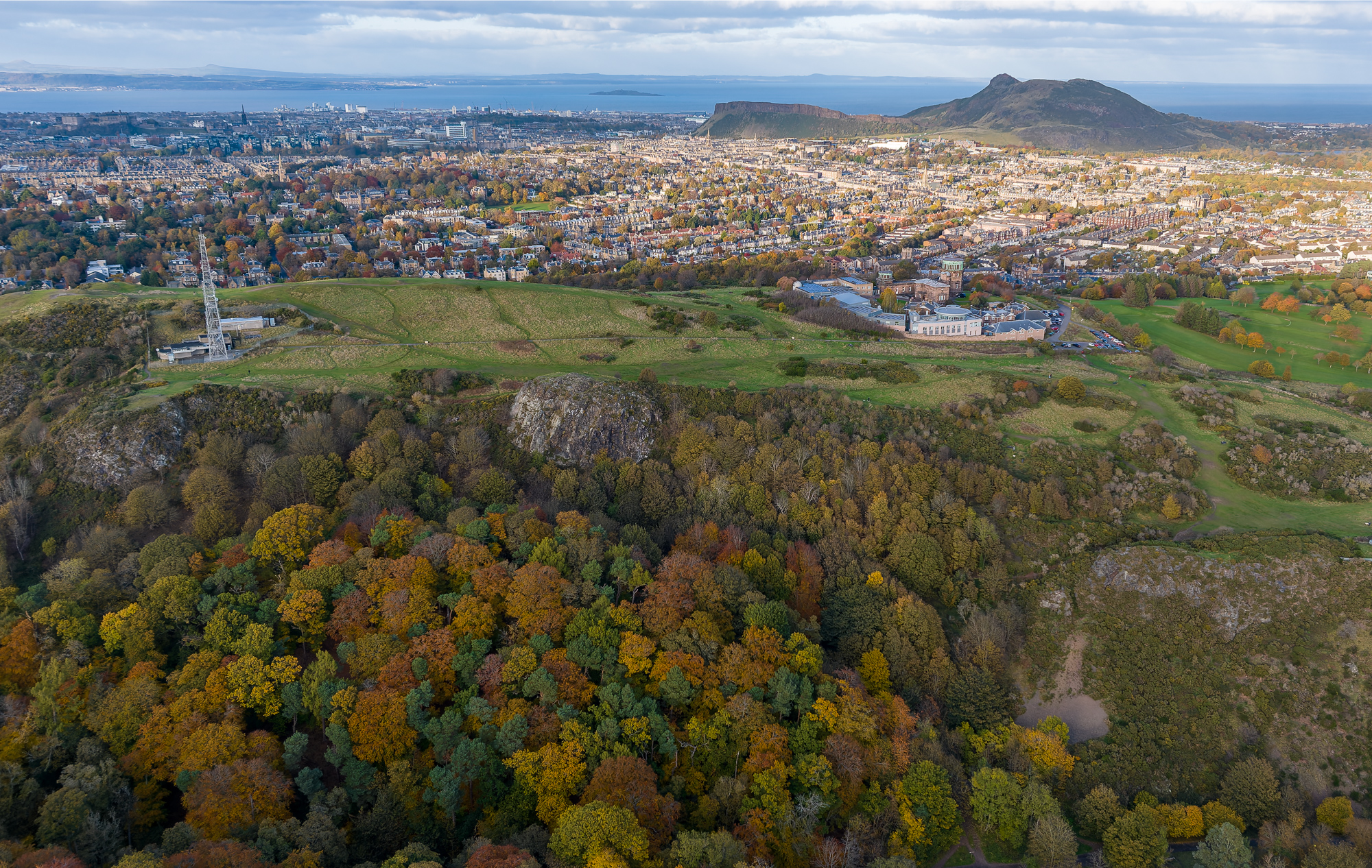
I used the Mavic 3 Pro drone to capture this photo in the late afternoon. The sun was low in the sky, creating long shadows a soft golden glow, ideal for photography.
Using the Mavic 3 Pro drone during the late afternoon, long shadows and a soft golden glow created an ideal setting for photography.
Use the Control Bar at the top left of the photo to change to full screen.
In the 30-40 minutes I spent there, the light kept changing, making it challenging to get consistent results between photos. I like the light cast over the Observatory and Craigmillar Park golf course to its right. The drone did a good job of ‘stitching’ the individual photos together, requiring minimal manual correction in Photoshop.
I created a short video taken over a few days at different times. This resulted in varying light conditions across the clips. I hope you enjoy it, and you can either watch below, or click the link to take you to YouTube.
Gallery
Some additional photos taken on my visits to Blackford Hill.