
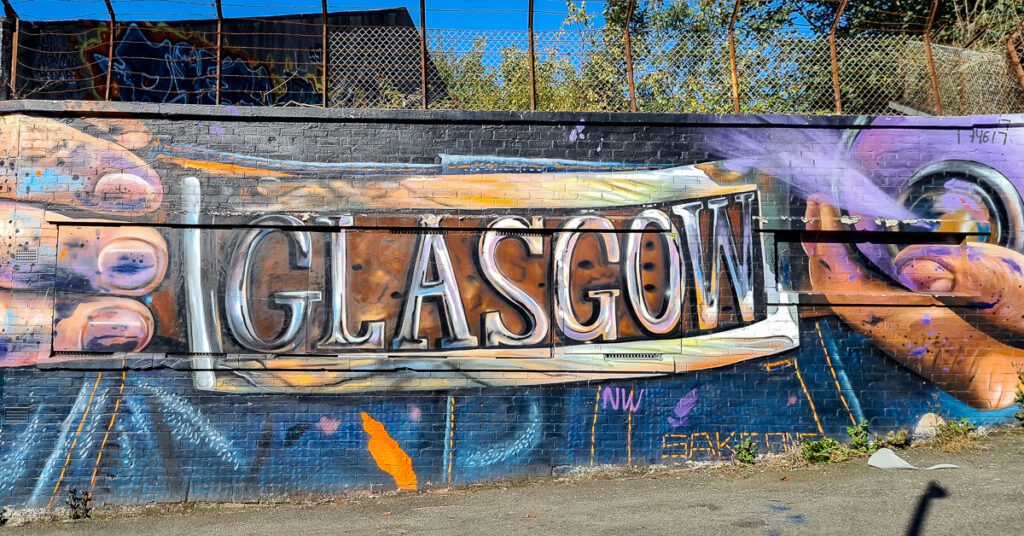
One of the things I appreciate about Glasgow’s murals and street art, aside from their accessibility, is their transient nature. Some of the art admittedly is mediocre, some of it is good, and a lot of it is outstanding. Emotionally, I think the better artworks probably deserve to be preserved, but then that goes against the whole ethos of street art. When one painting disappears, it’s soon replaced by something fresh and new.
Part and parcel of street art is that these things are transient, and they’re not meant to last forever, that’s what makes it special.
Peter Sheridan, Glasgow born street artist

This is one of Peter’s murals, created a few years ago on the side of a building near SWG3 in Finnieston. I love its ‘weirdness’, and its sense of humour. When I took that photo, it was a bright sunny day and its garish colours were still vibrant and fresh. The mural might still be there, but equally the building may have been demolished, or the artwork painted over with another, or it may have faded.

This building in Wilson Street, Candleriggs serves as a good example of the impermanence of murals. I captured the initial photo in 2020 when the building still featured a mural created for the 2014 Commonwealth Games. Subsequently, this artwork was replaced by “Bow Down, Honour the Roots.” Interestingly, you can still see the remains of the previous mural at the top, where the shuttlecock blends into the feathers of the headdress.
Glasgow boasts one of the most vibrant street art scenes in the country. Notably, murals are rejuvenating streets, buildings, and vacant sites that might appear a bit tired, effectively transforming them into captivating pieces of public art. Furthermore, these artworks serve as a magnet for visitors to the city. The city council’s mural fund has also played a role in fuelling the swift rise in the number of murals. Additionally, there’s an official Mural Trail; however, it doesn’t consistently feature the latest murals and tends to focus on the city centre.
Numerous others have already covered the subject matter in my posts. Still, I aim to kindle the interest of some readers by offering a slightly different perspective on the larger murals through the inclusion of a few drone images. You can use these posts as a foundation for exploring the murals in person, which may take anywhere from half a day to a full day, depending on how far outside the city centre you venture, and the number of murals you wish to view. For your convenience, there’s also a helpful map available on the official mural trail site, making it an excellent starting point for your mural adventure.
Strathclyde University

A good starting point is George Street, at Strathclyde University, where various artists, including Art Pistol, Rogue-One, and Ejek, have painted a number of interesting murals. The murals celebrate the people of the University of Strathclyde and their achievements. The drone shot above offers a slightly more elevated view of the side of one of the buildings than is usually seen. It’s based on an old photograph showing the Land-Ship, a mock up navigation bridge on the roof of the School of Navigation in the Royal College (now part of the University of Strathclyde). Instructors used the Land-Ship, a revolving platform with a Kelvin compass mounted on top, to teach students the principles of compass adjustment.

Covering the west gable of the Graham Hills building, this mural is also based on a monochrome photograph taken of a lecture in the Royal College during the 1920s. The artist has ‘updated’ the photo to include present day students, in colour, which I think is an ingenious touch. The boy in the blue top looks a bit like my younger son, who happens to be studying at Strathclyde University! I also like the student (complete with shadow) about to enter the door, painted onto the wall at street level.
From the University, walk West along George Street to see the artwork created as part of Glasgow’s preparations for hosting the 2023 UCI Cycling World Championships. This artwork is less interesting compared to the mural awaiting you in the opposite direction, toward the High Street, which we’ll explore in the next section.
St. Enoch and Child

This is a mural by street artist Sam Bates, who goes by the name SMUG. The artwork depicts St. Enoch, also known as St. Thenue. She’s seen holding her son, St. Mungo, who is featured in the mural on the opposite gable end of the same building, on the High Street. Sadly St. Enoch seems to be weathering worse than most, with the paint fading and parts of the wall decaying.
Saint Mungo

Continue along to the end of George Street and turn left up the High Street where you’ll see another mural by SMUG. This is one of my favourites, and I’ve posted about this depiction of St. Mungo previously. The robin, also featured in the previous mural, symbolises one of the miracles said to have been performed by St. Mungo.
Fellow Glasgow Residents
From the High Street, head South to Ingram Street. There’s a car park that looks like any other over-priced city centre facility, except this one has an enormous mural adorning a gable end wall facing onto the parking spaces. The painting features some of the wildlife living in the city parks, and is another amazing photorealistic work by SMUG.

A kilt-wearing hiker picks a mushroom, viewed through a hole that’s been knocked through the wall, like a portal leading from the drab car park to a leafy forest trail. It’s early Autumn I’m guessing, as some of the leaves still haven’t completely turned gold/brown.

I kept some of the cars in shot here to provide a sense of scale to this astonishing mural.

SMUG has captured delicate bees’ wings and dandelions convincingly.

I’ve always liked this squirrel, inquisitively staring through the wall at the humans beyond.

This drone shot provides an unusual perspective, looking down at the creatures. I love SMUG’s detail, look at the shadows the berries make on the wall, and the berries that have fallen on the ground, attracting the attention of the blue tit.
Falling Couple
From Ingram Street, make your way down Candleriggs towards the junction between Wilson Street and Bell Street. Looking up Wilson Street you’ll see the Bow Down, Honour the Roots mural, not one of my favourites but you may see something in it I don’t. According to the official mural trail, it “embodies an emotive statement of ‘power sovereignty’ and stands as a monument to the self-representation of diverse communities who have been misrepresented and marginalised around the world.” I’m none the wiser.
Turn around and you’ll see, painted high up on the side of a block of flats, a small mural showing a couple embracing as they fall through the air.

The Rebel Bear painted this mural, a Glasgow street artist of unknown identity, and sometimes referred to as The Scottish Banksy. There is a Banksy-like feeling about his work. Sadly, he doesn’t seem to be as active as he was during the Covid pandemic. Check out his Fear and Love piece, which became famous during this period.
The Big Yin
Now head East along Bell Street towards Gallowgate. Near Barrowland Park you’ll see a gable end with a garish pink background. This digital print of Billy Connolly depicts him in a specially created outfit, created by artist Rachel Maclean.

The mural depicts Billy in an outfit featuring motifs from the high points in his career. It includes symbols of past and present Glasgow life in the background.
Studies of a Woman in Black
Walk through Barrowland Park toward St. Andrew Street. There are two murals in close proximity featuring anonymous women wearing black clothing. James Klinge, formerly known as Klingatron, has created very detailed and realistic portraits from stencils. The women look incredibly lifelike in both murals.

Walk from here to nearby Bridgegate to see the second in the series.

Walk along Bridgegate and turn up King Street, toward Osborn Street. Turn left at the top, and you’ll shortly come across Billy Connolly’s second mural at the junction with Stockwell Street. This is my favourite of the three Connolly murals.
Billy Connolly 75BC
Rogue One created the next mural, and is based on a portrait of Connolly at the grand old age of 75. It’s based on a painting by The Big Yin’s friend – artist and writer John Byrne.

The mural is quite distinctive and easily spotted, even from the distance shown in the photo above. Billy’s mural is in the centre of the photo, the St. Enoch Centre is on the left.

The inscription around the outside reads:
Fling a chucky in the watter see the baggy minnies scatter
which means something like:
Throw a pebble into the stream and watch the little fish disperse
I believe it’s a reference to a song Connolly used to sing before he became famous. Unfortunately, I haven’t been able to find much more information about this.
At time of writing, the mural is in danger of disappearing forever. Many are protesting against developers planning to turn the site into student accommodation. The city council for their part contest that the murals around the city were only ever meant to be temporary.
Thomas Muir
Now head through the narrow path called Old Wynd, which leads to the Thomas Muir mural in a car park. Muir (1765-1799) was born in Glasgow, was an advocate, and a leading proponent of democratic reform.

Muir wore a dressing to cover his right eye socket after it had been smashed by shrapnel during a battle. His life reads like a Robert Louis Stevenson novel, and is worth investigating. The mural by Rogue One and Art Pistol Projects is a tribute to the ideals of freedom, democracy and universal suffrage.
This wraps up Part One of my mural photo post. Below, you’ll find a gallery featuring some additional photos not shown above. I hope you enjoy exploring these images as much as I did when I visited these amazing artworks


