I’ve always been fascinated by Bass Rock, a 320‑million‑year‑old volcanic plug of hard phonolite that rises abruptly from the sea only a few miles off the East Lothian coast. As a child, I remember my Dad taking us along the winding coast road through Port Seton, Longniddry, Aberlady and Gullane, sometimes all the way to North Berwick. There, the Rock stood on the horizon as it does now – unmoved, unchanged, a fixed point in a world that never stops shifting around it. I’ve changed. My family has changed. People I once stood beside on those shores are gone. Yet the Rock remains, holding its place on the horizon like a memory that refuses to fade, a reminder of the constancy I once took for granted.
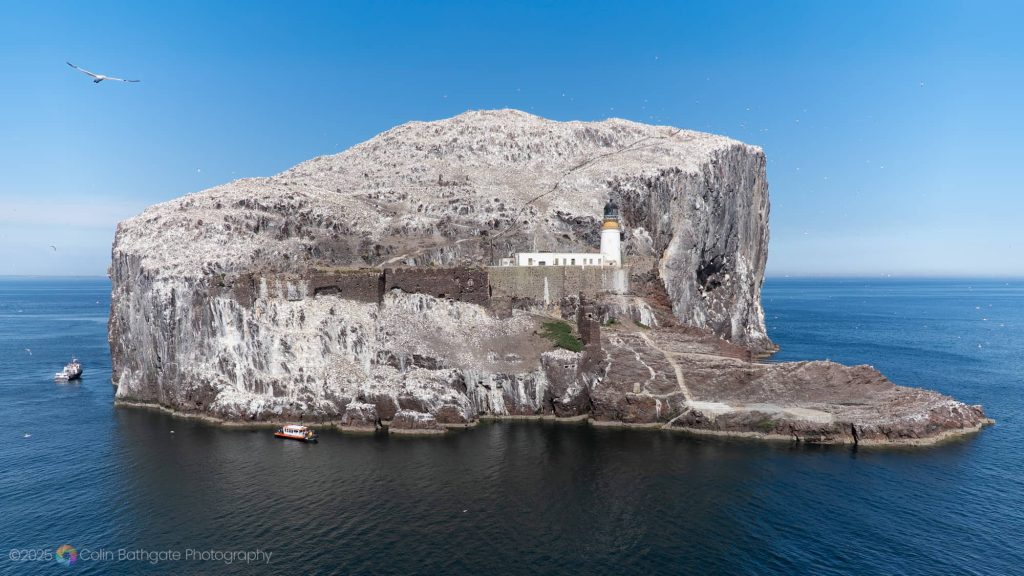
As my interest in wildlife photography deepened, so too had my desire to experience the island and its seabirds at close quarters. Eventually that pull became impossible to ignore, and I booked myself onto a photographic trip to the Rock. It was a chance not only to capture one of Britain’s most spectacular seabird colonies, but to spend a few hours immersed in the world of the northern gannet.
First Light
At 5.20am I lifted my heavy camera backpack onto my shoulders – already starting to regret packing two camera bodies, multiple lenses and a tripod – and began the short walk from the car park down to North Berwick’s small but picturesque harbour. The streets were almost completely deserted, the air cool and still, and as I passed the Scottish Seabird Centre I caught my first view of the Bass Rock in the distance.
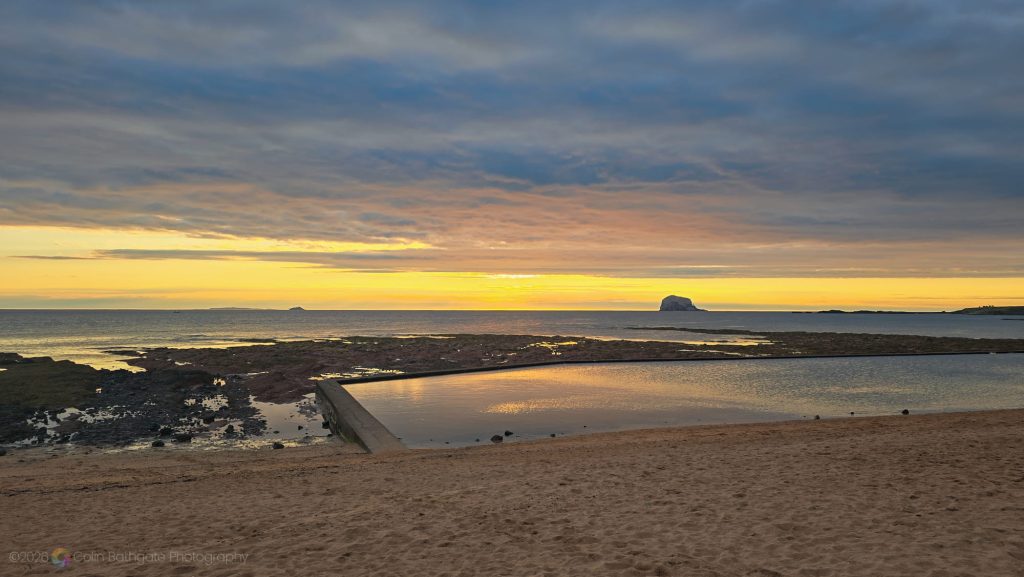
The sky had been spectacular on the hour‑long drive from Edinburgh, but now it had shifted again, forming a band of yellow‑gold on the horizon as the sun rose. I stopped to take a quick photo on my phone before continuing to the harbour office.
Time to Set Off
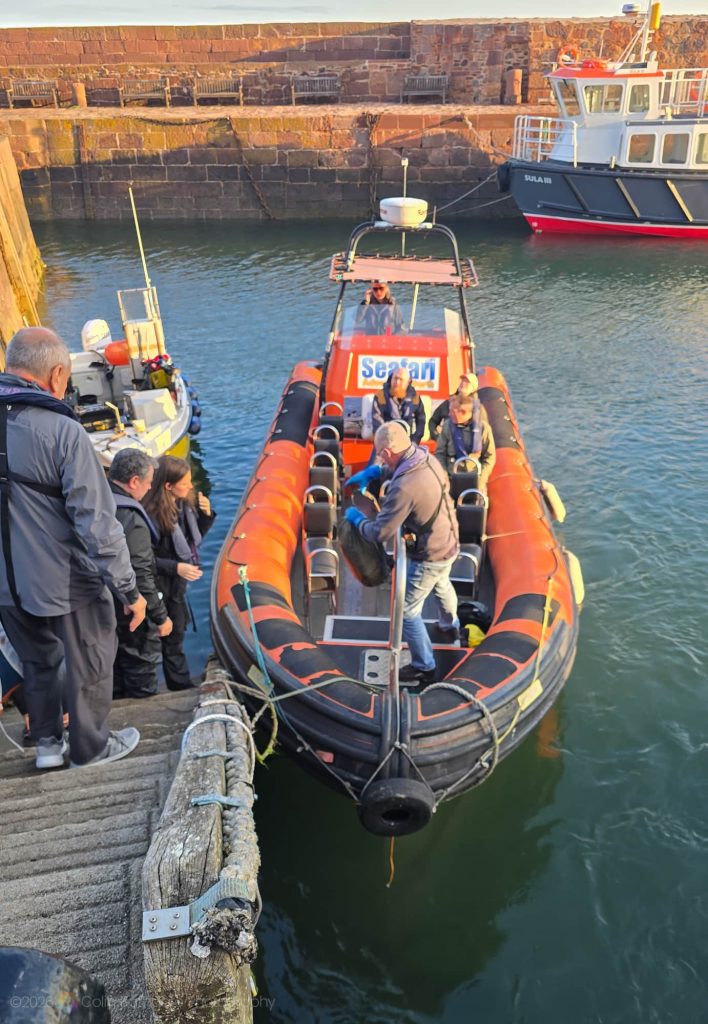
The group gathering for the trip came from all over, and included an Italian couple, a woman who’s travelled from Glasgow, a man from Edinburgh, and a woman from Belgium who was heading to the Orkneys the following day to photograph wildlife. After a brief safety talk, the donning of life jackets, and a final visit to answer nature’s call (there are no facilities on the Rock itself), our expert guides led us to the boat – a fast RIB that would take us to our destination in around fifteen minutes.
A Rock with a Name and History
The origin of the name Bass is uncertain, but it’s been suggested that it could come from the Old Norse bassi, meaning “bear” or “big animal”. Long before it became synonymous with one of the world’s largest colonies of northern gannets, Bass Rock was already a significant landmark for those travelling the Forth.
As I approached the Rock, I suddenly felt dwarfed by its scale. The boat is pushed hard against the stone steps with its engines, the only way to land here since there’s nowhere to moor. We then had to jump off the boat in turn, onto slippery stone steps with the help of the guides, who extend an arm out to steady you.
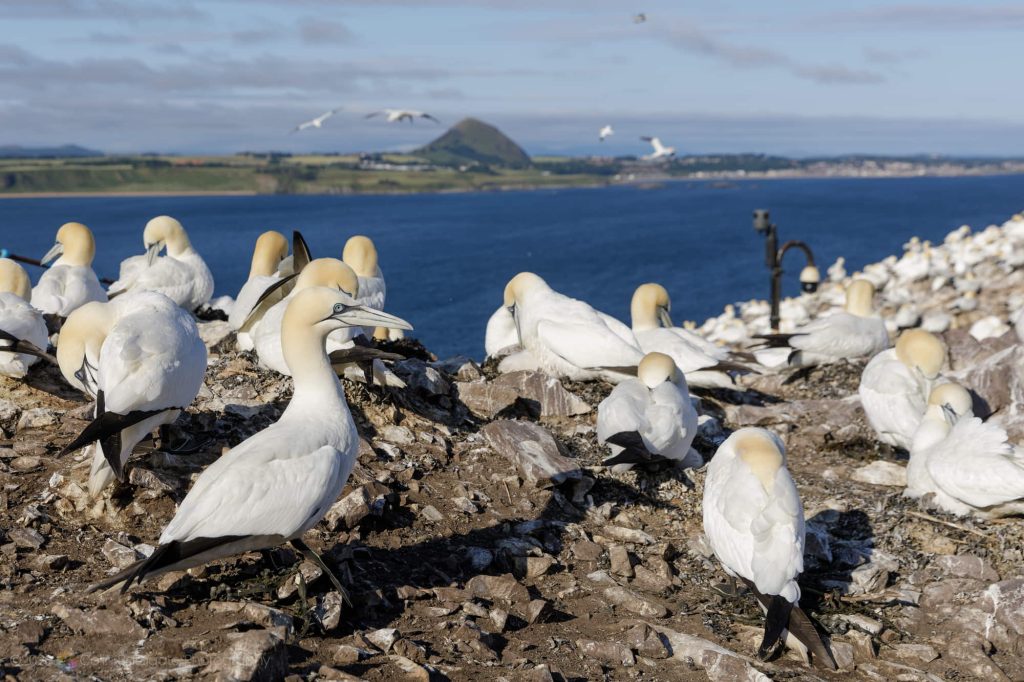
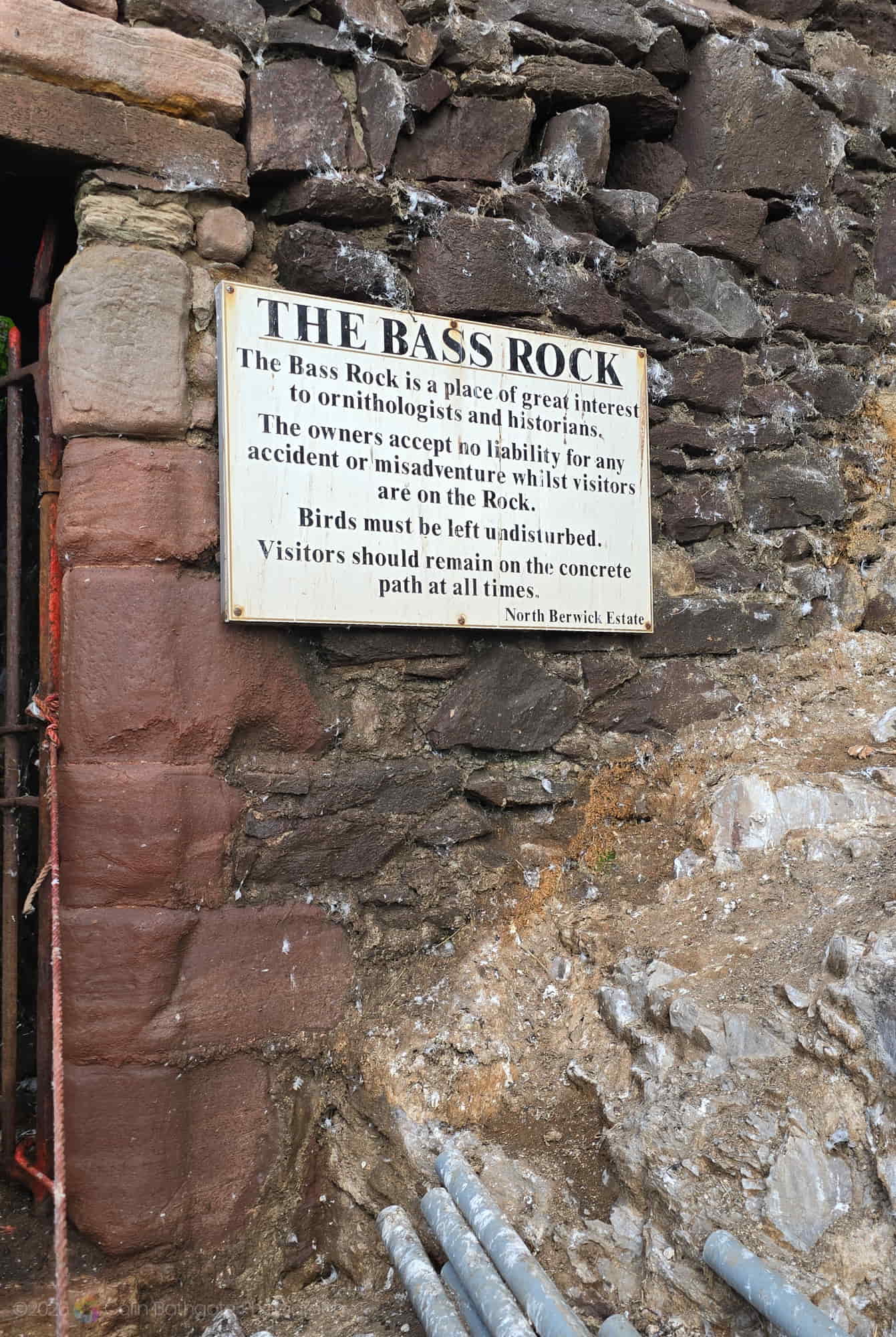
After climbing that first set of steps, things get a little easier, although we had still to negotiate gulls nesting on the lower part of the Rock. Our guides provided long sticks – not to injure the birds, but to divert their attacks away from our heads. They go for the stick instead. Following this encounter, we slowly ascended to our base further up. It quickly became clear that we were guests here, in a home occupied almost entirely by seabirds. We were the outsiders.
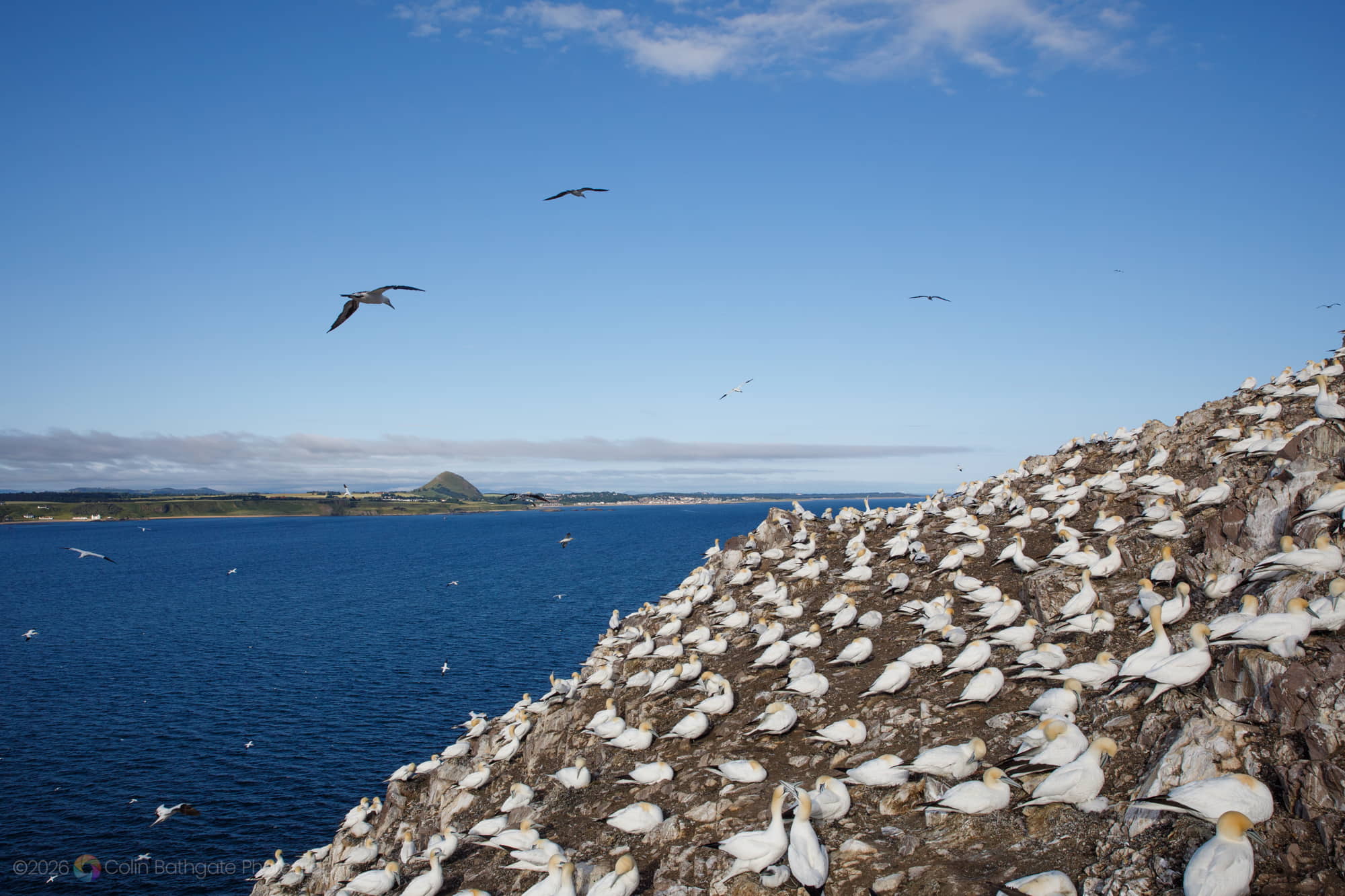
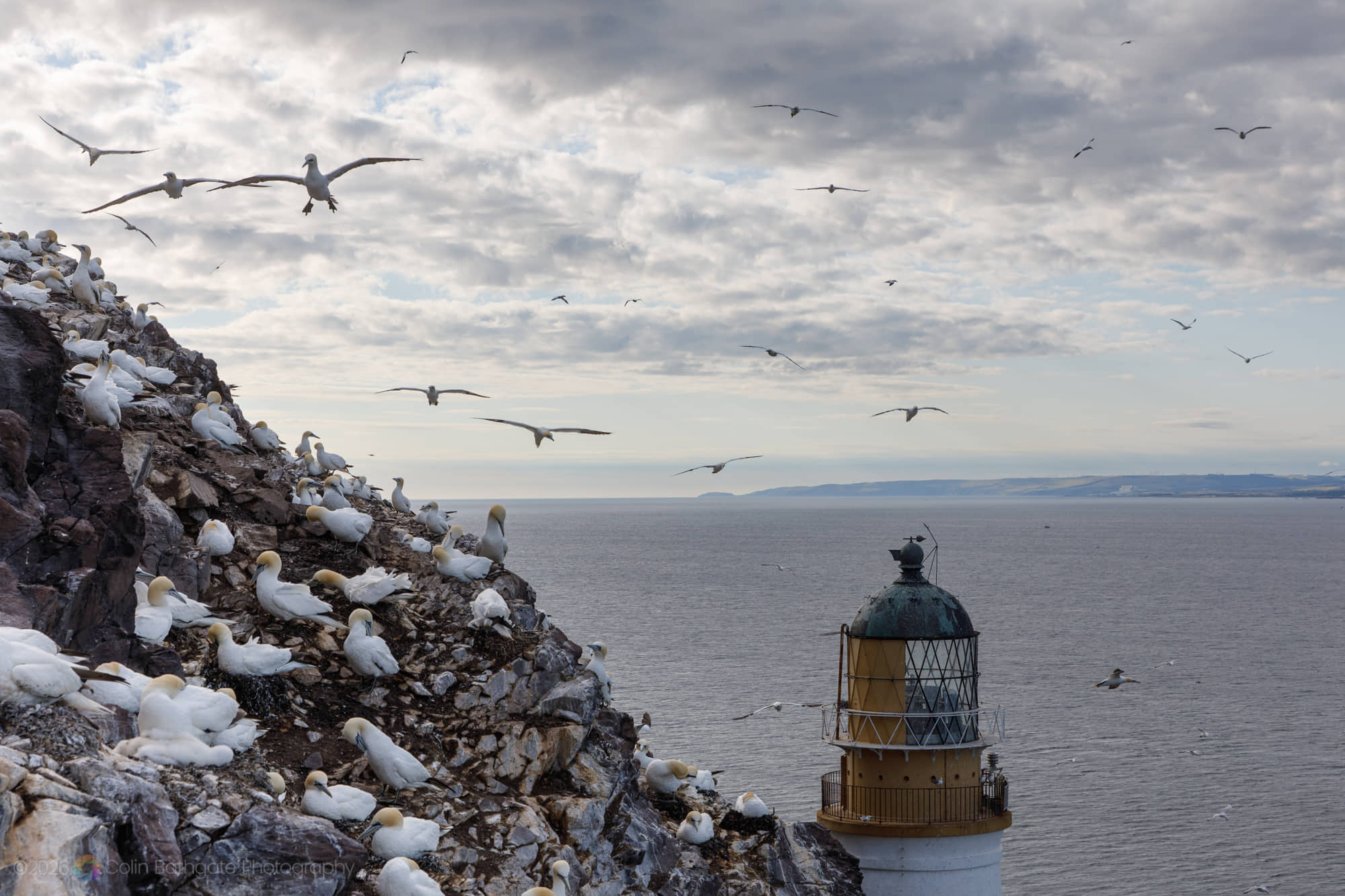
And then there were the gannets. Thousands of them. Once you’re further up the Rock, the scale of the colony becomes apparent. Tens of thousands of gannets calling, squabbling and flying overhead create an almost continuous wall of sound, accompanied by the pungent smell of guano that seems to permeate everything.
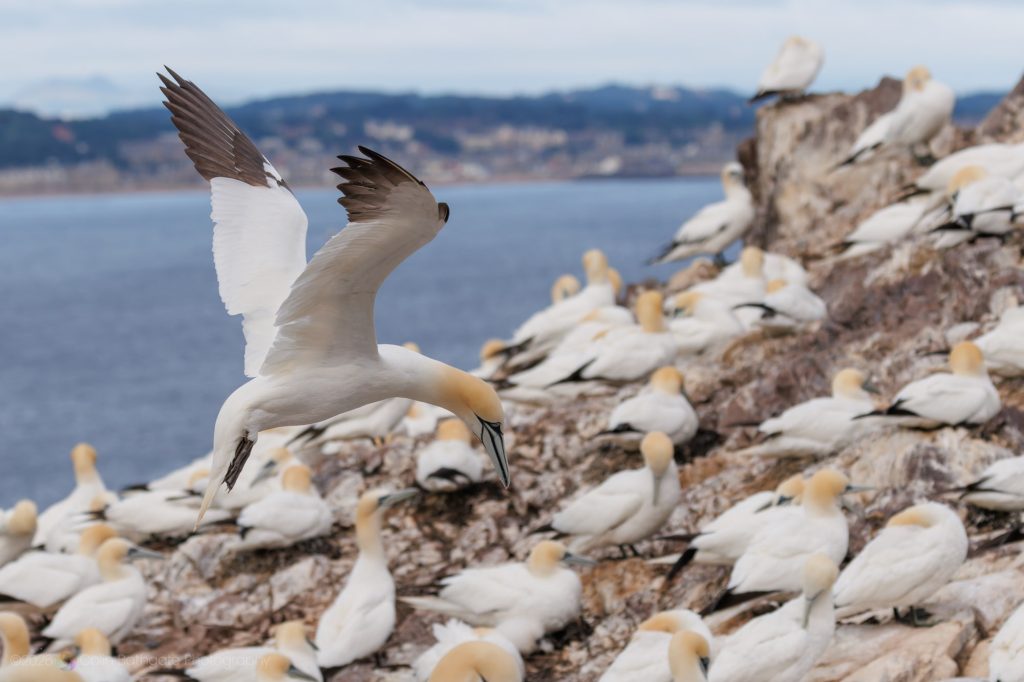
More than a century earlier, Robert Louis Stevenson had listened to the colony and described the Bass simply as “an unco place”, meaning strange or unfamiliar. He wrote of “the calling of the solans, and the plash of the sea and the rock echoes”, a description that still feels very apt.
The path we climbed had nesting gannets close to us on both sides, and I was pecked on the legs a couple of times. It didn’t hurt, but I could feel their beaks stabbing at me, a sharp reminder that we were getting a little too close to their nests.
Meeting the Gannets
Once you begin to focus on individual birds rather than the mass of the colony, their character starts to emerge.
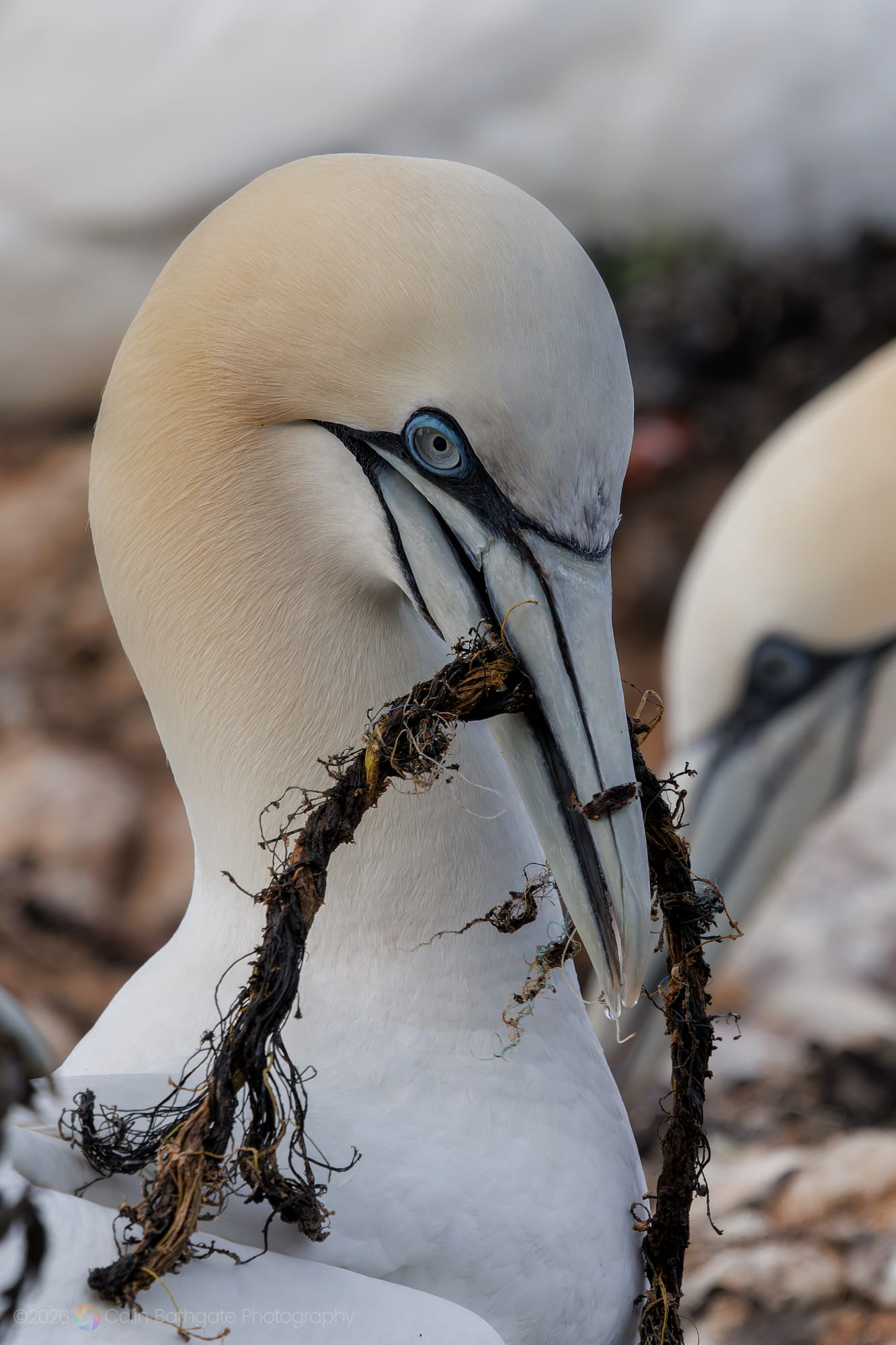
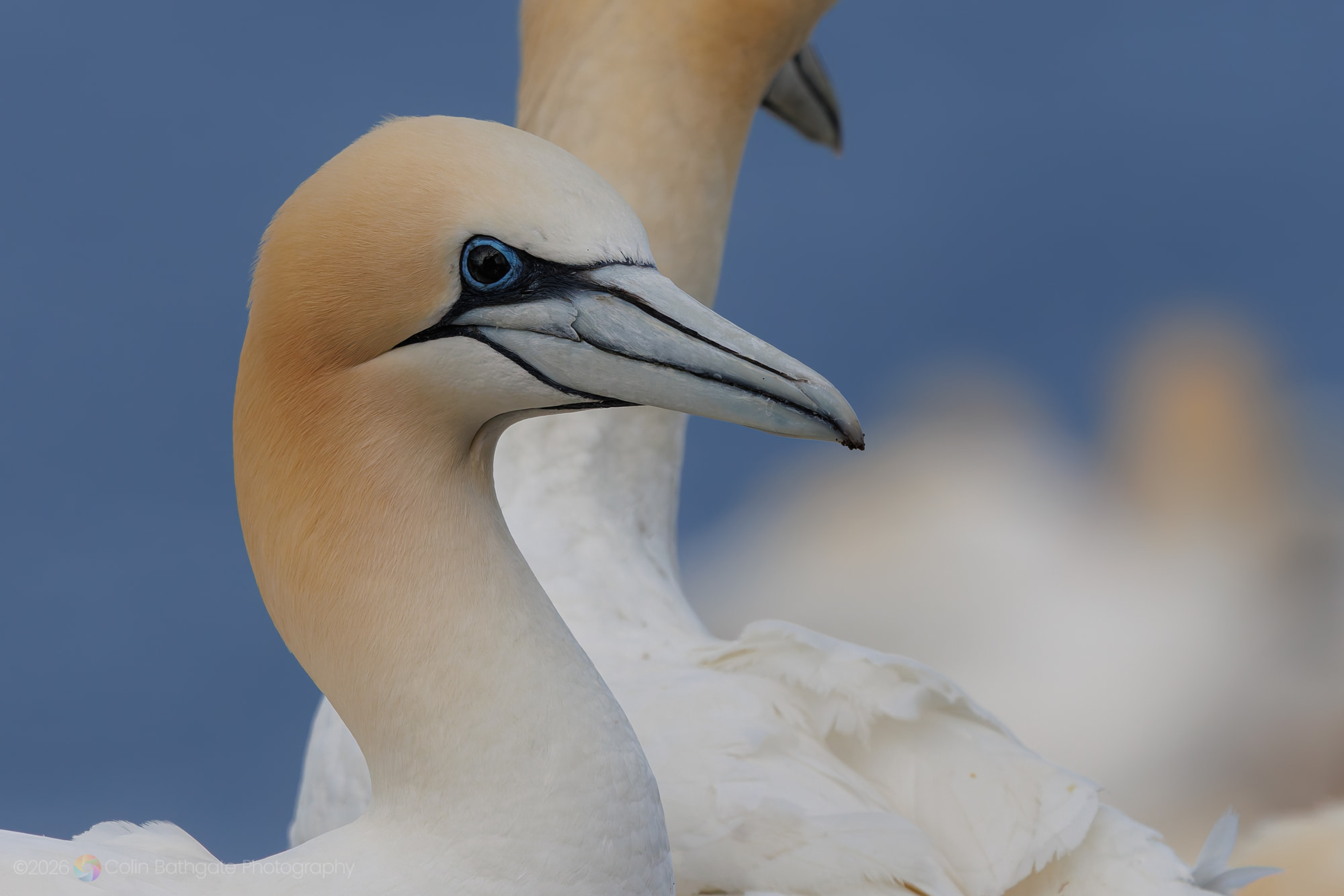
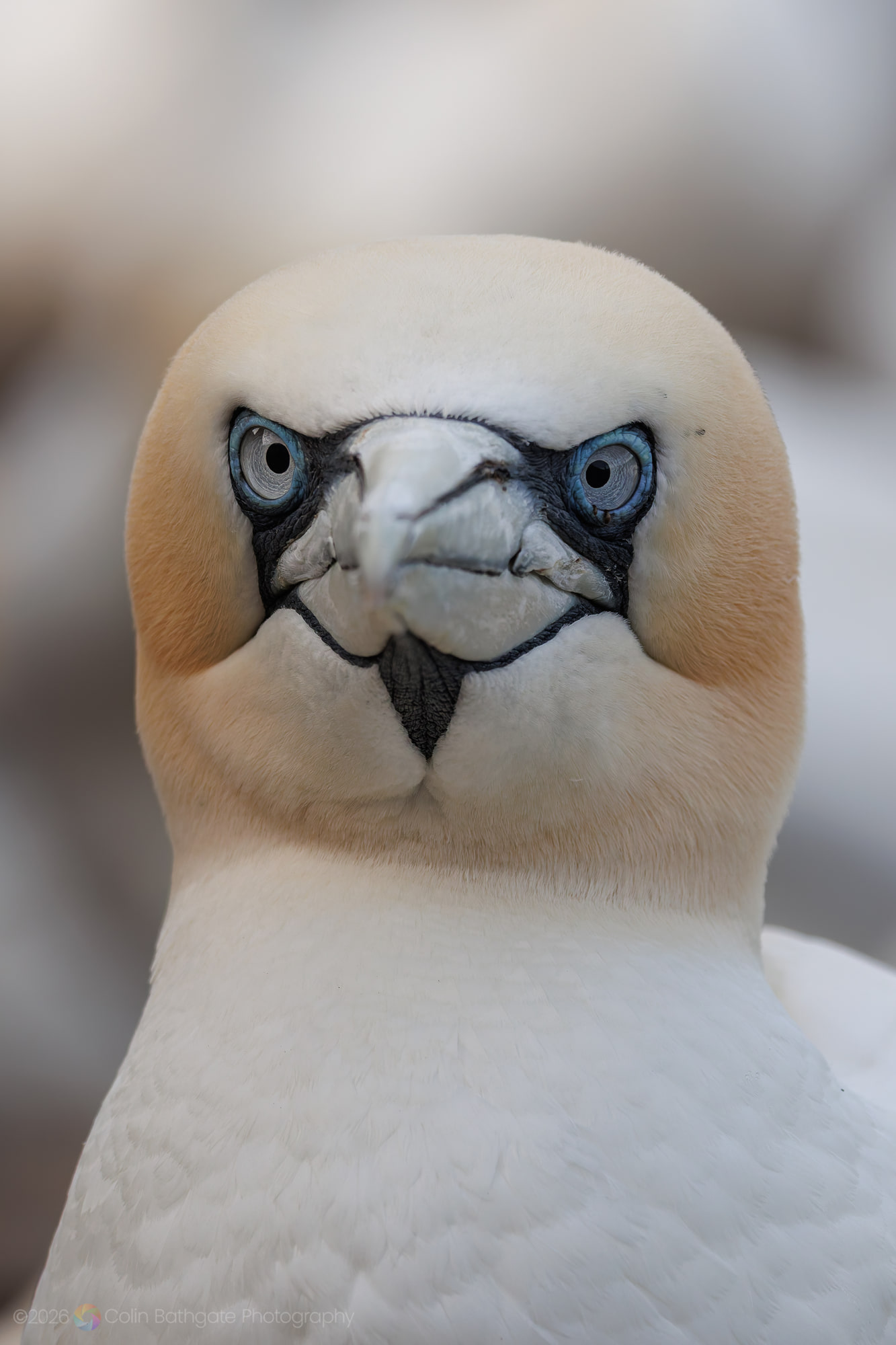
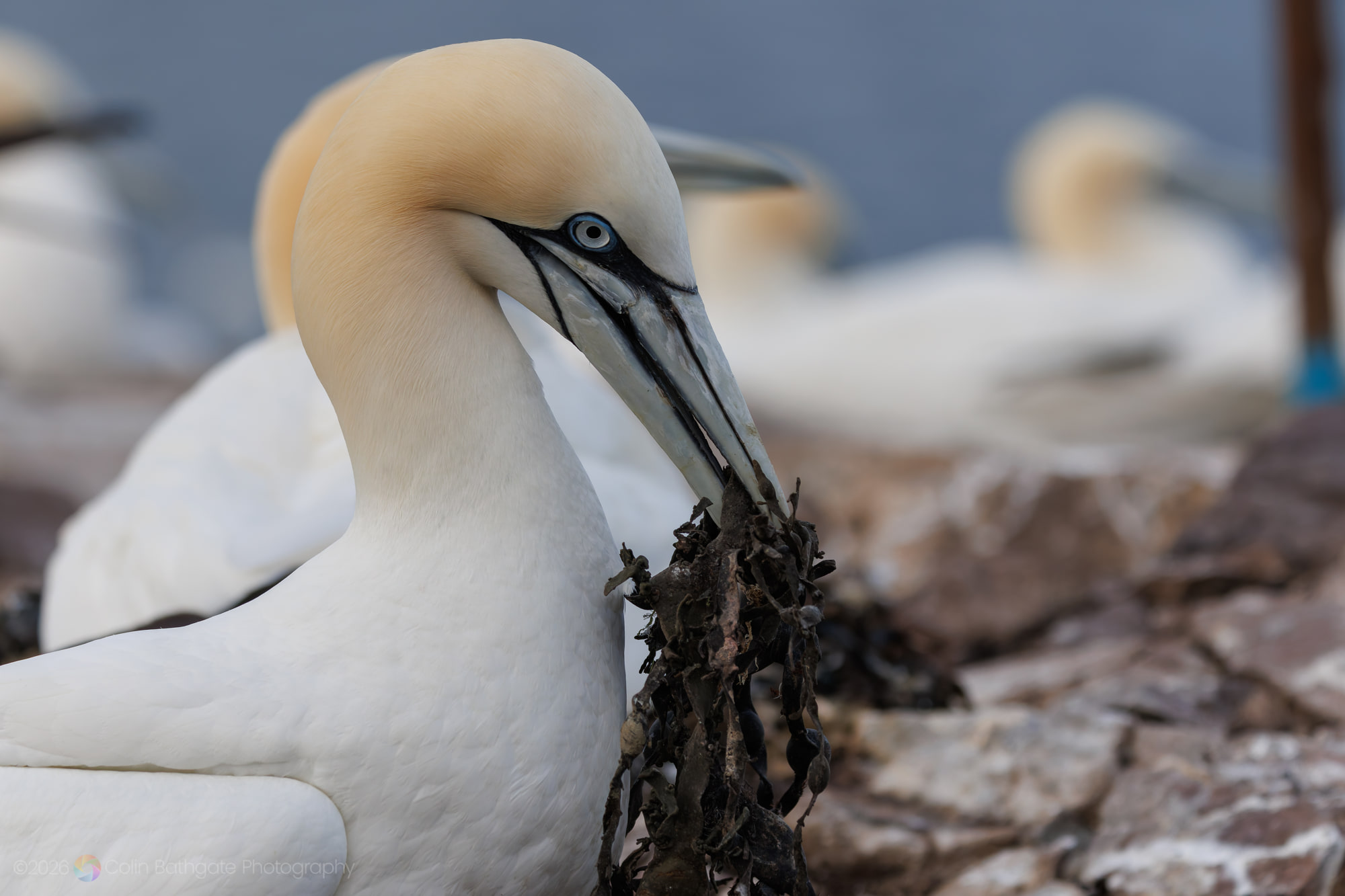
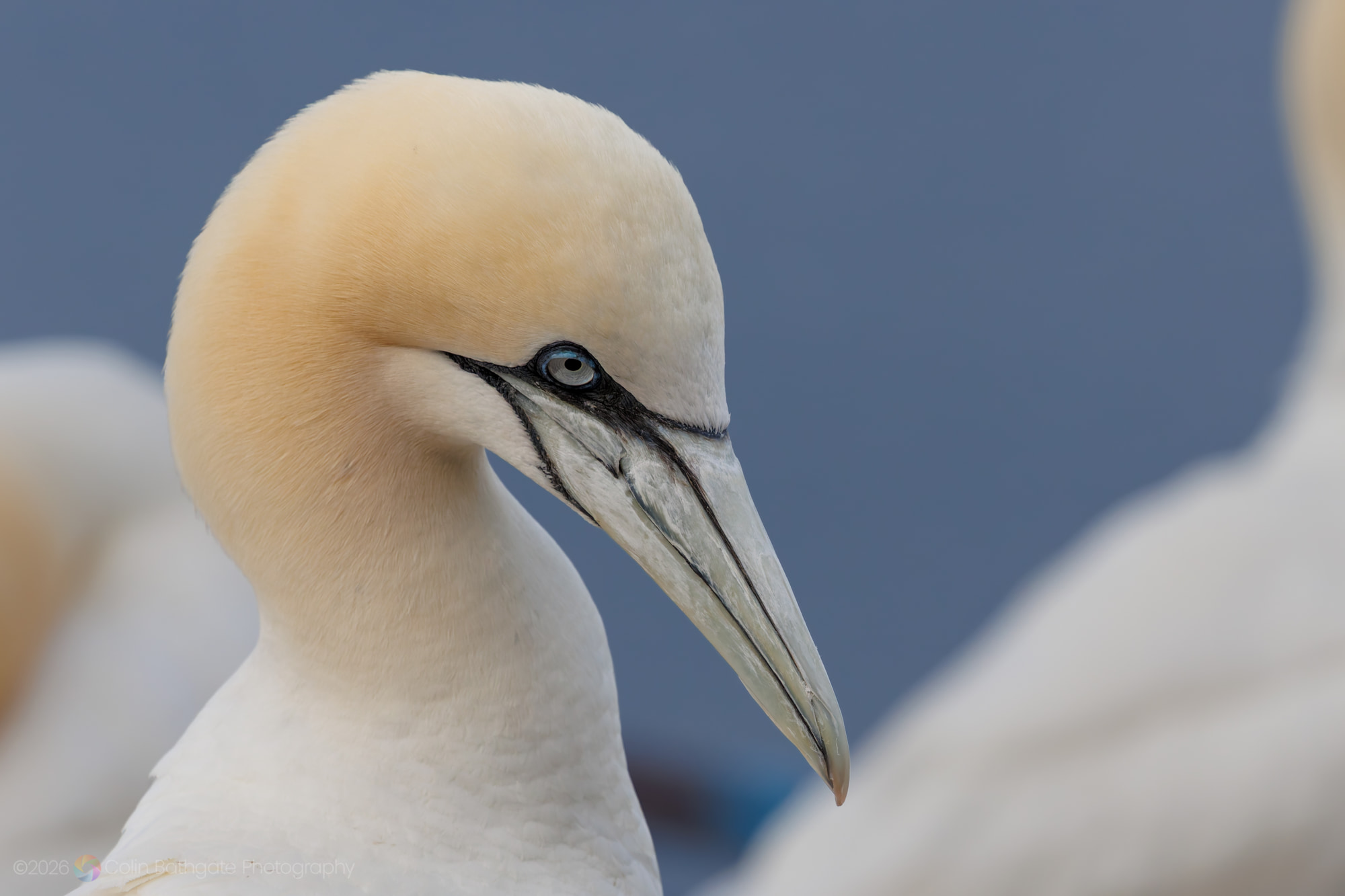
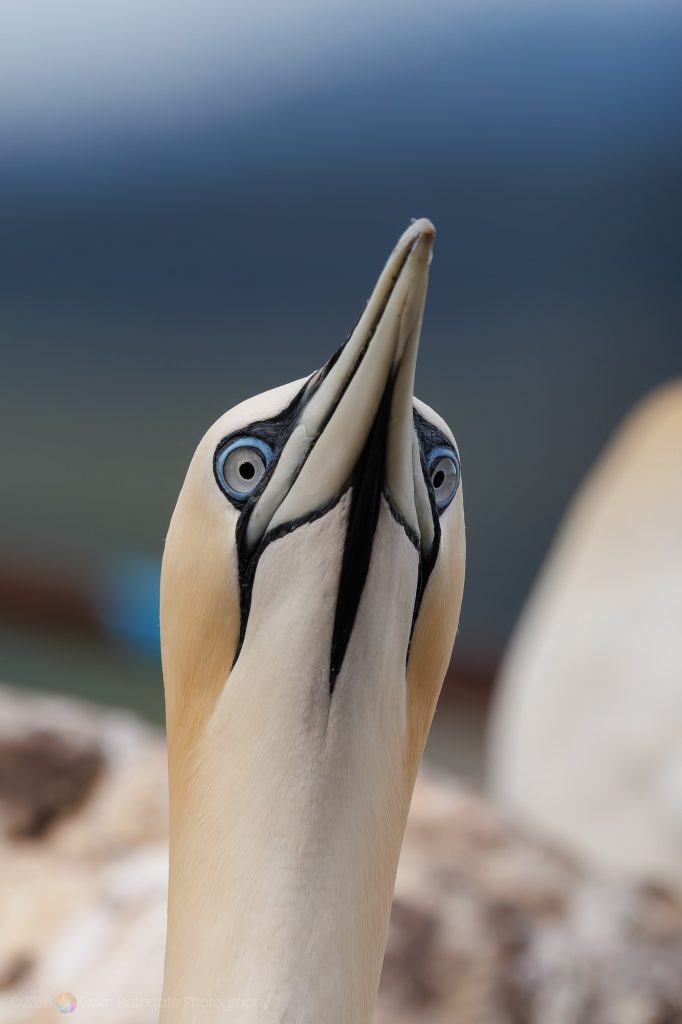
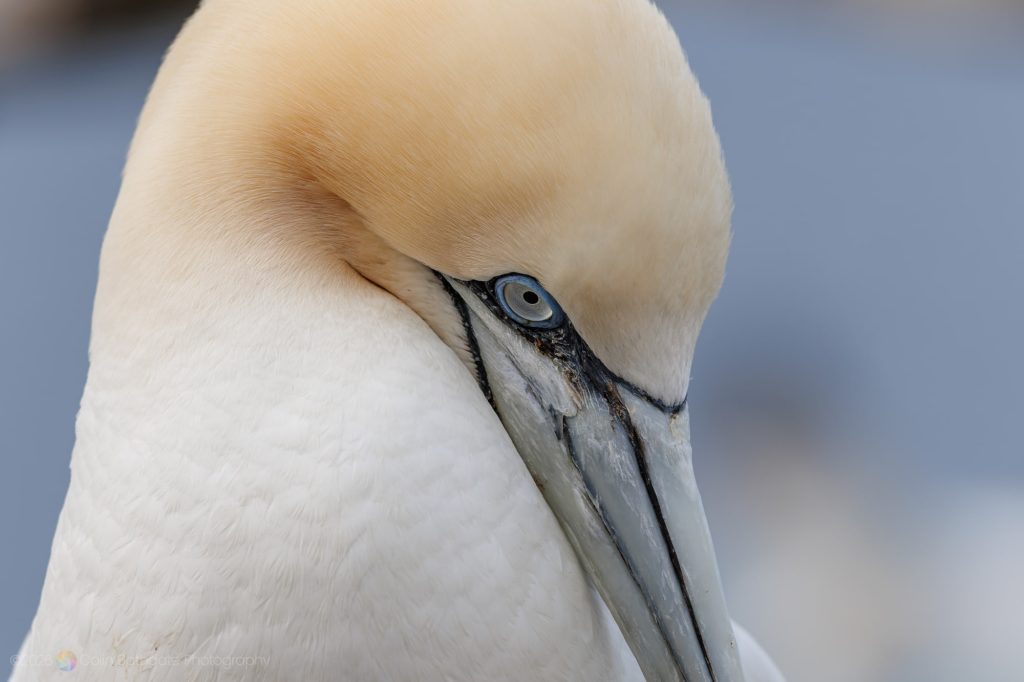
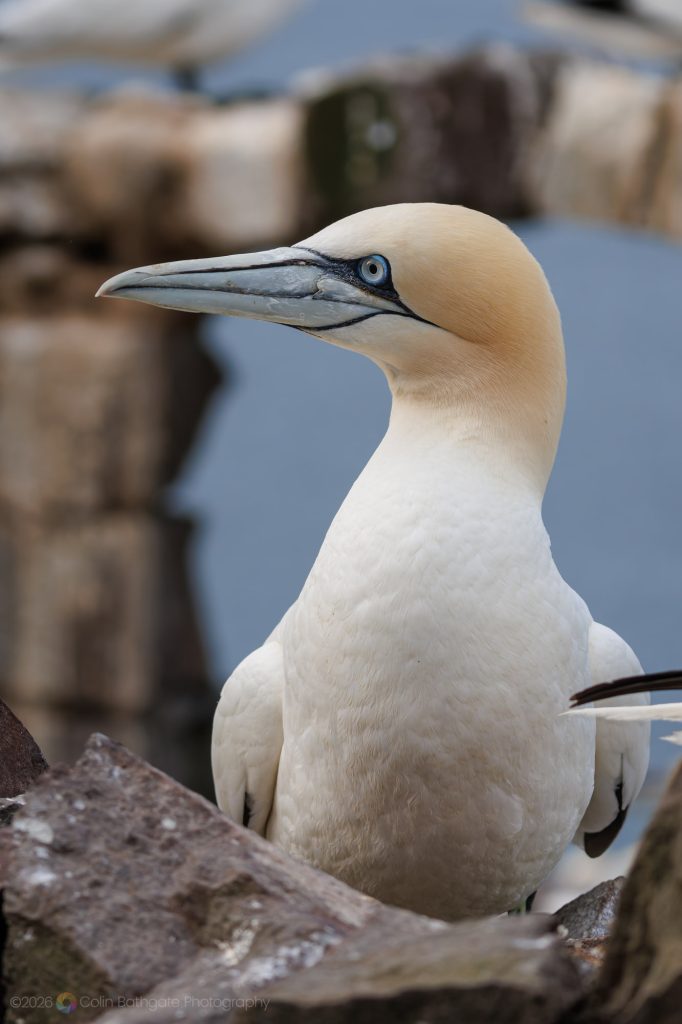
The northern gannet (Morus bassanus), Britain’s largest seabird with a wingspan of up to two metres, appears almost sculptural at close range – golden head, ice‑blue eyes, immaculate white plumage edged in black. The black markings around the beak and eye look like loosely applied paint, their edges more like natural strokes of pigment than crisp lines.
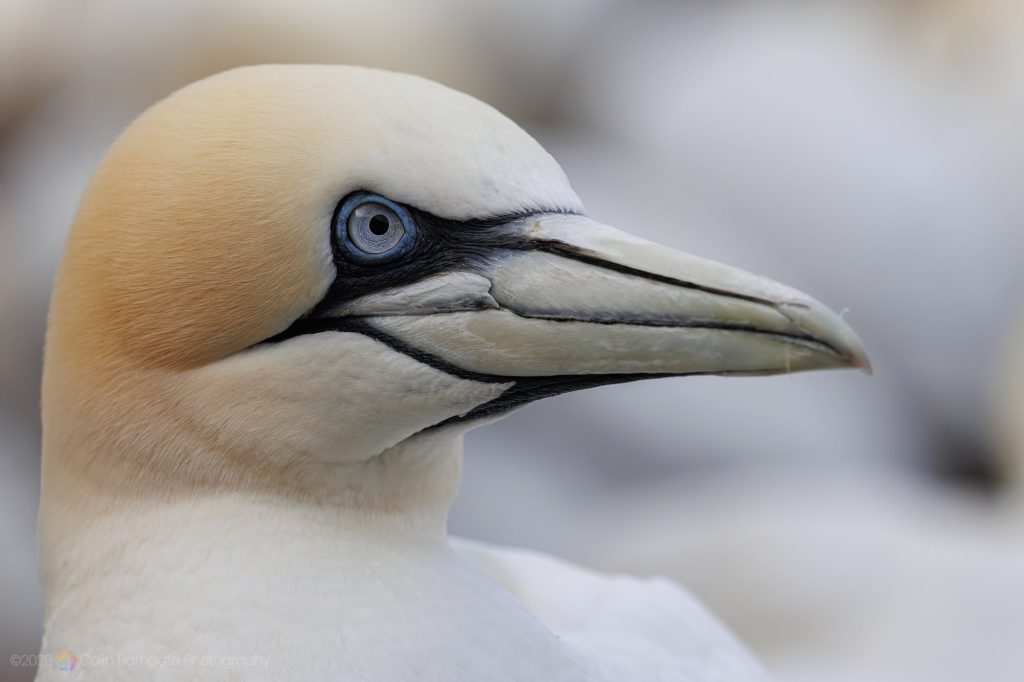
Looking into the eye of a wild gannet felt surprisingly intimate. Despite the thousands of birds around me, each seemed to have its own distinct presence. A tilt of the head, a curious glance, a moment of stillness before returning to its partner or its chick. Their eyes, ringed in pale blue, give them an expression that is both intense and strangely gentle.
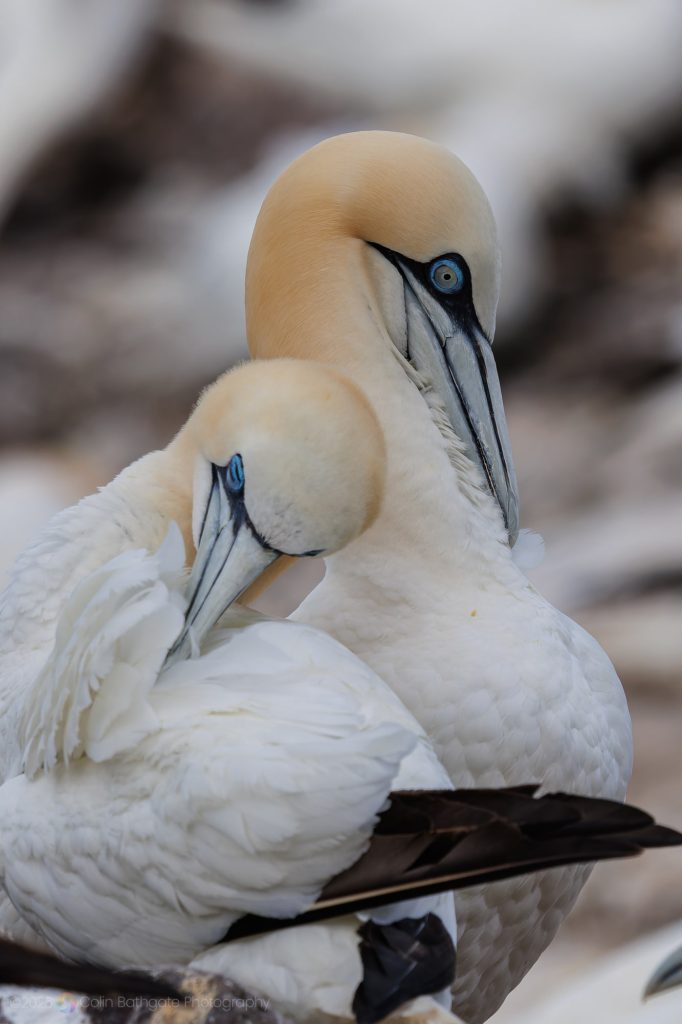
Their scientific name carries a direct link to the Rock itself: bassanus derives from Bass Rock, meaning that the very birds surrounding me carried the name of the island in their identity.
Once known as the solan goose, the name solan comes from the Old Norse súla, meaning gannet. They are extraordinary hunters, circling high above the sea before folding their wings and plunging into the water at up to 60 mph to catch fish. Unfortunately I couldn’t see much of that activity from the Rock, but there was so much more to take in.
Bonds That Last – Courtship & Pair Behaviour
Gannets form long‑term pair bonds, often lasting for many years. Watching them interact was one of the best parts of the visit.
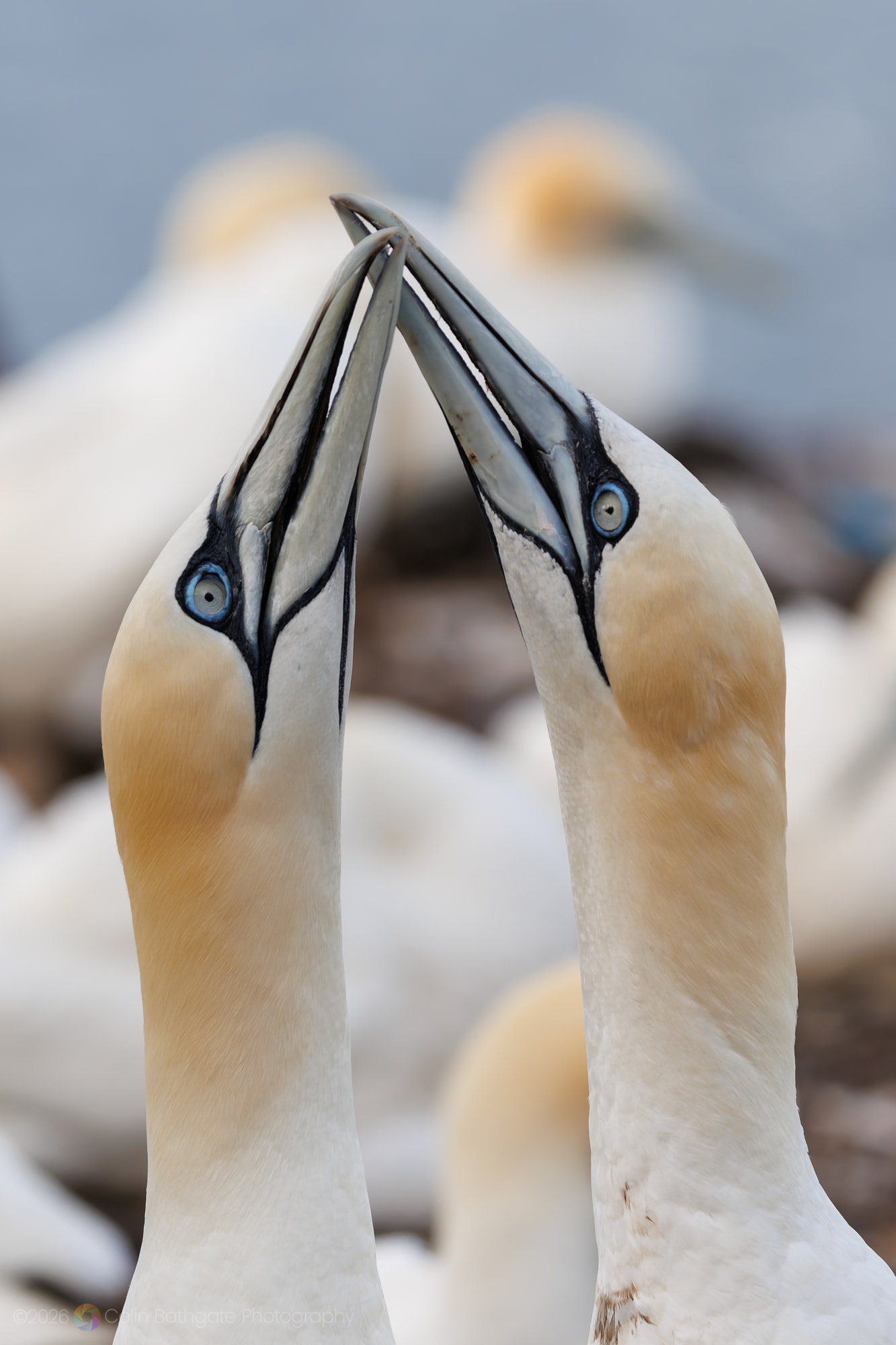
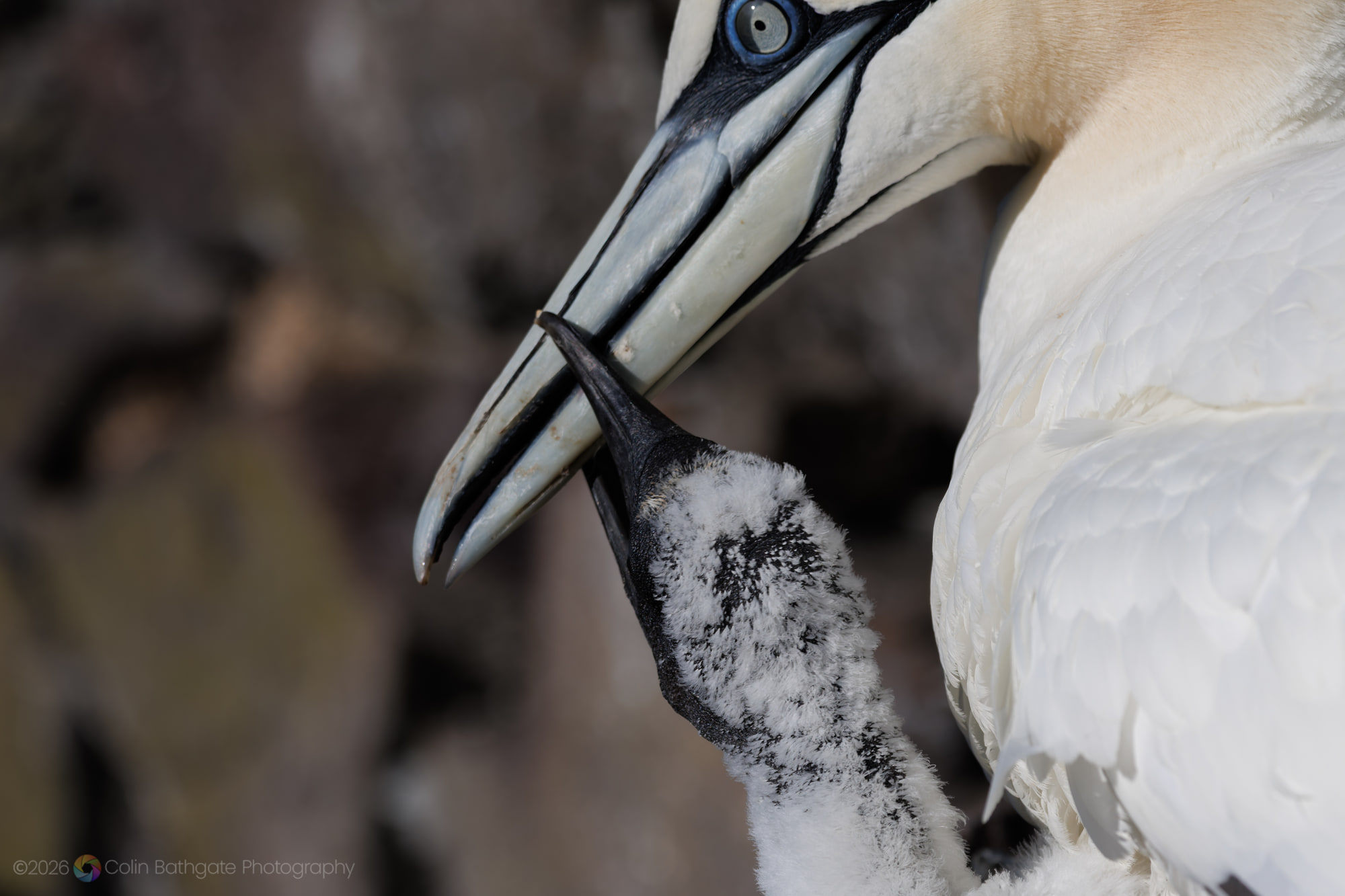
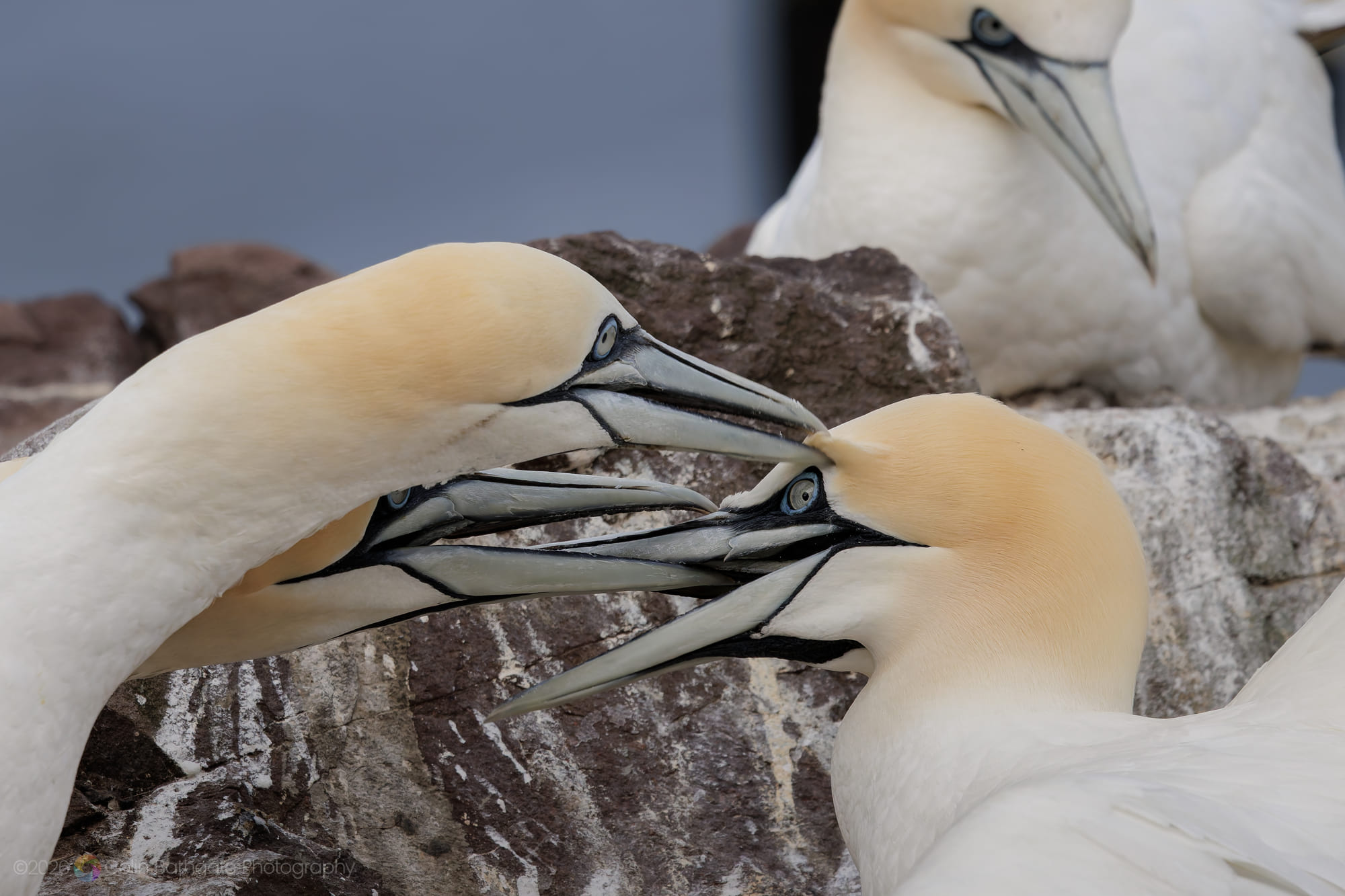
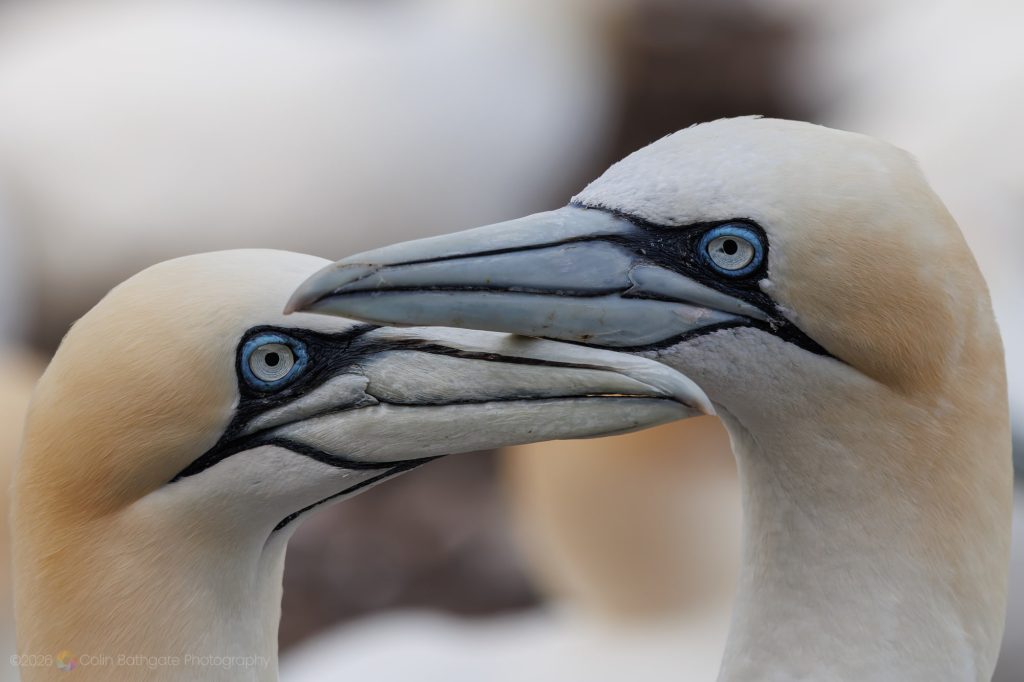
Pairs greet each other with a ritual known as fencing – gently tapping and crossing their beaks while raising their heads in a slow, deliberate motion. Others preened one another with some precision, reinforcing the bond that helps them survive in such a densely packed colony.
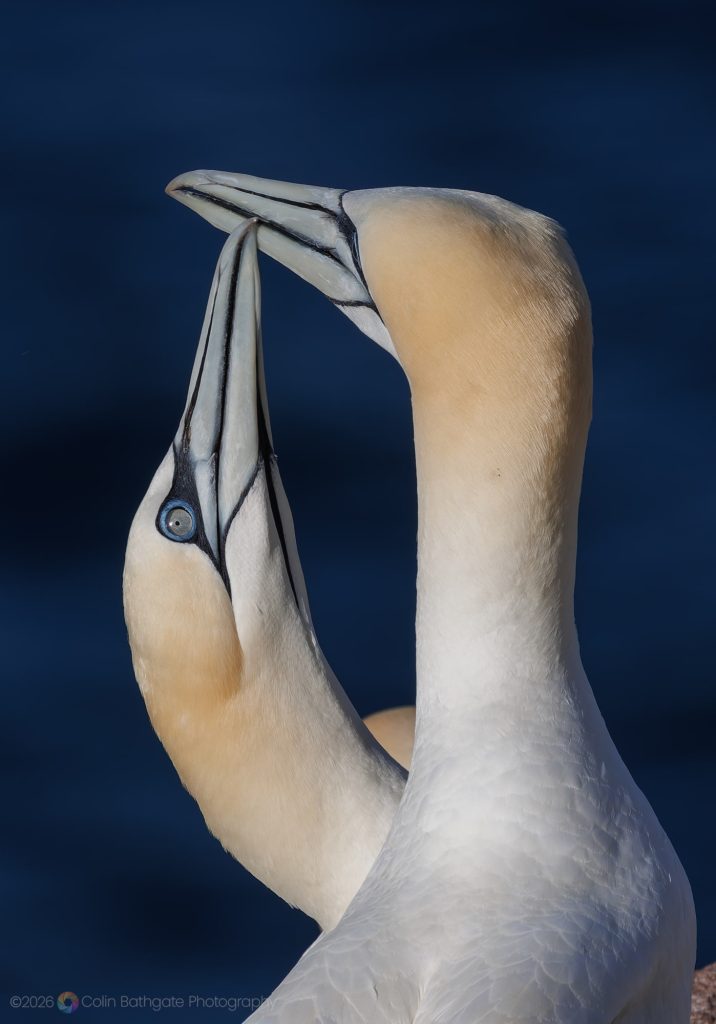
Amid the noise and chaos, these moments of connection stood out. A pair would reunite after a brief separation, touching bills and leaning close before returning to the business of life in the colony.
The guides were excellent, their knowledge and passion for these wonderful birds evident. They also made sure we stayed within the safe limits of the island and not too close to the birds’ nesting areas. I’d met Maggie Sheddan from the Scottish Seabird Centre many years before, on a trip to May Island at the mouth of the Forth estuary. On that occasion the main photographic subjects were puffins.
That was in 2012, when my dad was still here, and I always remember how we both enjoyed that trip. Standing on the Bass, I found myself wishing he could have been with me on this one.
Building a Home
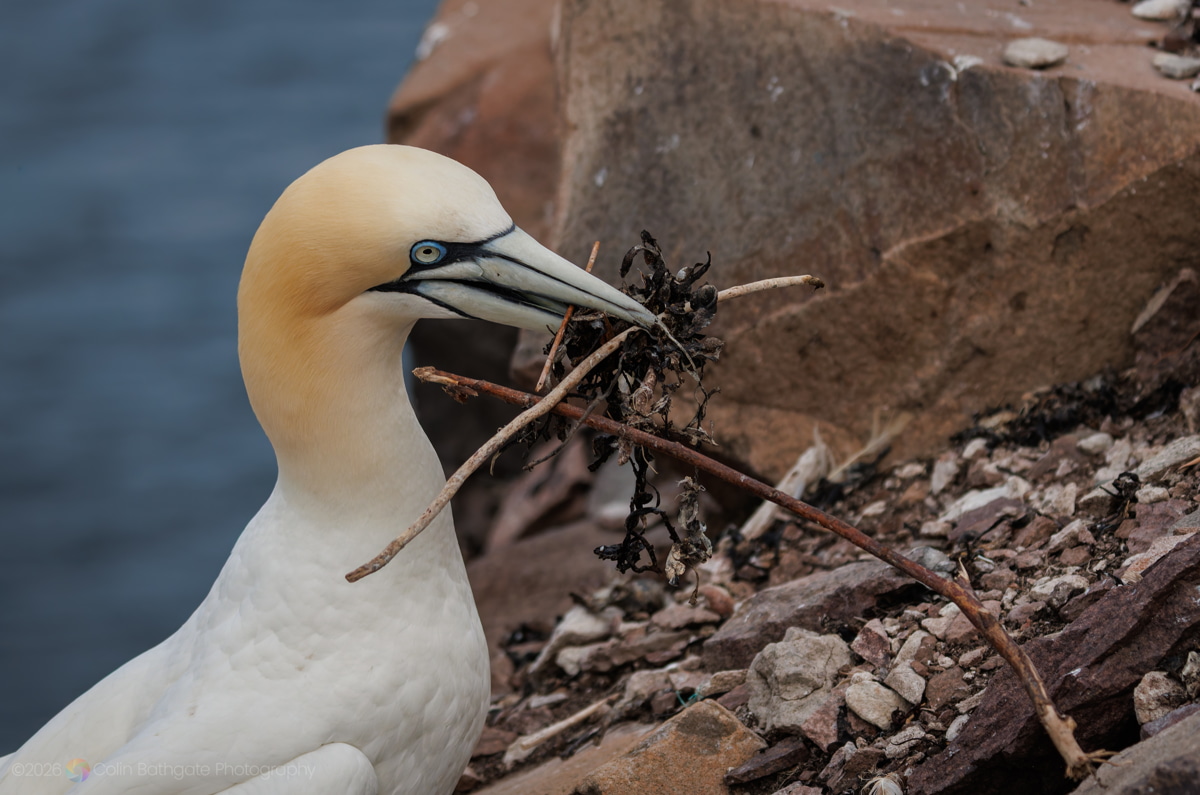
Amid all the noise and movement of the colony, there was much evidence of avian domesticity – birds returned from the sea carrying pieces of seaweed and vegetation to repair and add to their nests. These were not new homes being built from scratch – many pairs return to the same nest site year after year, renewing it each spring. In a colony as crowded as Bass Rock, each pair knows its tiny patch and fiercely defends it from its neighbours.
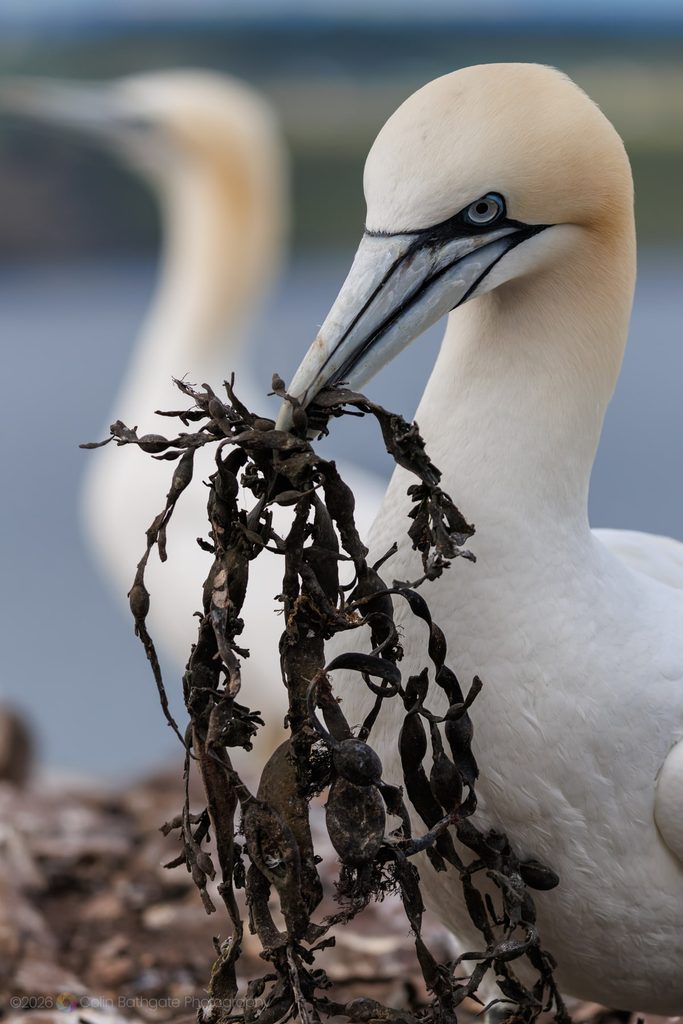
Watching them, I was struck by the thought that this ritual of returning, repairing and raising a new generation on this inhospitable rock has been repeated for countless seasons. For them, this extraordinary place is simply home.
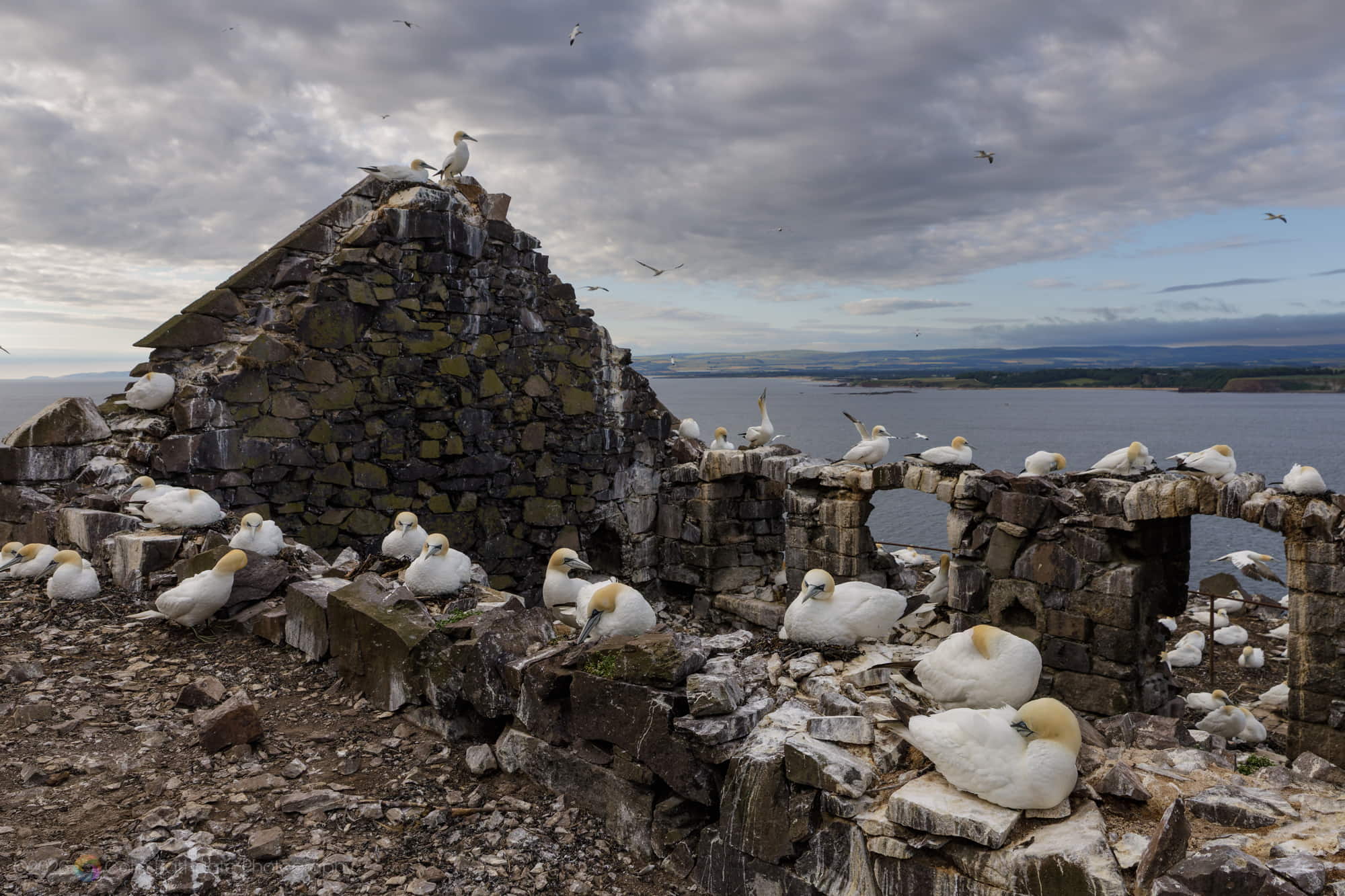
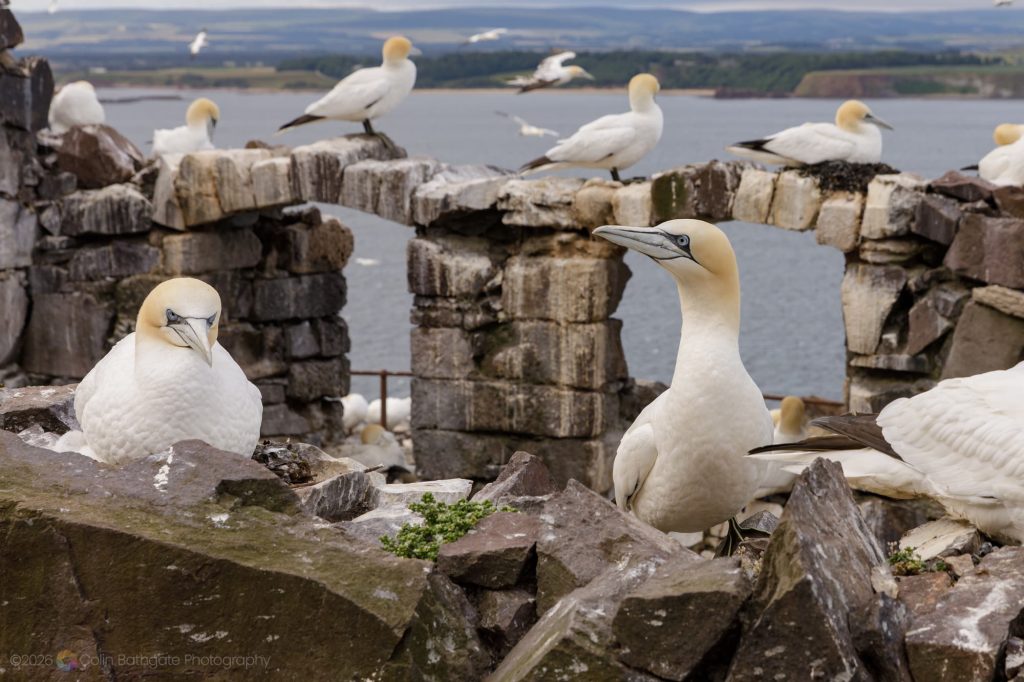
Nearby were the ruins of a chapel associated with St Baldred, an early Christian hermit who is said to have lived on the Rock. A church was newly erected here around the end of the 15th century and was later consecrated in his honour in 1542. Now the gannets have claimed its crumbling walls and ledges for their nests.
Raising the Next Generation
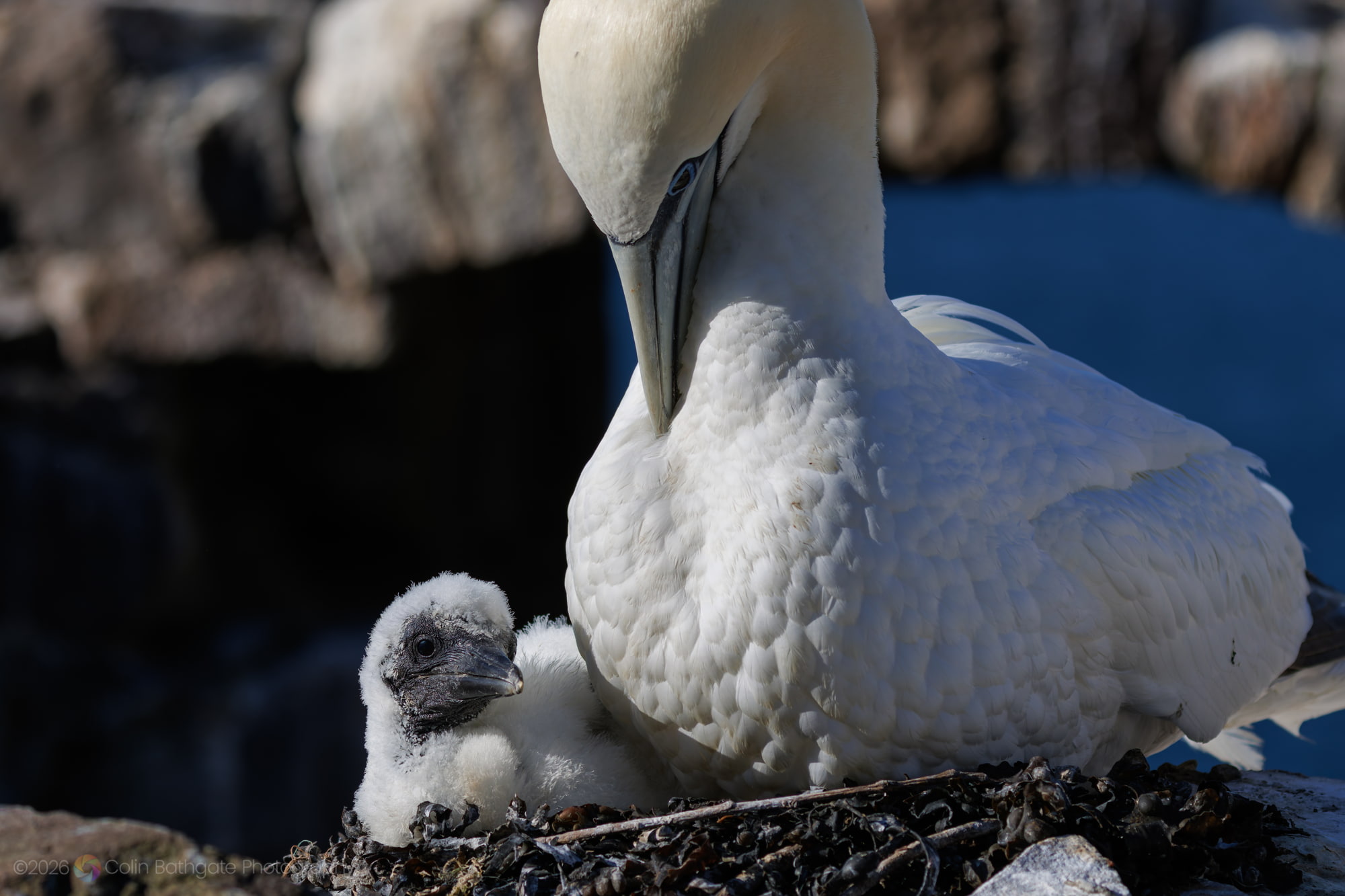
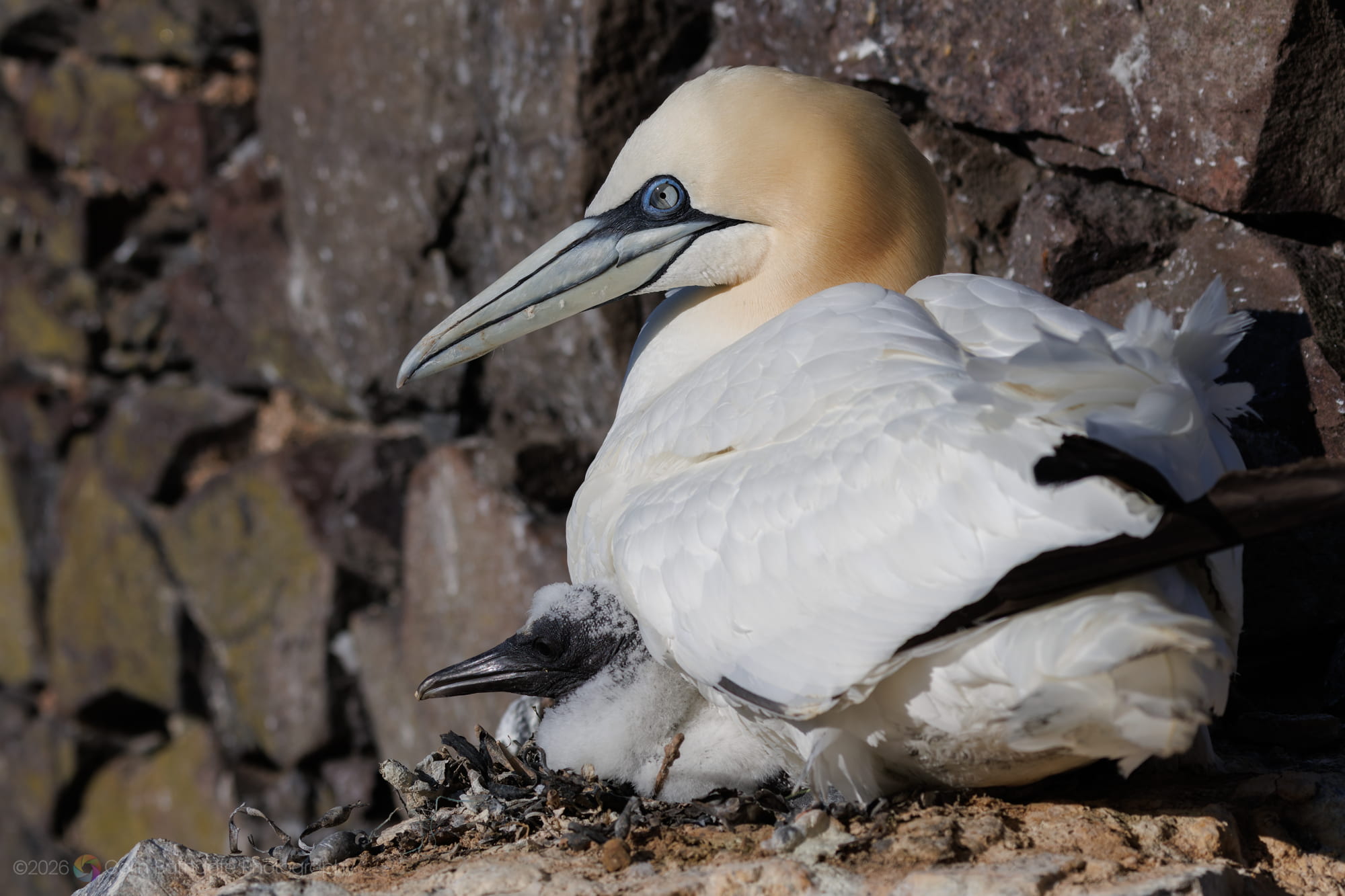
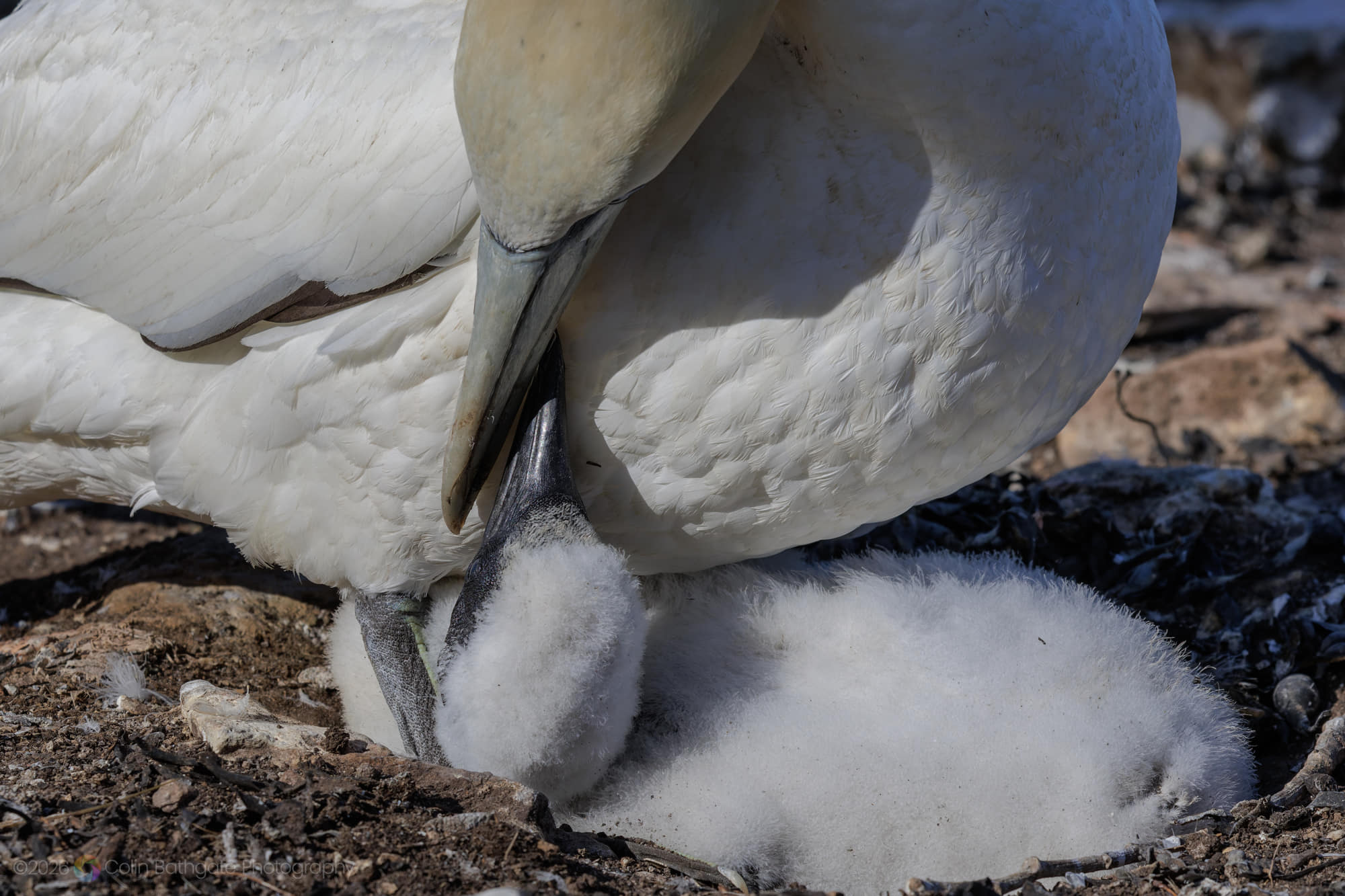
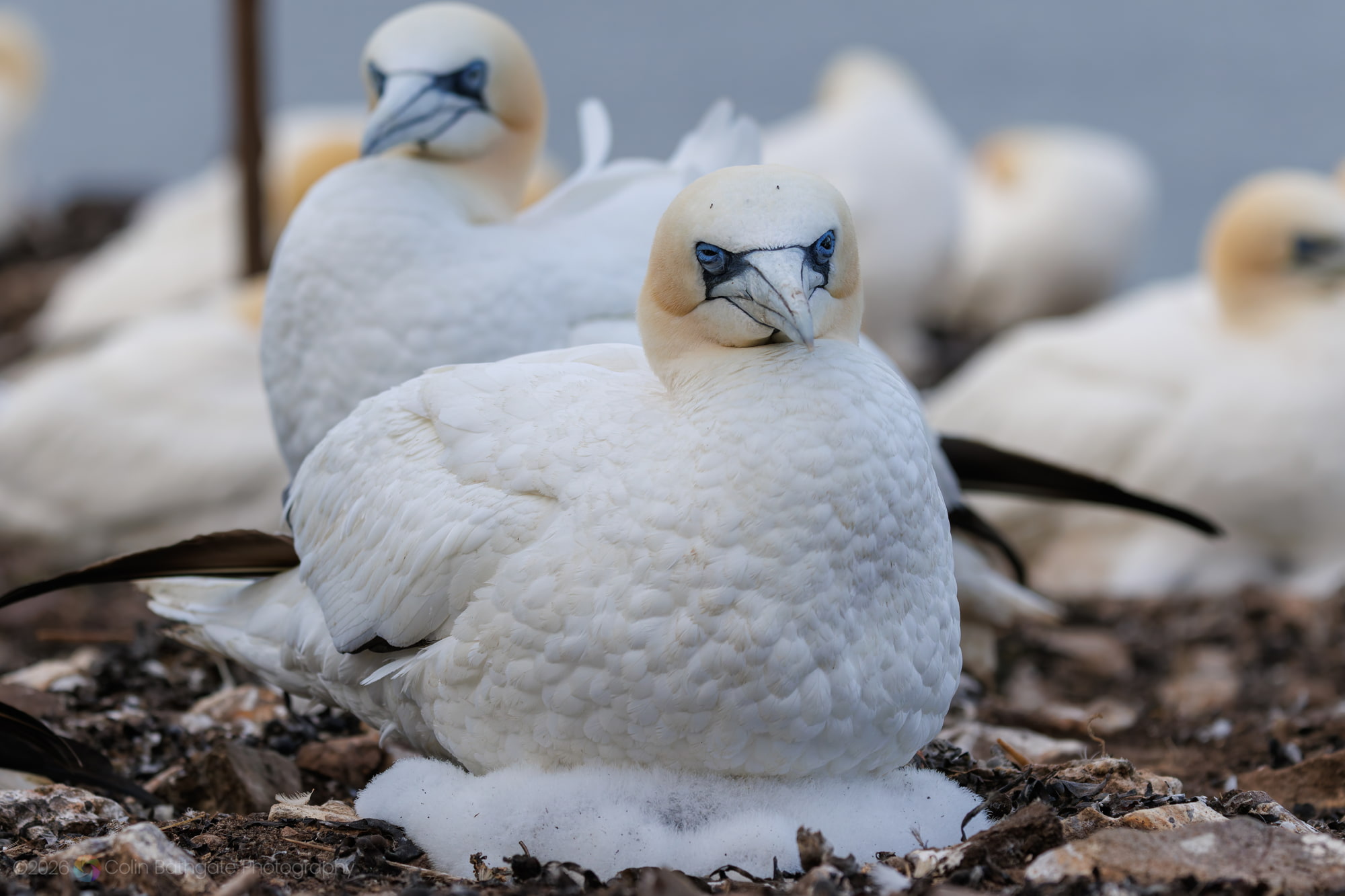
Among the most touching sights were the interactions between parents and chicks. Some chicks were still small and downy, tucked beneath a parent’s wing for warmth and protection. Others were larger, demanding food with insistent calls.
Gannet parents take turns incubating the egg and feeding the chick, and the gentleness with which they tended to their young was remarkable. A parent would lean down, touch bills with its chick, or carefully adjust its position to shield it from the elements.
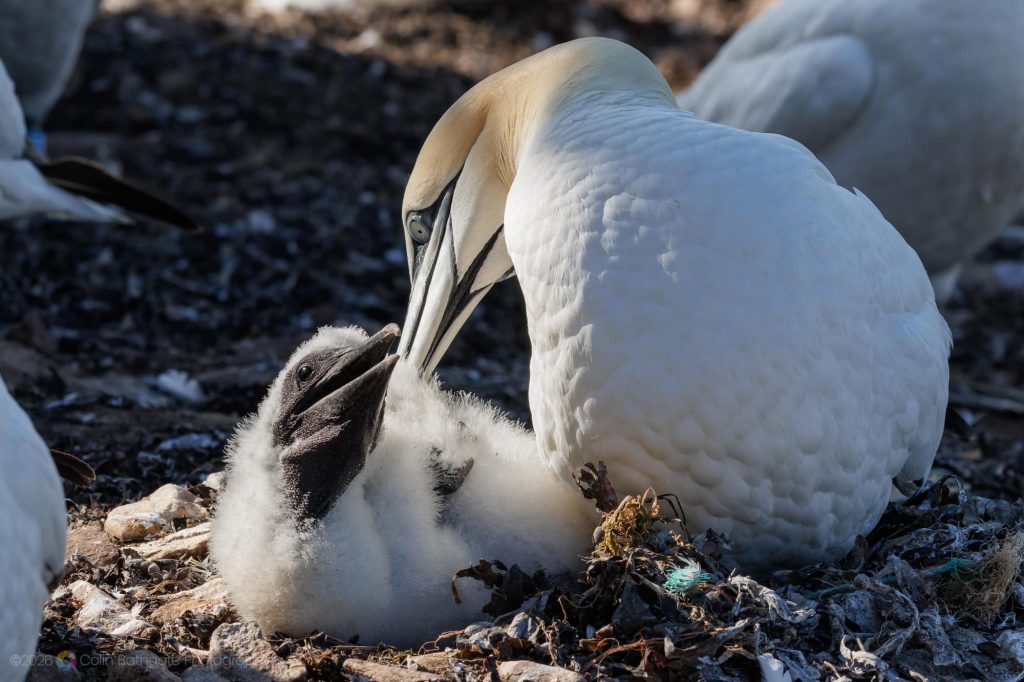
The gannets looked almost impossibly white in the bright sun, their feathers catching the light so fiercely that retaining detail became a battle. The harsh contrasts pushed my camera to its limits, but with many birds only two or three metres away, there was no need to hurry. I could sit down, take my time and simply enjoy their company. Most seemed remarkably at ease, even those guarding their young.
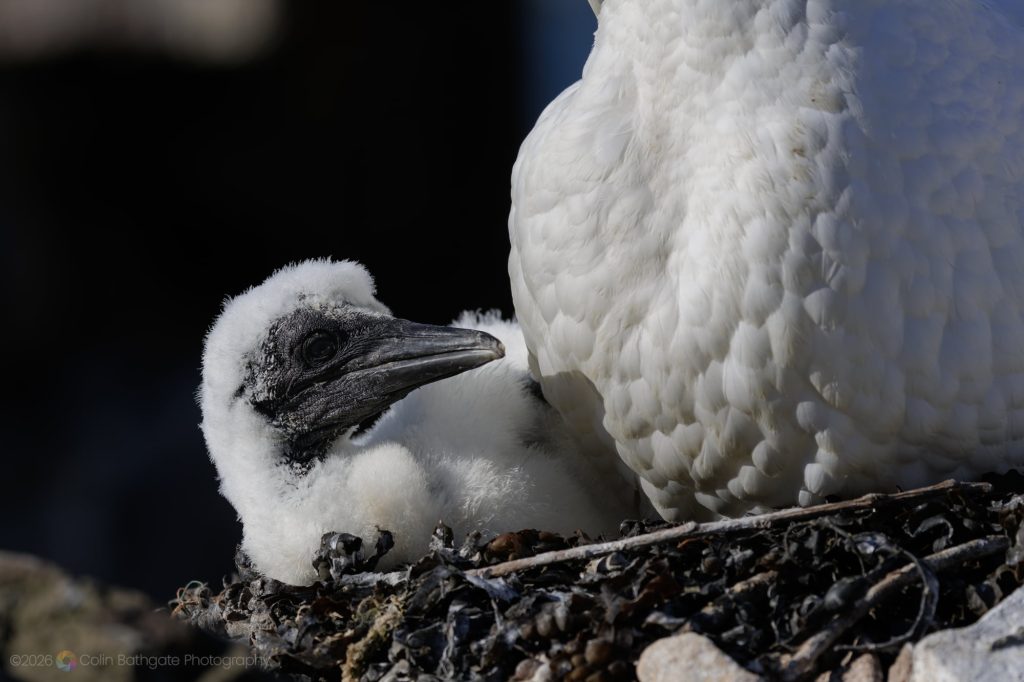
As a photographer I felt spoiled for choice. I found my eye and my lens constantly moving, trying to anticipate sudden gestures or behaviours. Isolating individual birds was difficult given the sheer density of the colony, but it was an enjoyable challenge.
The gannet’s striking white plumage, black wingtips and yellow head develop gradually. Young birds start out brown and can take three to five years to acquire their adult appearance.
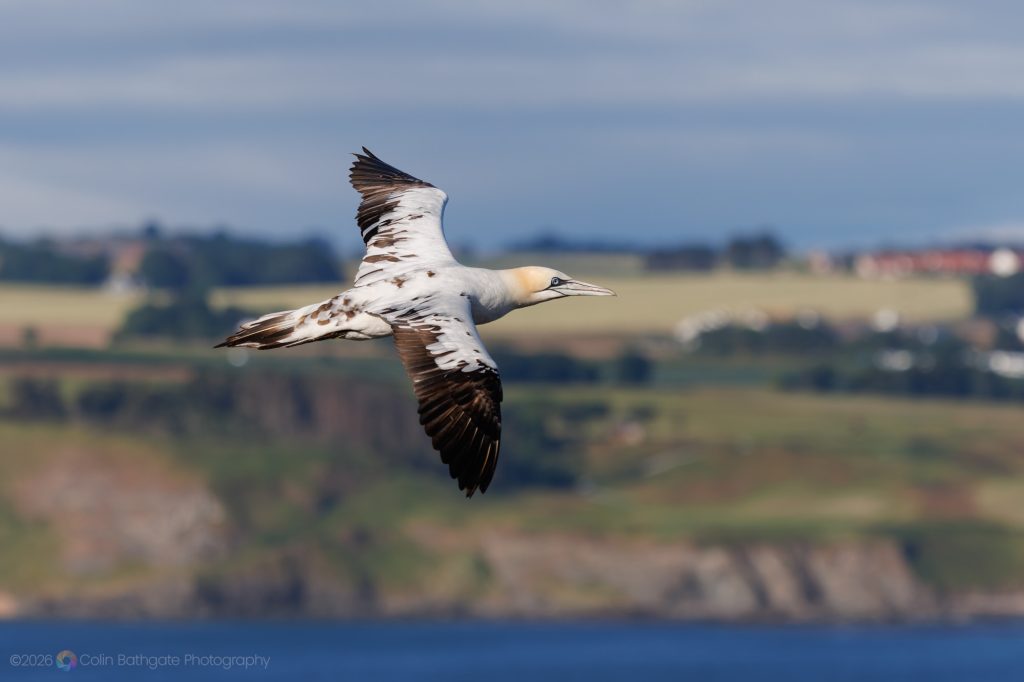
The younger gannet in the photo above is still acquiring its adult plumage, with the brown feathers of youth gradually being replaced by the characteristic white and black of the mature bird.
Even their eyes can tell a story. Following the devastating 2022 outbreak of avian flu, some surviving gannets developed unusually dark or completely black irises, providing researchers with a visible indication that the birds had survived infection. The bird on the left in the photo below provides an example of this.
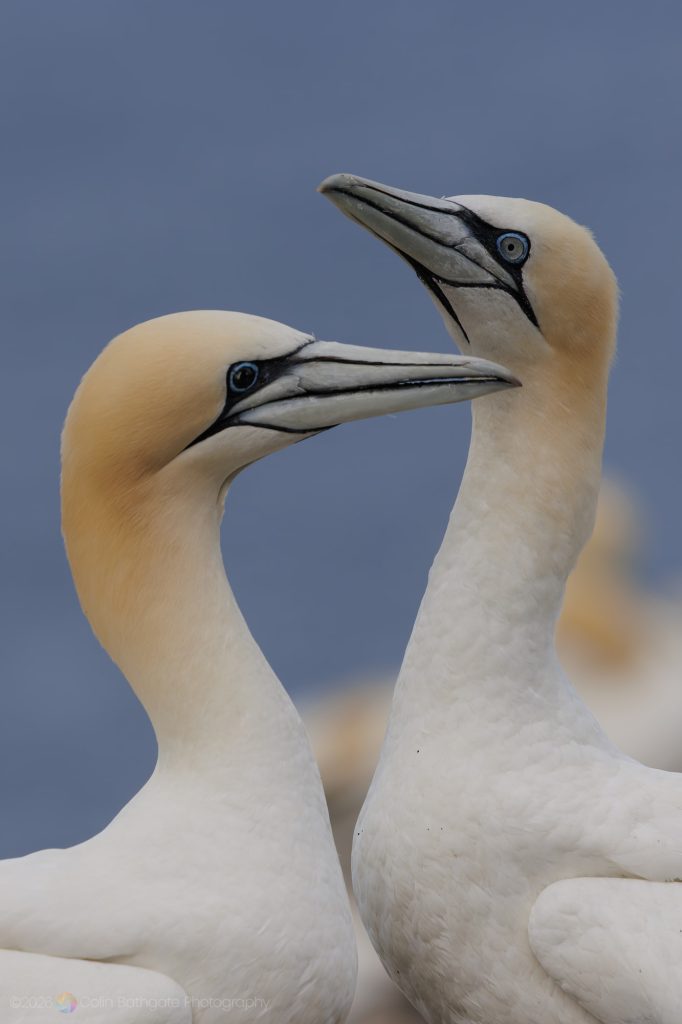
Strangely, I hadn’t spotted its black iris at the time. I was pleased to read that the affected birds can still see perfectly well.
Surrounded by thousands of gannets, it was hard to imagine that the colony could ever have seemed anything but abundant. Yet only a few years earlier, avian flu had devastated its numbers, and the colony was only slowly beginning to recover.
Masters of Flight
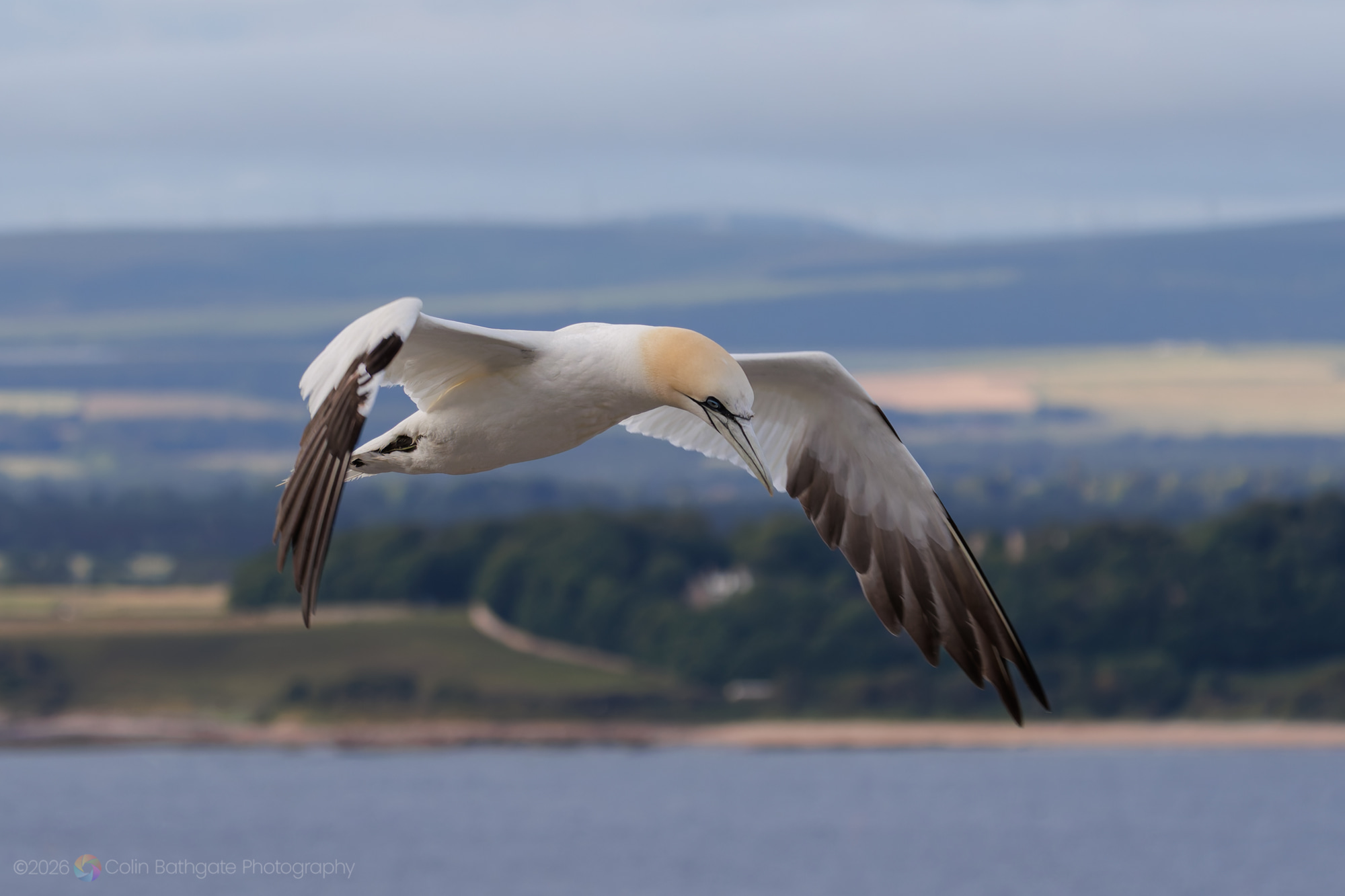
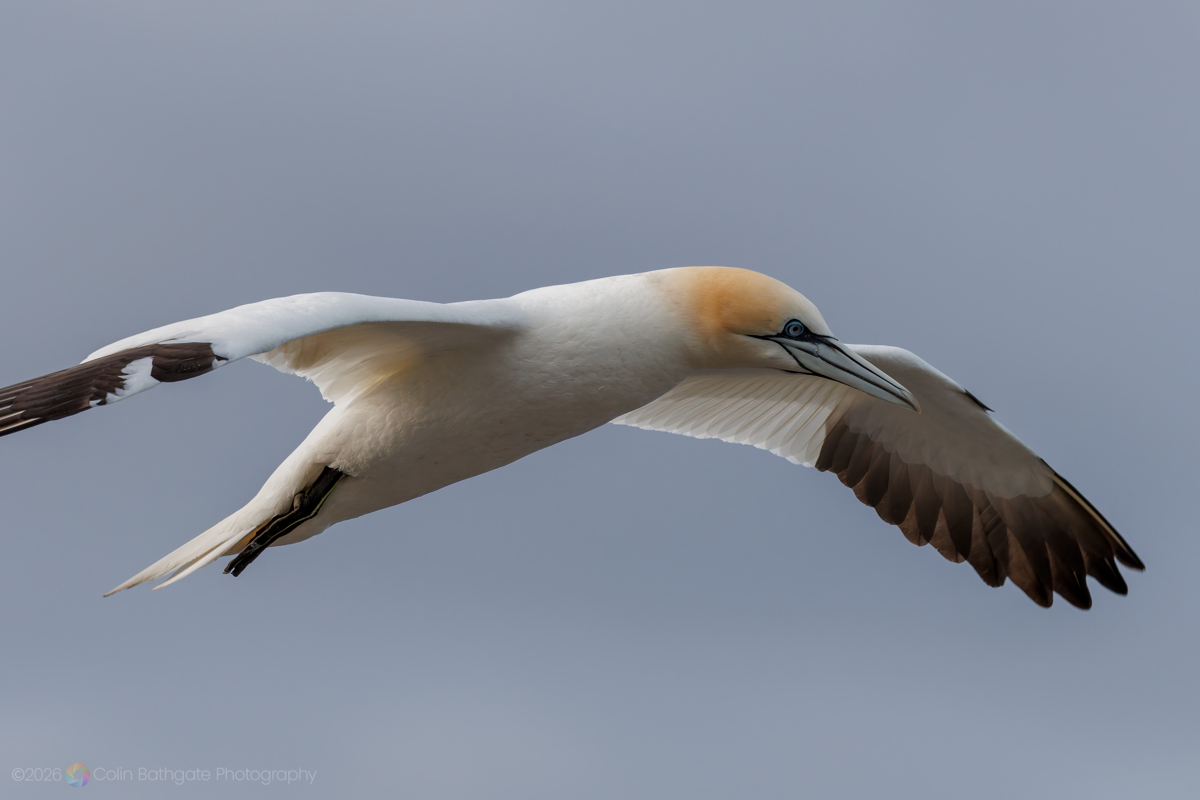
The experience also gave me plenty of practice photographing birds in flight, one of the trickier aspects of wildlife photography. Gannets are masters of the air, using dynamic soaring to glide effortlessly on the wind. Their wingspan, combined with their streamlined bodies, allows them to cover vast distances with minimal effort.
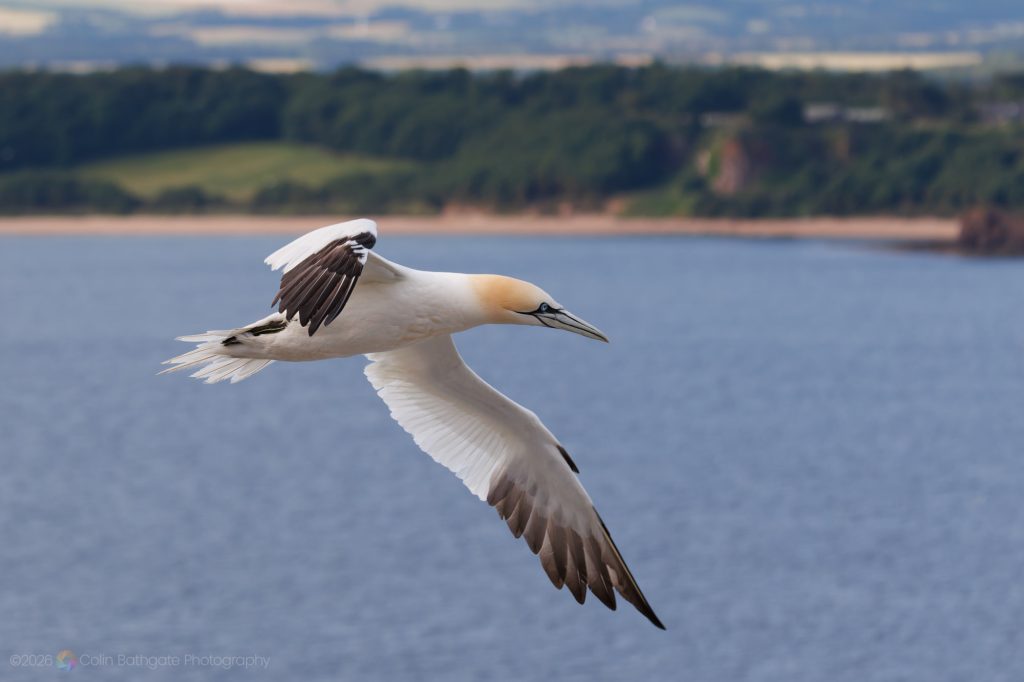
Tracking them through the viewfinder was difficult but exhilarating. Some birds passed close overhead; others circled high above before descending in a controlled glide, landing with a mixture of grace and occasional clumsiness on the crowded Rock. I used a fast shutter speed in an attempt to freeze their motion, letting my camera’s bird-detection autofocus track the gannets as they moved through the frame, allowing me to concentrate on following their flight rather than constantly trying to keep them in focus.
Every Inch Counts – Territorial Behaviour
For all their elegance, gannets are fiercely territorial. With nests packed tightly together, disputes are inevitable. I saw birds stretch their necks forward, open their bills in threat displays, and peck at neighbours who ventured too close.
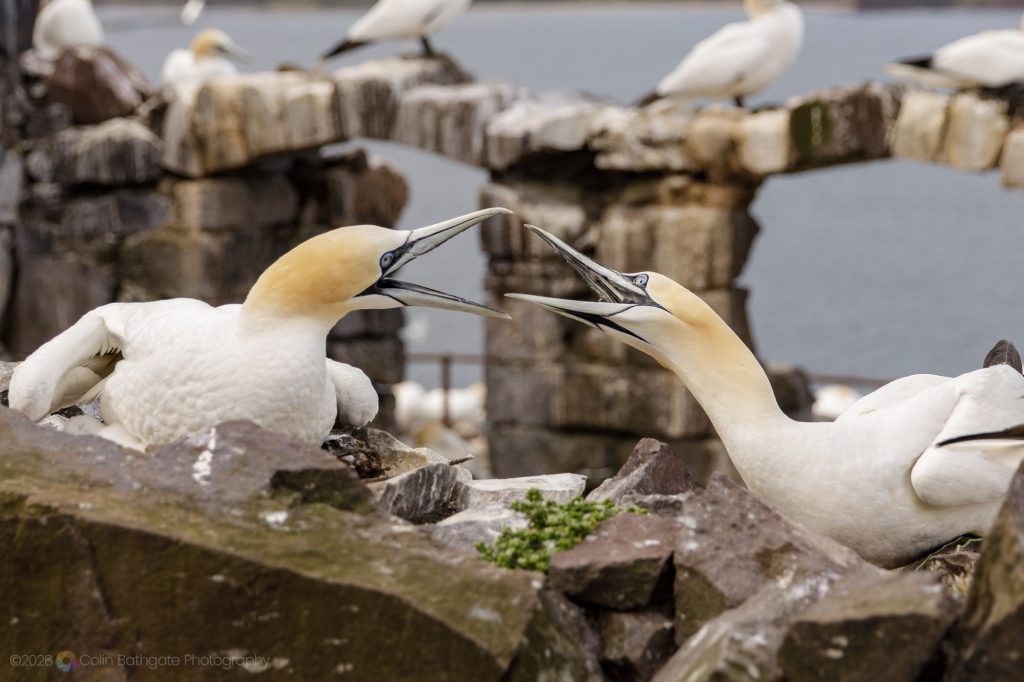
The same birds that gently preened their partners would, moments later, defend their nest with surprising aggression. It was a reminder of how finely balanced life is in such a densely populated colony, tenderness and conflict existing side by side.
Leaving Their World – Reflections
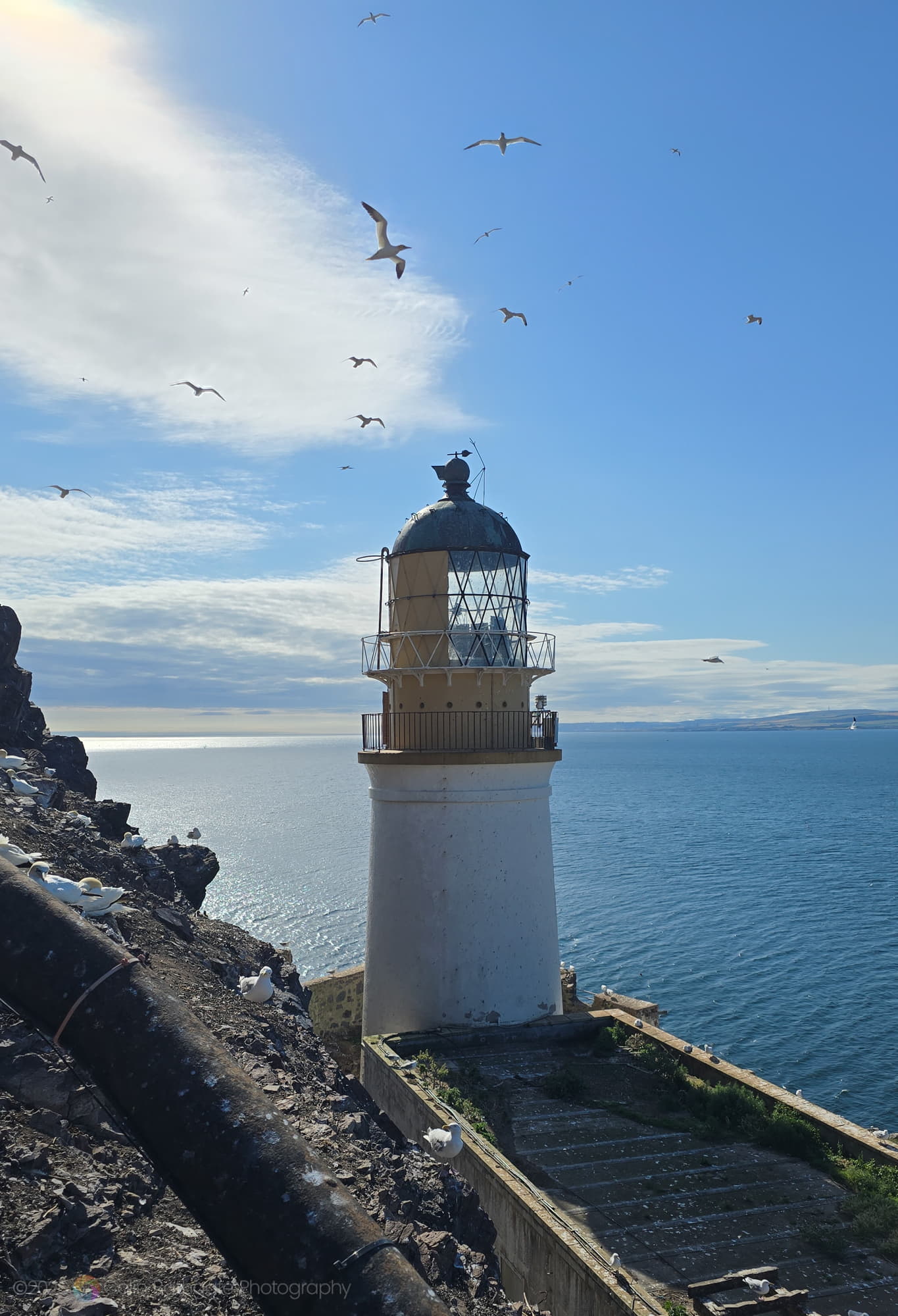
After an all too short three hours, we started packing so we could make the descent past the ruins and lighthouse to the steps where the boat would take us back to the mainland.
The lighthouse was built in 1902, designed by David Alan Stevenson, whose cousin was the novelist Robert Louis Stevenson. Stevenson spent much of his childhood around North Berwick, and the Bass and surrounding coastline became part of the landscape of his imagination. He later wrote about the Bass in his novel Catriona, his follow-up to Kidnapped, in which David Balfour is imprisoned on the island. It seemed fitting, then, that the novelist’s cousin should eventually leave his own mark on the Rock, with the lighthouse that still stands there.
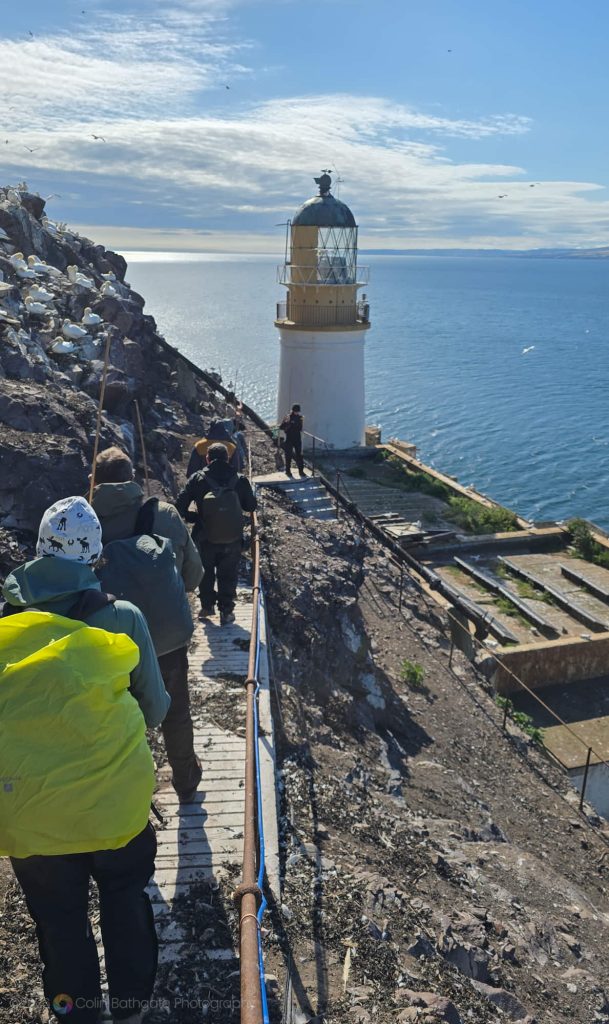
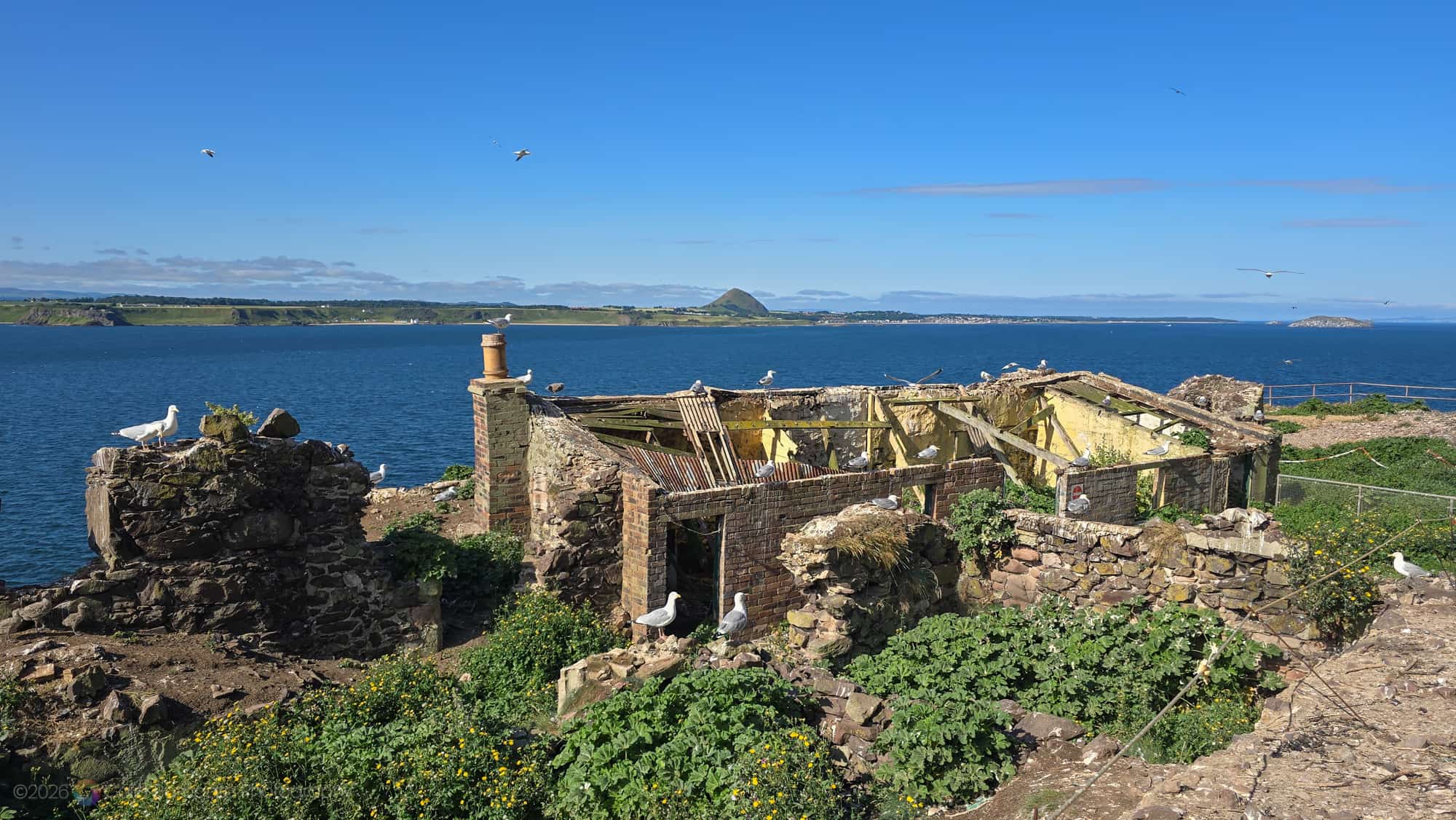
Passing the ruined buildings and remnants of the old fortifications, I found myself thinking about the many lives that had played out on this tiny piece of rock. Covenanters were imprisoned here in the 1670s and 1680s. Then, in 1691, four Jacobite prisoners seized the fortress and held it for almost three years.
Beyond the ruins, the views over to East Lothian were spectacular. It felt strange to see the familiar coastline from the other side of the water, with the distinctive shape of North Berwick Law standing out in particular, a place my Dad and I had climbed several times. For years I had looked towards the Bass from that coastline; now I was looking back from the Rock itself. As the RIB pulled away, the Bass gradually became smaller behind us.
For those few hours, we’d been allowed into a world that belonged entirely to the birds. We were visitors in their home. It was a memorable experience, and one I suspect I won’t want to wait too long to repeat.
Fortunately, I don’t have to wait long. I’ll be back in September, weather and conditions permitting.

The gallery below includes some additional photographs from the day.